

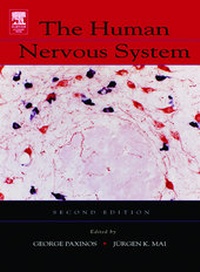
The Human Nervous System
2nd Edition
Published on 19. January 2004
Book
Hardback
1366 pages
978-0-12-547626-3 (ISBN)
Description
This long-awaited update of the classic, The Human Nervous System, stands as an impressive survey of our knowledge of the brain, spinal cord, and peripheral nervous system. The book has been completely redone and brought up-to-date. An impressive and respected cast of international authors have contributed 37 chapters on topics ranging from Brain Evolution, all phases of Brain Development, to all areas of the adult brain and peripheral pathways, along with careful descriptions of the spinal cord and peripheral nervous system, brainstem and cerebellum. The Human Nervous System, Second Edition will again serve as the gold standard, providing a one-stop source of up-to-date information about our knowledge of the human nervous system.
More details
Edition
2nd edition
Language
English
Place of publication
San Diego
United States
Publishing group
Elsevier Science Publishing Co Inc
Target group
Professional and scholarly
Neuroscientists, neurologists, and neuropsychologists.
Edition type
New edition
Dimensions
Height: 276 mm
Width: 216 mm
Weight
4050 gr
ISBN-13
978-0-12-547626-3 (9780125476263)
Copyright in bibliographic data and cover images is held by Nielsen Book Services Limited or by the publishers or by their respective licensors: all rights reserved.
Schweitzer Classification
Other editions
New editions
Juergen K Mai | George Paxinos
The Human Nervous System
Book
11/2011
3rd Edition
Academic Press
€276.50
Article exhausted; check for reprint
Previous edition
George Paxinos
The Human Nervous System
Book
08/1990
Academic Press
€70.55
Article exhausted; check for reprint
Persons
George Paxinos has written 62 books on the brain of humans, monkeys, rodents and birds. His first atlas, The Rat Brain in Stereotaxic Coordinates, is the most cited neuroscience publication. His Atlas of the Human Brain received The Award for Excellence in Publishing in Medical Science (Assoc American Publishers, 1997) and The British Medical Association Illustrated Book Award (2016). His eco-fiction book A River Divided (georgepaxinos.com.au) considers the question of whether the brain in the Goldilocks Zone - the right "size? for survival.
Professor Mai studied medicine in Freiburg, Germany, Vienna and UT Southwestern Medical School, Dallas, U.S.A. Student and Medical practices in Freiburg (Clinic for Neurosurgery), Berlin and Duesseldorf. Dissertation ("summa cum laude") and habilitation were awarded by the University of Duesseldorf: After a period as GP in private practice (Titisee-Neustadt) he became scientific assistant and senior assistant at the C. and O. Vogt-Institute for Brain Research, University of Duesseldorf (1972 - 1983) and Professor of Neuroanatomy at the Institute of Neuroanatomy, H.-Heine-University of Duesseldorf. He served as director of the Department of the Institute of Anatomy 1 until retirement in 2011. His main research interests are (i) the structural and molecular anatomy of the mammalian brain and (ii) expression patterns and regulation of terminal carbohydrates in development, cell activation and disease (III) operation planning in stereotactic neurosurgery. He works on a "Digital Brain Atlas for Planning and Interindividual Registration of Targets in Deep Brain Stimulation" and on a "Spatial Information Management Resource for the Human Brain". J. K. Mai has edited the catalogue of human brain sections from the Vogt collection; he is author and editor of several books, e.g. the awarded "Atlas of the Human Brain" (Academic Press/Elsevier, San Diego), "The Human Nervous System" (Academic Press/Elsevier, San Diego, Amsterdam, 3rd ed. 2012), Human Brain in Standard MNI Space: A Comprehensive Pocket Atlas (Academic Press/Elsevier, San Diego, 2017; with M. Majtanik), Funktionelle Anatomie fuer Zahnmediziner (Quintessenz, Berlin, 2nd. ed. 2008; Sensi Divini (ital., engl., ger, russ. eds). J. K. Mai is founder and CEO of MR-X-Brain GmbH.
Professor Mai studied medicine in Freiburg, Germany, Vienna and UT Southwestern Medical School, Dallas, U.S.A. Student and Medical practices in Freiburg (Clinic for Neurosurgery), Berlin and Duesseldorf. Dissertation ("summa cum laude") and habilitation were awarded by the University of Duesseldorf: After a period as GP in private practice (Titisee-Neustadt) he became scientific assistant and senior assistant at the C. and O. Vogt-Institute for Brain Research, University of Duesseldorf (1972 - 1983) and Professor of Neuroanatomy at the Institute of Neuroanatomy, H.-Heine-University of Duesseldorf. He served as director of the Department of the Institute of Anatomy 1 until retirement in 2011. His main research interests are (i) the structural and molecular anatomy of the mammalian brain and (ii) expression patterns and regulation of terminal carbohydrates in development, cell activation and disease (III) operation planning in stereotactic neurosurgery. He works on a "Digital Brain Atlas for Planning and Interindividual Registration of Targets in Deep Brain Stimulation" and on a "Spatial Information Management Resource for the Human Brain". J. K. Mai has edited the catalogue of human brain sections from the Vogt collection; he is author and editor of several books, e.g. the awarded "Atlas of the Human Brain" (Academic Press/Elsevier, San Diego), "The Human Nervous System" (Academic Press/Elsevier, San Diego, Amsterdam, 3rd ed. 2012), Human Brain in Standard MNI Space: A Comprehensive Pocket Atlas (Academic Press/Elsevier, San Diego, 2017; with M. Majtanik), Funktionelle Anatomie fuer Zahnmediziner (Quintessenz, Berlin, 2nd. ed. 2008; Sensi Divini (ital., engl., ger, russ. eds). J. K. Mai is founder and CEO of MR-X-Brain GmbH.
Content
Section I: Evolution and DevelopmentSection II: Peripheral Nervous System and Spinal CordSection III: Brainstem and CerebellumSection IV: Diencephalon, Basal Ganglia and AmygdalaSection V: Cortex; Section IV: Systems