

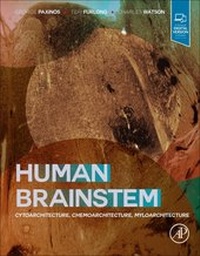
Human Brainstem
Cytoarchitecture, Chemoarchitecture, Myeloarchitecture
Published on 24. July 2019
Book
Hardback
246 pages
978-0-12-814184-7 (ISBN)
Description
Human Brainstem: Cytoarchitecture, Chemoarchitecture, Myeloarchitecture explores how the human brainstem has been impeded by the unavailability of an up-to-date, comprehensive, diagrammatic and photographic atlas. Now, with the first detailed atlas on the human brainstem in more than twenty years, this book presents an accurate, comprehensive and convenient reference for students, researchers and pathologists.
More details
Language
English
Place of publication
San Diego
United States
Publishing group
Elsevier Science Publishing Co Inc
Target group
College/higher education
Researchers and advanced students in neuroscience, neuroanatomy, neurophysiology, pathology, and biomedicine.
Dimensions
Height: 276 mm
Width: 216 mm
Weight
1130 gr
ISBN-13
978-0-12-814184-7 (9780128141847)
Copyright in bibliographic data and cover images is held by Nielsen Book Services Limited or by the publishers or by their respective licensors: all rights reserved.
Schweitzer Classification
Other editions
Additional editions
George Paxinos | Teri Furlong | Charles Watson
Human Brainstem
Cytoarchitecture, Chemoarchitecture, Myeloarchitecture
E-Book
05/2019
Academic Press
€131.00
Available for download
Persons
George Paxinos has written 62 books on the brain of humans, monkeys, rodents and birds. His first atlas, The Rat Brain in Stereotaxic Coordinates, is the most cited neuroscience publication. His Atlas of the Human Brain received The Award for Excellence in Publishing in Medical Science (Assoc American Publishers, 1997) and The British Medical Association Illustrated Book Award (2016). His eco-fiction book A River Divided (georgepaxinos.com.au) considers the question of whether the brain in the Goldilocks Zone - the right "size? for survival.
Teri Furlong works at Neuroscience Research Australia, New South Wales, Sydney, Australia. Charles Watson is a neuroscientist and public health physician. His qualifications included a medical degree (MBBS) and two research doctorates (MD and DSc). He is Professor Emeritus at Curtin University, and holds adjunct professorial research positions at the University of New South Wales, the University of Queensland, and the University of Western Australia.
He has published over 100 refereed journal articles and 40 book chapters, and has co-authored over 25 books on brain and spinal cord anatomy. The Paxinos Watson rat brain atlas has been cited over 80,000 times. His current research is focused on the comparative anatomy of the hippocampus and the claustrum.
He was awarded the degree of Doctor of Science by the University of Sydney in 2012 and received the Distinguished Achievement Award of the Australasian Society for Neuroscience in 2018.
Teri Furlong works at Neuroscience Research Australia, New South Wales, Sydney, Australia. Charles Watson is a neuroscientist and public health physician. His qualifications included a medical degree (MBBS) and two research doctorates (MD and DSc). He is Professor Emeritus at Curtin University, and holds adjunct professorial research positions at the University of New South Wales, the University of Queensland, and the University of Western Australia.
He has published over 100 refereed journal articles and 40 book chapters, and has co-authored over 25 books on brain and spinal cord anatomy. The Paxinos Watson rat brain atlas has been cited over 80,000 times. His current research is focused on the comparative anatomy of the hippocampus and the claustrum.
He was awarded the degree of Doctor of Science by the University of Sydney in 2012 and received the Distinguished Achievement Award of the Australasian Society for Neuroscience in 2018.
Content
IntroductionSource of TissueHistologyPhotography/ImagingDiagrams and Labeled PhotographsIn Vivo MRIStereotaxic Grid
Nomenclature and AbbreviationsGene Expression Reveals the Segmentation of the BrainstemThe Construction of Abbreviations in the Paxinos/Watson Nomenclature
The Basis of the Delineation of StructuresEfferent and Afferent nuclei of the Cranial NervesReticular and Tegmental Nuclei of BrainstemMonoamine Nuclei of the BrainstemPrecerebellar Nuclei and Red NucleusNuclei Related to the Visual System
Nomenclature and AbbreviationsGene Expression Reveals the Segmentation of the BrainstemThe Construction of Abbreviations in the Paxinos/Watson Nomenclature
The Basis of the Delineation of StructuresEfferent and Afferent nuclei of the Cranial NervesReticular and Tegmental Nuclei of BrainstemMonoamine Nuclei of the BrainstemPrecerebellar Nuclei and Red NucleusNuclei Related to the Visual System