

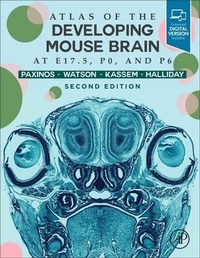
Atlas of the Developing Mouse Brain
2nd Edition
Published on 19. June 2020
Book
Hardback
384 pages
978-0-12-818543-8 (ISBN)
Description
Atlas of the Developing Mouse Brain, Second Edition builds on the features of successful first edition, providing a comprehensive and convenient reference for all areas of the mouse brain at Fetal-Day 17.5 (E17.5), Day-of-Birth (P0), and Day-Six postnatal (P6). The book also delineates the parts of the eye, features of the skull, ganglia, nerves, arteries, veins, bones and foramina. This atlas is an essential tool for researchers and students who study the development of the mouse brain, or for those who interpret findings from genetic manipulation.
More details
Edition
2nd edition
Language
English
Place of publication
San Diego
United States
Publishing group
Elsevier Science Publishing Co Inc
Target group
Professional and scholarly
Standard neuroanatomy lab atlas for all labs doing neuroanatomy, neurophysiology, neuropharmacology, behavioral neuroscience, or molecular expression/cloning/neurogenetics in the mouse brain
Product notice
sewn/stitched
Cloth over boards
Illustrations
Approx. 500 illustrations (500 in full color)
Dimensions
Height: 283 mm
Width: 222 mm
Thickness: 26 mm
Weight
1276 gr
ISBN-13
978-0-12-818543-8 (9780128185438)
Copyright in bibliographic data and cover images is held by Nielsen Book Services Limited or by the publishers or by their respective licensors: all rights reserved.
Schweitzer Classification
Other editions
Additional editions
Ma Paxinos AO (BA | Glenda Halliday | Charles Watson
Atlas of the Developing Mouse Brain
E-Book
03/2020
2nd Edition
Academic Press
€130.00
Available for download
Previous edition
Book
11/2006
Academic Press
€227.79
Article exhausted; check for reprint
Persons
George Paxinos has written 62 books on the brain of humans, monkeys, rodents and birds. His first atlas, The Rat Brain in Stereotaxic Coordinates, is the most cited neuroscience publication. His Atlas of the Human Brain received The Award for Excellence in Publishing in Medical Science (Assoc American Publishers, 1997) and The British Medical Association Illustrated Book Award (2016). His eco-fiction book A River Divided (georgepaxinos.com.au) considers the question of whether the brain in the Goldilocks Zone - the right "size? for survival.
Glenda Halliday works at the University of Sydney in NSW, Sydney, Australia.. Charles Watson is a neuroscientist and public health physician. His qualifications included a medical degree (MBBS) and two research doctorates (MD and DSc). He is Professor Emeritus at Curtin University, and holds adjunct professorial research positions at the University of New South Wales, the University of Queensland, and the University of Western Australia.
He has published over 100 refereed journal articles and 40 book chapters, and has co-authored over 25 books on brain and spinal cord anatomy. The Paxinos Watson rat brain atlas has been cited over 80,000 times. His current research is focused on the comparative anatomy of the hippocampus and the claustrum.
He was awarded the degree of Doctor of Science by the University of Sydney in 2012 and received the Distinguished Achievement Award of the Australasian Society for Neuroscience in 2018. Mustafa S. Kaseem works at Neuroscience Research Australia in NSW, Sydney, Australia
Glenda Halliday works at the University of Sydney in NSW, Sydney, Australia.. Charles Watson is a neuroscientist and public health physician. His qualifications included a medical degree (MBBS) and two research doctorates (MD and DSc). He is Professor Emeritus at Curtin University, and holds adjunct professorial research positions at the University of New South Wales, the University of Queensland, and the University of Western Australia.
He has published over 100 refereed journal articles and 40 book chapters, and has co-authored over 25 books on brain and spinal cord anatomy. The Paxinos Watson rat brain atlas has been cited over 80,000 times. His current research is focused on the comparative anatomy of the hippocampus and the claustrum.
He was awarded the degree of Doctor of Science by the University of Sydney in 2012 and received the Distinguished Achievement Award of the Australasian Society for Neuroscience in 2018. Mustafa S. Kaseem works at Neuroscience Research Australia in NSW, Sydney, Australia
Author
NHMRC Senior Principal, NeuRA, Australia
University of Sydney, NSW, Sydney, Australia
John Curtin Distinguished Professor of Health Science, Curtin University of Technology, Perth, Australia and Neuroscience Research Australia, NSW Sydney, Australia
Neuroscience Research Australia, NSW, Sydney, Australia
Content
Preface to the second editionReproduction of altas figures in other publicationsAcknowledgementsIntroductionHistologyPreparation of photographs and drawingsThe construction of abbreviations in the Paxinos/Watson nomenclatureIdentification of structuresReferencesList of structuresIndex of abbreviationsFigures