

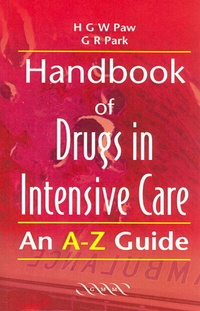
Handbook of Drugs in Intensive Care
An A-Z Guide
2nd Edition
Published on 3. January 2000
Book
Paperback/Softback
230 pages
978-1-84110-047-0 (ISBN)
Description
This concise, clear, pocket-sized text explains how to use drugs safely and efficiently in the management of the critically ill patient. It is also an invaluable quick reference for the doctor and nurse working in the intensive care unit. In addition to concise notes on important topics such as routes of drug administration, drug metabolism, drug interactions, monitoring, pharmacology in the critically ill and advanced life support, amongst others, the book includes an A-Z listing of the most widely used drugs and for each, outlines their key features, uses, administration, adverse effects and interactions/cautions in a standardised format for ease of quick reference.
More details
Edition
2nd Revised edition
Language
English
Place of publication
Cambridge
United Kingdom
Publishing group
Cambridge University Press
Target group
Professional and scholarly
Edition type
Revised edition
Product notice
Paperback (trade)
Illustrations
5 Line drawings, unspecified
Dimensions
Height: 190 mm
Width: 117 mm
Thickness: 16 mm
Weight
240 gr
ISBN-13
978-1-84110-047-0 (9781841100470)
Copyright in bibliographic data and cover images is held by Nielsen Book Services Limited or by the publishers or by their respective licensors: all rights reserved.
Schweitzer Classification
Other editions
New editions
Book
02/2007
3rd Edition
Cambridge University Press
€26.03
Article exhausted; check for reprint
Persons
Content
1. Short notes: routes of administration; 2. Leading dose; 3. Drugs metabolism; 4. Enzyme systems; 5. Drug interactions; 6. Therapeutic drug monitoring; 7. Pharmacology in the critically ill; 8. Myocardiopulmonary resuscitation; 9. Management of acute major anaphylaxis; 10. Management of severe hyperthermia; 11. Management of malignant hyperthermia; 12. Sedation, analgesia and neuromuscular blockade; 13. Management of status epilepticus; 14. Anti-arrhythmic drugs; 15. Inotropes and vasopressors; 16. Bronchospasm; 17. Immunonutrition in the ICU; 18. Corticosteroids; 19. Short synacthen test; 20. Bone marrow rescue following nitrous oxide; 21. Antioxidants; 22. Prophylaxis following splenectomy; 23. Anti-microbial drugs; 24. Renal replacement therapy.