

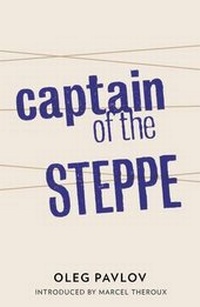
Captain of the Steppe
Published on 15. April 2013
Book
Paperback/Softback
978-1-908276-18-6 (ISBN)
Description
Deep in the desolate steppe, Captain Khabarov waits out his service at a camp where the news arrives in bundles of last year's papers and rations turn up rotting in their trucks. One Spring, he decides to plant a field of potatoes to feed his half-starved men . . .
This blackly comic novel shows the unsettling consequences of thinking for yourself under the Soviet system. Oleg Pavlov's first novel, published when he was only 24, Captain of the Steppe was immediately praised for its chilling but humane and hilarious depiction of the Soviet Empire's last years.
This blackly comic novel shows the unsettling consequences of thinking for yourself under the Soviet system. Oleg Pavlov's first novel, published when he was only 24, Captain of the Steppe was immediately praised for its chilling but humane and hilarious depiction of the Soviet Empire's last years.
Reviews / Votes
'Pavlov imbues his world with a very particular flavour: the mixture of tragedy, absurdity and black comedy that runs in the veins of Russian literature as far back as the work of Nikolai Gogol - Pavlov fashions a disquieting and comic elegy.' Marcel Theroux -------- 'Captain of the Steppe combines a traditional Russian faith in the humanising power of literature with a boisterous energy and imagination. Pavlov wrote two further army novels which, along with Captain of the Steppe, have become known as the Tales of the Last Days trilogy, and we can be grateful that both are due for publication by And Other Stories.' Michael Nicholson, The Times Literary Supplement -------- 'A comedy as dark and bitter as ersatz coffee.' Daily Mail 'Pavlov skillfully navigates the razor-thin gap between dark comedy and tragedy' Words without Borders -------- 'Pavlov's evocations of character and atmosphere are both engaging and depressing' Russia Beyond the Headlines -------- 'Captain of the Steppe becomes a brilliant and lasting expression of a bitter, righteous rage'. The Literateur -------- 'His tales delve into the world of soldiers sent to the bleakest regions of central Asia, where their hopelessness ends up matching that of their prisoners, whose absurd routine, hunger and boredom they share. This is Berg's Wozzek set in Buzzati's Tartar Steppe.' Jacque Franck, lalibre.be -------- 'An extraordinary portraitist, with a nose for trenchant, black humour, Oleg Pavlov delves into the shadowy outer edges of existence.' France Culture -------- 'Poetry, sensuality, humour, metaphoric genius' Philippe Delaroche, L'Express Culture avec Lire 'Oleg Pavlov is one of the best contemporary Russian authors - There are moments of great humanity in this book, for Pavlov gives a voice to every human being, even the most pathetic. When nothing of value remains, we still have language.' Nils C. Ahl, Art Press -------- 'Captain of the Steppe seems to be stuck in the vast, boundless and bottomless space, where there is no roof and no place to hide.' Inna Borisova -------- 'Pavlov has great powers of description and the translation by Ian Appleby is consistent in tone, and both fluent and flowing' Asian Review of Books -------- 'A dark, absurdist satire: both funny and depressing - Pavlov has great powers of description and the translation by Ian Appleby is consistent in tone, and both fluent and flowing - It is not hard to see why it was shortlisted for the Russian Booker.' Peter Gordon, Asian Review of BooksMore details
Language
English
Place of publication
High Wycombe
United Kingdom
Product notice
Paperback (UK-B)
Dimensions
Height: 198 mm
Width: 129 mm
Weight
298 gr
ISBN-13
978-1-908276-18-6 (9781908276186)
Copyright in bibliographic data and cover images is held by Nielsen Book Services Limited or by the publishers or by their respective licensors: all rights reserved.
Schweitzer Classification
Other editions
Additional editions
Persons
Oleg Pavlov is one of the most highly regarded Russian writers alive today. He has won the Russian Booker Prize (2002) and Solzhenitsyn Prize (2012) among many other awards. Born in Moscow in 1970, Pavlov spent his military service as a prison guard in Kazakhstan. Many of the incidents portrayed in his fiction were inspired by his experiences there; he recalls how he found himself reading about Karabas, the very camp he had worked at, in Aleksandr Solzhenitsyn's The Gulag Archipelago. He later became Solzhenitsyn's assistant and was inspired to continue the great writer's work. Pavlov's writing is firmly in the tradition of the great Russian novelists Dostoyevsky and Solzhenitsyn.
He was only 24 years old when his first novel, Captain of the Steppe, was published, receiving praise not only from critics but from the jury of the Russian Booker Prize, which shortlisted the novel for the 1995 award. Pavlov went on to win the Prize in 2002 with his next book, The Matiushin Case (English translation published in 2014 by And Other Stories). The Matiushin Case was the second novel in what would become the thematic trilogy set in the last days of the Soviet empire: Tales from the Last Days. All three works in the trilogy are stand-alone novels. The third book, Requiem for a Soldier, was published by And Other Stories in 2015.
He was only 24 years old when his first novel, Captain of the Steppe, was published, receiving praise not only from critics but from the jury of the Russian Booker Prize, which shortlisted the novel for the 1995 award. Pavlov went on to win the Prize in 2002 with his next book, The Matiushin Case (English translation published in 2014 by And Other Stories). The Matiushin Case was the second novel in what would become the thematic trilogy set in the last days of the Soviet empire: Tales from the Last Days. All three works in the trilogy are stand-alone novels. The third book, Requiem for a Soldier, was published by And Other Stories in 2015.