

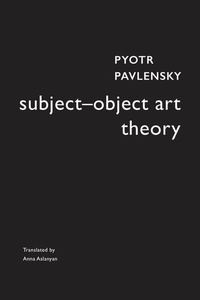
Subject-Object Art Theory
Published on 10. November 2025
Book
Paperback/Softback
132 pages
978-1-80309-581-3 (ISBN)
Description
Pyotr Pavlensky turns state violence into his medium-now, in his own words, he reveals the theory behind the fire.
Pyotr Pavlensky's Subject-Object Art Theory is both a manifesto and a method-an incendiary redefinition of what art can and should be in an era of increasing repression. Known for his radical public performances, such as setting fire to government buildings, stitching his lips shut, or nailing his own body to the ground, Pavlensky has been called a provocateur. In this book, he offers his own framework: subject-object art, a practice that weaponizes state mechanisms against themselves, forcing institutions to react and, thus, become part of the work.
Venturing past the confines of political art, he examines the historical intersections of art and power, situating his work within a lineage of radical avant-garde movements. Whether seen as a guide or an act of defiance in itself, Subject-Object Art Theory urges the reader to rethink artistic freedom; not as an abstract ideal, but as a confrontation with authority.
Pyotr Pavlensky's Subject-Object Art Theory is both a manifesto and a method-an incendiary redefinition of what art can and should be in an era of increasing repression. Known for his radical public performances, such as setting fire to government buildings, stitching his lips shut, or nailing his own body to the ground, Pavlensky has been called a provocateur. In this book, he offers his own framework: subject-object art, a practice that weaponizes state mechanisms against themselves, forcing institutions to react and, thus, become part of the work.
Venturing past the confines of political art, he examines the historical intersections of art and power, situating his work within a lineage of radical avant-garde movements. Whether seen as a guide or an act of defiance in itself, Subject-Object Art Theory urges the reader to rethink artistic freedom; not as an abstract ideal, but as a confrontation with authority.
Reviews / Votes
"Pavlensky's work draws on a venerable tradition of performance art in which the body is used to interrogate cultural norms and power dynamics. . . . For Pavlensky, the initial action is just the beginning of a larger process. Even as every element is precisely calculated - 'I have to practice each gesture carefully, where I'm going to put my foot, my hand, because once I'm there, everything moves very quickly and there are so many unforeseeables,' he told me - what interests him is the state's involuntary collaboration in his work." -- Praise for Pyotr Pavlensky * Fernanda Eberstadt, New York Times *More details
Series
Language
English
Place of publication
Greenford
United Kingdom
Target group
Professional and scholarly
Dimensions
Height: 228 mm
Width: 150 mm
Thickness: 12 mm
Weight
183 gr
ISBN-13
978-1-80309-581-3 (9781803095813)
Copyright in bibliographic data and cover images is held by Nielsen Book Services Limited or by the publishers or by their respective licensors: all rights reserved.
Schweitzer Classification
Persons
Pyotr Pavlensky is an artist and author born in 1984 in Leningrad and now lives in Paris. Initially, his art was labeled political, but in 2019 Pavlensky rejected this term as inconsistent with the very essence of his work. Redefining his practice as subject-object art, he formulated its theoretical foundations and presently combined them into a book. Anna Aslanyan is a journalist and translator. Her translations from Russian include A Journey to Inner Africa by Egor Kovalevsky and Sergei Tretyakov's essays for a forthcoming anthology of modernism. She is the author of Dancing on Ropes: Translators and the Balance of History, a popular history of translation.
Content
1.Art/Politics
2.Political/Decorative
3.Political/About Politics
4.Subject/Object
5.Event/Precedent
6.Decontextualization/Recontextualization
7.Light/Shadow
8.Tragedy/Comedy
9.Image/Text
10.Shimmer/Shine
11.Reason/Madness
12.Ethics/Aesthetics
13.Organic/Geometric
14.Form/Content
2.Political/Decorative
3.Political/About Politics
4.Subject/Object
5.Event/Precedent
6.Decontextualization/Recontextualization
7.Light/Shadow
8.Tragedy/Comedy
9.Image/Text
10.Shimmer/Shine
11.Reason/Madness
12.Ethics/Aesthetics
13.Organic/Geometric
14.Form/Content