

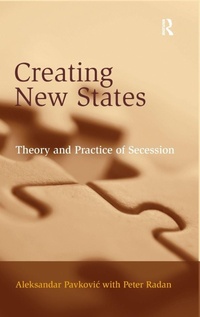
Creating New States
Theory and Practice of Secession
1st Edition
Published on 23. November 2007
Book
Hardback
292 pages
978-0-7546-7163-3 (ISBN)
Description
Secession is the creation of a new independent state out of an existing state. This key volume examines the political, social and legal processes of the practice of secession. Following an analysis of secessionist movements and their role in attempts at secession, eight case studies are explored to illustrate peaceful, violent, sequential and recursive secessions. This is followed by a look at the theoretical approaches and a discussion that focuses on the economic causes. Normative theories of secession are discussed as well as the status of secession in legal theory and practice. The book systematizes our present knowledge of secessions in an accessible way to readers not familiar with the phenomenon and its consequences. It is ideal as a supplementary text to courses on contemporary political and social movements, applied ethics and political philosophy, international relations and international law, state sovereignty and state formation.
Reviews / Votes
'The question of secession is subject to much conceptual, moral, political and legal disagreement and confusion, and has too often given rise to violent conflict in recent history. Aleksandar Pavkovic and Peter Radan provide a comprehensive, empirically-grounded guide to the issues raised by secessionist claims, and thereby illuminate many of the central issues of contemporary world politics.' Michael Freeman, University of Essex, UK '...provides a novel and valuable approach to the explanation and normative evaluation of secession. In its broad scope the book is unique in the contemporary literature on secession, providing case studies as well as systematic discussions of philosophical, social science, and legal theories of secession. Creating New States offers an excellent introduction to the study of secession and secessionist processes and should encourage further research in these topics.' Harry Beran, formerly at the University of Wollongong, Australia 'Readers interested in the vital issue of secession will benefit from reading this careful survey.' David Gordon, Ludwig von Mises Institute, USA 'This is a highly successful introductory text to a complex and controversial topic which, in its broad treatment of both empirical and theoretical dimensions, is a valuable and unique addition to the contemporary literature on secession.' Nations and Nationalism 'This is a highly successful introductory text to a complex and controversial topic which, in its broad treatment of both empirical and theoretical dimensions, is a valuable and unique addition to the contemporary literature on secession.' The Association for the Study of Ethnicity and Nationalism '...an ideal companion to studies of contemporary history, social movements, international relations or international law. The authors propose a slightly different approach to those taken to far in this field by trying to distinguish - and rightly so - between peaceful and violent secessions...This book hasMore details
Language
English
Place of publication
London
United Kingdom
Publishing group
Taylor & Francis Ltd
Target group
College/higher education
Dimensions
Height: 240 mm
Width: 161 mm
Thickness: 21 mm
Weight
611 gr
ISBN-13
978-0-7546-7163-3 (9780754671633)
Copyright in bibliographic data and cover images is held by Nielsen Book Services Limited or by the publishers or by their respective licensors: all rights reserved.
Schweitzer Classification
Other editions
Additional editions
E-Book
05/2016
Routledge
€73.99
Available for download
E-Book
05/2016
Routledge
€73.99
Available for download
Persons
Aleksandar Pavkovic is Lecturer in the Department of Politics & International Relations, at Macquarie University, Australia. Peter Radan is Associate Professor and Head of the Department of Law, at Macquarie University, Australia.
Content
Preface; Introduction; What is Secession? Part I Secession in Practice: Secessions and secessionist movements; Peaceful secessions: Norway, Slovakia and Quebec; Violent secessions: Biafra, Bangladesh, Chechnya; Multiple secessions and state dissolution: the USSR and Yugoslavia. Part II Secession in Theory: Theoretical approaches to secession: an introduction; Explanatory theories; Normative theories; Secession and the law; Why new states?; References; Appendix; Bibliography; Index.