

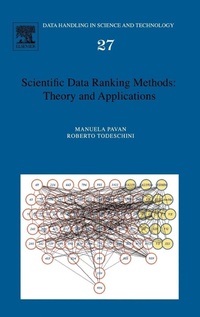
Scientific Data Ranking Methods: Volume 27
Theory and Applications
Published on 28. November 2008
Book
Hardback
224 pages
978-0-444-53020-2 (ISBN)
Description
This volume presents the basic mathematics of ranking methods through a didactic approach and the integration of relevant applications. Ranking methods can be applied in several different fields, including decision support, toxicology, environmental problems, proteomics and genomics, analytical chemistry, food chemistry, and QSAR.
More details
Series
Language
English
Place of publication
Oxford
United Kingdom
Publishing group
Elsevier Science & Technology
Target group
Professional and scholarly
Researchers in several scientific fields, such as Research Centres and Universities, Governmental Organizations, Pharmaceutical Companies, Health Control Organizations, Environmental Control Organizations
Product notice
Laminated cover
Illustrations
Illustrated
Dimensions
Height: 234 mm
Width: 156 mm
Thickness: 14 mm
Weight
494 gr
ISBN-13
978-0-444-53020-2 (9780444530202)
Copyright in bibliographic data and cover images is held by Nielsen Book Services Limited or by the publishers or by their respective licensors: all rights reserved.
Schweitzer Classification
Other editions
Additional editions
Scientific Data Ranking Methods
Theory and Applications
E-Book
11/2008
Elsevier
€165.00
Available for download
Persons
Content
Preface by Manuela Pavan and Roberto Todeschini
Chapter 1
Introduction to Ranking Methods
by L.A. Sarabia, M.S. Sanchez and M.C. Ortiz
Chapter 2
Total Order Ranking Methods
by M. Pavan and R. Todeschini
Chapter 3
Partial Ordering and Hasse Diagrams: Applications in Chemistry and Software
by Rainer Brueggemann, Kristina Voigt and Stefan Pudenz
Chapter 4
Partial Ordering and Prioritizing Polluted Sites
by Lars Carlsen
Chapter 5
Similarity/Diversity Measure for Sequentia Data based on Hasse Matrices : Theory and Applications
by A. Mauri and D. Dallabio
Chapter 6
The Interplay between Partial Ranking and Quantitative Structure-Activity Relationships
by Lars Carlsen
Chapter 7
Semi-Subordination Sequences in Multi-Measure Priorization Problems
by W.L. Myers adn G.P. Patil
Chapter 8
Multi-Criteria Decision Making (MCDM) Methods: A Tool for Assessing River Ecosystem Health using Functional Macroinvertebrate Traits
by Sergio Canobbio, Valeria Mezzanotte, Davide Ballabio and Manuela Pavan
Chapter 9
The DART (Decision Analysis by Ranking Techniques) Software
by A. Manganaro, D. Ballabio, V. Consonni, A. Mauri, M. Pavan and R. Todeschini
Chapter 1
Introduction to Ranking Methods
by L.A. Sarabia, M.S. Sanchez and M.C. Ortiz
Chapter 2
Total Order Ranking Methods
by M. Pavan and R. Todeschini
Chapter 3
Partial Ordering and Hasse Diagrams: Applications in Chemistry and Software
by Rainer Brueggemann, Kristina Voigt and Stefan Pudenz
Chapter 4
Partial Ordering and Prioritizing Polluted Sites
by Lars Carlsen
Chapter 5
Similarity/Diversity Measure for Sequentia Data based on Hasse Matrices : Theory and Applications
by A. Mauri and D. Dallabio
Chapter 6
The Interplay between Partial Ranking and Quantitative Structure-Activity Relationships
by Lars Carlsen
Chapter 7
Semi-Subordination Sequences in Multi-Measure Priorization Problems
by W.L. Myers adn G.P. Patil
Chapter 8
Multi-Criteria Decision Making (MCDM) Methods: A Tool for Assessing River Ecosystem Health using Functional Macroinvertebrate Traits
by Sergio Canobbio, Valeria Mezzanotte, Davide Ballabio and Manuela Pavan
Chapter 9
The DART (Decision Analysis by Ranking Techniques) Software
by A. Manganaro, D. Ballabio, V. Consonni, A. Mauri, M. Pavan and R. Todeschini