

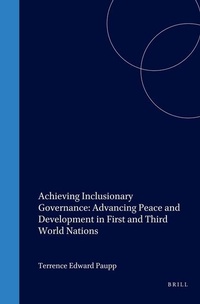
Achieving Inclusionary Governance: Advancing Peace and Development in First and Third World Nations
Published on 1. August 2000
Book
Hardback
541 pages
978-1-57105-136-3 (ISBN)
Description
This work shows that not only is inclusionary governance possible, but that the essential legal foundation is already in place; all that is required is the compliance of nations with their obligations under international human rights law, and the centuries-old, nation-state-dominated, war-oriented "balance of power" will be gone forever.
Achieving Inclusionary Governance is an essential starting point for any study or project that aims to pursue, in today's globalized environment, the democratic tradition on its historically mandated way to realizing the political, civil, and socioeconomic rights of all people.
Published under the Transnational Publishers imprint.
Achieving Inclusionary Governance is an essential starting point for any study or project that aims to pursue, in today's globalized environment, the democratic tradition on its historically mandated way to realizing the political, civil, and socioeconomic rights of all people.
Published under the Transnational Publishers imprint.
More details
Series
Language
English
Place of publication
Netherlands
Publishing group
Brill
Target group
College/higher education
Professional and scholarly
Product notice
sewn/stitched
Cloth over boards
Weight
1034 gr
ISBN-13
978-1-57105-136-3 (9781571051363)
Copyright in bibliographic data and cover images is held by Nielsen Book Services Limited or by the publishers or by their respective licensors: all rights reserved.
Schweitzer Classification
Person
Terrence E. Paupp is the National Chancellor of the United States for the International Association of Educators for World Peace(IAEWP) - an NGO of the United Nations. He is also Director, Nuclear Weapons Abolition Project for the Association of World Citizens, and a policy analyst for The Nuclear Age Peace Foundation.
Content
Acknowledgments; Foreword by Professor Richard Falk; Introduction: Inclusion, Exclusion, and the Reconstitution of Power; Part I: Obstacles and Opportunities;
Chapter 1. Preface to Inclusionary Governance: The Deepening of Democracy as an Aspect of a Peaceful World; Chapter 2. Obstacles and Opportunities: Nuclear
Disarmament and the Abolition of the Globalization of Militarization;
Chapter 3. The Globalization of Media and the Media of Globalization;
Part II: Paths to and from Inclusion; Chapter 4. Moving Toward Inclusion: Overcoming the Dynamics of Democratic Exclusion; Chapter 5. Back to the Future: Hobbes's Vision of Sovereignty, Commonwealth, and Anarchy;
Part III: The Broken and Unbroken Promise of Inclusion; Chapter 6. The Promise of Inclusion: Inclusionary Versus Exclusionary Governance; Chapter 7. Between Poverty and Polyarchy: The Praxis of Democracy in Third World States;
Part IV: Conclusion; Chapter 8. Establishing Perspectives on Inclusionary
Governance, Inclusionary Development, and International Law; Index
Chapter 1. Preface to Inclusionary Governance: The Deepening of Democracy as an Aspect of a Peaceful World; Chapter 2. Obstacles and Opportunities: Nuclear
Disarmament and the Abolition of the Globalization of Militarization;
Chapter 3. The Globalization of Media and the Media of Globalization;
Part II: Paths to and from Inclusion; Chapter 4. Moving Toward Inclusion: Overcoming the Dynamics of Democratic Exclusion; Chapter 5. Back to the Future: Hobbes's Vision of Sovereignty, Commonwealth, and Anarchy;
Part III: The Broken and Unbroken Promise of Inclusion; Chapter 6. The Promise of Inclusion: Inclusionary Versus Exclusionary Governance; Chapter 7. Between Poverty and Polyarchy: The Praxis of Democracy in Third World States;
Part IV: Conclusion; Chapter 8. Establishing Perspectives on Inclusionary
Governance, Inclusionary Development, and International Law; Index