

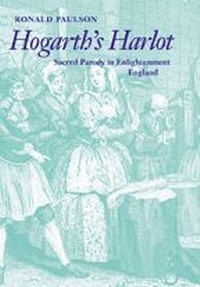
Hogarth's Harlot
Sacred Parody in Enlightenment England
Published on 28. January 2004
Book
Hardback
448 pages
978-0-8018-7391-1 (ISBN)
Description
In 1732, a blasphemous burlesque of the Christian Atonement was published in England without comment from the government or the Church of England. In Hogarth's Harlot, Ronald Paulson explains this absence of official censure through a detailed examination of the parameters of blasphemy in eighteenth-century England and the changing attitudes toward the central tenets of the Christian Church among artists in this period. Discerning a profound spiritual and cultural shift from atonement and personal salvation to redemption, incarnation, and acts of charity and love, Paulson focuses on such influential factors as English antipopery and anti-Jacobitism, as well as the ideas of the English Enlightenment.
Offering imaginative and deeply informed readings of a wide range of artistic works-engravings by Hogarth; poems by Milton, Pope, Christopher Smart, and Blake; plays by Nicholas Rowe and George Lillo; paintings and sculptures by Benjamin West, John Zoffany, Joseph Wright of Derby, and Louis-Francois Roubiliac; and oratorios by George Frederic Handel-Paulson explores the significance of the medium in which artists produced "sacred parody" and how these works both reflected and influenced attitudes toward the nature of Christianity in England. As England's faithful began to worry less about everlasting felicity in heaven and more about life on earth, these diverse artists provided them with new ways of thinking about both their spiritual and their social existence.
Offering imaginative and deeply informed readings of a wide range of artistic works-engravings by Hogarth; poems by Milton, Pope, Christopher Smart, and Blake; plays by Nicholas Rowe and George Lillo; paintings and sculptures by Benjamin West, John Zoffany, Joseph Wright of Derby, and Louis-Francois Roubiliac; and oratorios by George Frederic Handel-Paulson explores the significance of the medium in which artists produced "sacred parody" and how these works both reflected and influenced attitudes toward the nature of Christianity in England. As England's faithful began to worry less about everlasting felicity in heaven and more about life on earth, these diverse artists provided them with new ways of thinking about both their spiritual and their social existence.
Reviews / Votes
This remarkably learned work argues that... readers need to understand the technicalities of atonement, incarnation, redemption, and mediation to appreciate the parodia sacra of Hogarth's famous series, The Harlot's Progress. Choice 2004 This book is everywhere inventive and suggestive, a pleasure to read through but also to use discontinuously for its erudite commentary on particular texts, prints and paintings. -- Steven N. Zwicker Studies in English Literature 2004 An incomparably rich and suggestive book... It should be required reading for all those scholars of the eighteenth century-from whatever discipline of the humanities-who are interested in ideas and the widening of horizons. -- Min Wild Cercles Even as it advances a provocative argument, Hogarth's Harlot enlarges our enjoyment of Hogarth and his rowdy times. -- Clement Hawes Modern Philology 2005More details
Language
English
Place of publication
Baltimore, MD
United States
Target group
College/higher education
Professional and scholarly
Product notice
sewn/stitched
Cloth over boards
Illustrations
77 s/w Abbildungen
77 Illustrations, black and white
Dimensions
Height: 223 mm
Width: 176 mm
Thickness: 36 mm
Weight
757 gr
ISBN-13
978-0-8018-7391-1 (9780801873911)
DOI
10.56021/9780801873911
Copyright in bibliographic data and cover images is held by Nielsen Book Services Limited or by the publishers or by their respective licensors: all rights reserved.
Schweitzer Classification
Person
Ronald Paulson is William D. and Robin Mayer Professor of the Humanities at the Johns Hopkins University. His many books include Don Quixote in England: The Aesthetics of Laughter, also available from Johns Hopkins.
Content
Introduction - the sacrament of the Eucharist; Blasphemy and belief - the case of a Harlot's progress; Redemption; Mediation; The end of days; Smart - the Magnificat and Jubilate agno; Blake - the harlot and the Lamb.