

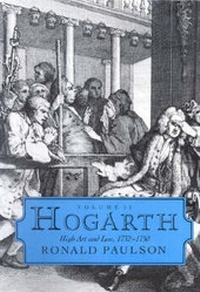
Hogarth
Volume II: High Art and Low 1732-1750
Published on 6. January 1992
Book
Hardback
508 pages
978-0-7188-2855-4 (ISBN)
Description
The second volume in Paulson's definitive study of William Hogarth explores the peak of the artist's career, from A Harlot's Progress to The March of Finchley, and concentrates particularly on the production and consumption of his works. It plays out Hogarth's conflicting aims of producing a polite or popular art, for patrons or for the general public. It is also concerned with the central issue of Hogarth as painter and engraver. Hogarth recognised that the art market was changing. Personal patronage was declining, art works were being commercialised, and a huge new market was opening up. From his earliest professional training Hogarth had witnessed and participated in the employment of mechanical reproduction - printing and engraving - to create and extend cultural markets. The enterprising Hogarth set out to develop a new product corresponding to the expanding audience, especially appealing to those who wanted to maintain their own identity and not merely to emulate the upper class. Prints could now be seen in coffee houses and shop windows, therefore reaching an audience far beyond their owners. Art was no longer limited to the simple status of personal possession - this put in question the whole matter of property as it did of class. Hogarth's interests extended straight down from the dukes and princesses of his conversation pictures to the lowest denizens of the London underworld. Although he makes clear in his graphic works that his sympathies lay with the 'nobodies', at the same time his pictures, with their learned allusions and visual and verbal puns, also address themselves to an educated audience. He was at once both inside and outside the system. Volume II also focuses on Hogarth's relationship to the emergent literary form - the novels of Samuel Richardson and Henry Fielding. Without Hogarth's graphic experiments of the 1730s, Richardson and Fielding would have written very differently.
Reviews / Votes
"No one working in any field that Hogarth touched can afford not to begin with Paulson's splendid book." Times Literary Supplement "Beyond question, Professor Paulson's commentary will remain the most influential well into the next century." The Sunday Telegraph "To say that Paulson writes with authority would be an understatement; when it comes to Hogarth, Paulson is authority." The Spectator "This is the definitive work and, barring almost inconceivable future scholarly finds, will remain the definitive work." Art in America "Truly indispensable." Studies in English Literature "Paulson's new trilogy is a substantial and brilliant revision of his original masterpiece." Linda Colley, The Observer "Paulson's study is densely packed with well-researched facts, and he evokes a strong sense of period and of the cultural milieu of London during the first part of the eighteenth century ... Hogarth reused props in different pictures. Paulson is excellent when describing these props and their significance." Literary Review "These very thoroughly researched books give us as much understanding of society, politics and life in England in the first half of the 18th century as they do about Hogarth... Presented in a well-organised way, and with a firm grasp of the balance that must be found between the literary and pictorial content of Hogarth's art." The Art Book ReviewMore details
Language
English
Place of publication
Cambridge
United Kingdom
Publishing group
James Clarke & Co Ltd
Target group
College/higher education
Dimensions
Height: 228 mm
Width: 152 mm
Weight
1150 gr
ISBN-13
978-0-7188-2855-4 (9780718828554)
Copyright in bibliographic data and cover images is held by Nielsen Book Services Limited or by the publishers or by their respective licensors: all rights reserved.
Schweitzer Classification
Person
Ronald Paulson is Mayer Professor of the Humanities at The Johns Hopkins University. Among his many earlier books are Hogarth: His Life, Art, and Times; Hogarth's Graphic Works; Literary Landscape: Turner and Constable; Breaking and Remaking: Aesthetic Practice in England, 1700-1820 and Figure and Abstraction in Contemporary Painting, both from Rutgers University Press.
Content
List of Illustrations
Preface
1. Patron and Public (I): Paintings and Prints, 1732-1733
2. Patron and Public (II): A Rake's Progress and the Engravers' Act, 1733-1735
3. Public and Private Life in the 1730s
4. St. Bartholomew's Hospital and New Testament History Painting, 1734-1738
5. The Mediating Woman: Literary history Paintings and Artist Satires, 1737-1741
6. Urban Pastoral: The Four Times of the Day, 1737-1738
7. Portrait Painting, 1738-1745
8. Richardson, Fielding, "Comic History-Painting," and the Rise of the Novel
9. Marriage-a-la-mode, 1742-1745
10. Garrick and the Theatre: Public and Private Life in the 1740s
11. Popular Prints (I): Lord Lovat and The Stage Coach, 1746-1747
12. Popular Prints (II): Industry and Idleness, 1747
13. Public Paintings: The Foundling Hospital and Lincoln's Inn, 1740-1750
14. The March to Finchley, 1749-1750
Notes
General Index
Index of Hogarth's Works
Preface
1. Patron and Public (I): Paintings and Prints, 1732-1733
2. Patron and Public (II): A Rake's Progress and the Engravers' Act, 1733-1735
3. Public and Private Life in the 1730s
4. St. Bartholomew's Hospital and New Testament History Painting, 1734-1738
5. The Mediating Woman: Literary history Paintings and Artist Satires, 1737-1741
6. Urban Pastoral: The Four Times of the Day, 1737-1738
7. Portrait Painting, 1738-1745
8. Richardson, Fielding, "Comic History-Painting," and the Rise of the Novel
9. Marriage-a-la-mode, 1742-1745
10. Garrick and the Theatre: Public and Private Life in the 1740s
11. Popular Prints (I): Lord Lovat and The Stage Coach, 1746-1747
12. Popular Prints (II): Industry and Idleness, 1747
13. Public Paintings: The Foundling Hospital and Lincoln's Inn, 1740-1750
14. The March to Finchley, 1749-1750
Notes
General Index
Index of Hogarth's Works