

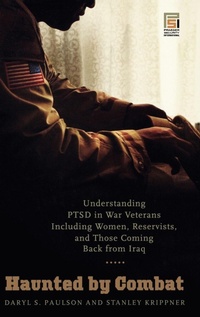
Haunted by Combat
Understanding PTSD in War Veterans Including Women, Reservists, and Those Coming Back from Iraq
Published on 30. August 2007
Book
Hardback
200 pages
978-0-275-99187-6 (ISBN)
Description
Across history, the condition has been called soldier's heart, shell shock, or combat fatigue. It is now increasingly common as our service men and women return from Iraq, Afghanistan, and other ongoing combat zones. Since 1990, Veterans' centers here have treated more than 1.6 million affected men and women, including an estimated 100,000 from the Gulf War and an untallied total from the Iraq front and fighting in Afghanistan. The number also includes some 35,000 World War II veterans, because PTSD does not fade easily. Regardless of the months, years, and even decades that have passed, the traumatic events can flash back as seemingly real as they were when they occurred.In Haunted by Combat Paulson and Krippner range across history and into current experiences and treatments for this haunting disorder.
They take us into the minds of PTSD-affected veterans, as they struggle against the traumatic events lingering in their minds, sometimes exploding into violent behavior. The authors explain how and why PTSD develops-and how we can help service members take the steps to heal today.
They take us into the minds of PTSD-affected veterans, as they struggle against the traumatic events lingering in their minds, sometimes exploding into violent behavior. The authors explain how and why PTSD develops-and how we can help service members take the steps to heal today.
Reviews / Votes
"Including empirical research and anecdotal prose and poetry about combat veterans, this book discusses post-traumatic stress disorder among war veterans and present debates about diagnoses. Paulson and Krippner also take up other important issues-for example, the difficulty in determining who combatants are (in the case of Iraq) and coping when returning home....Readers will appreciate the volume's general assurance that most veterans get beyond their combat experiences, despite the fact that most receive no formal intervention. Those involved with veterans may wish to explore this existential view of intervention. Recommended. Graduate students through professionals." - Choice "The testimonials by Paulson and other war veterans, the easily comprehensible discussion of neurobiologic mechanisms, and the author's recommdedations of essential therapeutic elements make Haunted by Combat a solid contribution." - The New England Journal of MedicineMore details
Series
Language
English
Place of publication
United States
Publishing group
Bloomsbury Publishing Plc
Target group
Professional and scholarly
Illustrations
3426 Illustrations
Dimensions
Height: 240 mm
Width: 161 mm
Thickness: 16 mm
Weight
473 gr
ISBN-13
978-0-275-99187-6 (9780275991876)
Copyright in bibliographic data and cover images is held by Nielsen Book Services Limited or by the publishers or by their respective licensors: all rights reserved.
Schweitzer Classification
Other editions
Additional editions
Daryl S. Paulson | Stanley Krippner
Haunted by Combat
Understanding Ptsd in War Veterans Including Women, Reservists, and Those Coming Back from Iraq
E-Book
08/2007
1st Edition
Praeger Publishers Inc
€61.99
Available for download
Persons
Daryl S. Paulson is a Psychologist, a Fellow of the American Academy of Traumatic Stress, and a veteran of the U.S. Marines who served in Vietnam. He has worked extensively with veterans affected by PTSD.
Stanley Krippner is Professor of Psychology at Saybrook Graduate Institute and Research Center. He is also the editor of The Psychological Impact of War Trauma on Civilians (Praeger, 2003). And, he is a member of the Advisory or Editorial Boards for journals including The Behavioral and Brain Sciences and the Journal of Humanistic Psychology. His many awards include the American Psychological Association Award for Distinguished Contributions to the International Advancement of Psychology.
Stanley Krippner is Professor of Psychology at Saybrook Graduate Institute and Research Center. He is also the editor of The Psychological Impact of War Trauma on Civilians (Praeger, 2003). And, he is a member of the Advisory or Editorial Boards for journals including The Behavioral and Brain Sciences and the Journal of Humanistic Psychology. His many awards include the American Psychological Association Award for Distinguished Contributions to the International Advancement of Psychology.