

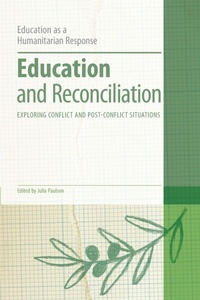
Education and Reconciliation
Exploring Conflict and Post-Conflict Situations
Published on 2. June 2011
Book
Paperback/Softback
208 pages
978-1-4411-5325-8 (ISBN)
Description
This book explores the role education has played in fostering or hindering reconciliation between groups divided by violent and/or social conflict. What is the relationship between education and reconciliation initiatives? Who encourages and enacts it and who discourages and detracts from it? Do reconciliatory educational practices offer any insight into the nature of reconciliation as a process? Drawing on international research in numerous countries, including Bosnia Herzegovina, Rwanda, South Africa, Jordan, Peru and the USA, the contributors consider, conceptually and empirically, the role of education in reconciling societies, groups and individuals divided by conflict. These case studies expand conceptual and empirical understandings of the understudied relationship between education and reconciliation and its potential for addressing and repairing the divisions of conflict. Each chapter contains a summary of the key points and issues within the chapter to enable easy navigation, key relevant and contemporary questions to encourage you to actively engage with the material and an annotated list of suggested further reading to support you to take your exploration further.
A companion website supports the text and provides updates and additional resources. This series presents an authoritative, coherent and focused collection of texts to introduce and promote the notion of education as a humanitarian response as a prime function of educational activity. The series takes a holistic interpretation of education, dealing not only with formal schooling and other systemic provisions in the mainstream, but rather with educational reality - teaching and learning in whatever form it comes at any age.
A companion website supports the text and provides updates and additional resources. This series presents an authoritative, coherent and focused collection of texts to introduce and promote the notion of education as a humanitarian response as a prime function of educational activity. The series takes a holistic interpretation of education, dealing not only with formal schooling and other systemic provisions in the mainstream, but rather with educational reality - teaching and learning in whatever form it comes at any age.
Reviews / Votes
'A must-read for those working in the area of international education development. Paulson brings together a superb group of varied authors to help us gain better insights into the realities of post-conflict reconciliation practices and the (un)intended effects of these in diverse contexts worldwide.' Janet Shriberg, Assistant Professor of Professional Psychology, University of Denver, USA In Education and Reconciliation, Julia Paulson has assembled an impressive array of new and established voices to explore some of the most pressing themes in the study of conflict societies: how should we define and pursue 'reconciliation'; what impact does violence have on children, either as victims, perpetrators, bystanders or the next generation left to deal with the legacies of conflict; and how can education permit a direct confrontation with the trauma of the past while safeguarding against future harm. Combining theoretical precision and in-depth analyses of case studies, this book is essential reading for anyone interested in the role that pedagogy and historical narratives play in fomenting, redressing and preventing conflict. * Phil Clark, Lecturer in Comparative and International Politics, School of Oriental and African Studies, University of London, UK, and convener of Oxford Transitional Justice Research * 'The strength of this collection of papers extends its importance far beyond educational research circles. Paulson and colleagues lays out a cogent case that reconciliation is built on much ambiguity and many assumptions that ultimately come to hamper, even exacerbate, smouldering conflict situations around the World. It is rare to find insight from educational research that so powerfully resonates in so many other conflict-related arena.' Jeremy Rappleye, Reader in Comparative Education, University of Tokyo, JapanMore details
Series
Language
English
Place of publication
New York
United States
Target group
Professional and scholarly
Illustrations
10
Dimensions
Height: 234 mm
Width: 156 mm
Thickness: 11 mm
Weight
324 gr
ISBN-13
978-1-4411-5325-8 (9781441153258)
Copyright in bibliographic data and cover images is held by Nielsen Book Services Limited or by the publishers or by their respective licensors: all rights reserved.
Schweitzer Classification
Other editions
Additional editions
E-Book
03/2011
1st Edition
Continuum Publishing Corporation
€48.49
Available for download
E-Book
03/2011
1st Edition
Bloomsbury Continuum
€48.49
Available for download
Persons
Julia Paulson is Researcher at the University of Oxford, UK, and Chair of the Conflict and Education Research Group (CERG).
Content
Series Editor's Preface Colin Brock Foreword Julia Paulson Introduction: Assuming and Imagining Education and Reconciliation Julia Paulson; 1. Young People, Conflict and the Implications for Education Jason Hart; 2. Reconciliation through Relationships among Teachers and Sub-Saharan African Families in the USA Sarah Dryden-Peterson; 3. Education and Reconciliation in Northern Ireland Alan Smith; 4. Understanding Responses to Post-War Education Reform in the Multiethnic District of Brcko, Bosnia-Herzegovina Briony Jones; 5. Beyond Reconciliation? Designing a Democratic Citizenship in Post Apartheid South Africa David Johnson; 6. Education as Cause or Cure? Conflict and Reconciliation in Peru Julia Paulson; 7. Balancing Local and International Actors in The Aftermath of Ethnic Conflict in Rwanda James Kearney Conclusion: Re- Imagining Education and Reconciliation Julia Paulson Bibliography Index.