

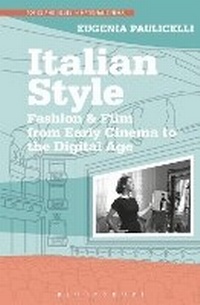
Italian Style
Fashion & Film from Early Cinema to the Digital Age
Published on 21. September 2017
Book
Paperback/Softback
288 pages
978-1-5013-3492-4 (ISBN)
Description
This is the first in-depth, book-length study on fashion and Italian cinema from the silent film to the present. Italian cinema launched Italian fashion to the world. The book is the story of this launch. The creation of an Italian style and fashion as they are perceived today, especially by foreigners, was a product of the post World War II years. Before then, Parisian fashion had dominated Europe and the world. Just as fashion was part of Parisian and French national identity, the book explores the process of shaping and inventing an Italian style and fashion that ran parallel to, and at times took the lead in, the creation of an Italian national identity. In bringing to the fore these intersections, as well as emphasizing the importance of craft in cinema, fashion and costume design, the book aims to offer new visions of films by directors such as Nino Oxilia, Mario Camerini, Alessandro Blasetti, Federico Fellini, Michelangelo Antonioni, Luchino Visconti and Paolo Sorrentino, of film stars such as Lyda Borelli, Francesca Bertini, Pina Menichelli, Lucia Bose, Monica Vitti, Marcello Mastroianni, Toni Servillo and others, and the costume archives and designers who have been central to the development of Made in Italy and Italian style.
Reviews / Votes
This critically elegant and highly readable book tackles anew how fashion and cinema combine social history with aesthetics. Impressively well researched, Italian Style is a compelling exploration of how the fashion industry and its costume designers shaped the cultural context of national identity. With vigor and clarity, Paulicelli illuminates such films as Fellini's Roma, Antonioni's Le amiche, and Sorrentino's La grande bellezza. A must-read for anyone with an interest in cinema and passion for this glorious art. * Gaetana Marrone, Professor of Italian, Princeton University, USA * "Paulicelli's book is a tour de force of film and fashion scholarship, a beautifully written and authoritative exploration of Italian national identity that will appeal to a wide readership. In mapping out Italy's rich cultural heritage from early twentieth century modernism, through the economic miracle years to the present day, this book sets out to do nothing less than define Italian style as embodied by the dialogue between fashion and film. That Italian Style achieves this is testament to its brilliance." * Stella Bruzzi, Professor of Film and Television Studies, University of Warwick, UK * Eugenia Paulicelli's Italian Style: Fashion and Film from Early Cinema to the Digital Age, is a lucid and beautifully written text that promotes, with the qualitative value of its intellectual research, the engaging fields of fashion and film. This text is a must to understand their complex interrelation and influence on the construction of Italian national and cultural identity from the early 20th century to our 21st century. * La Voce di New York *More details
Series
Language
English
Place of publication
New York
United States
Publishing group
Bloomsbury Publishing Plc
Target group
College/higher education
Illustrations
40 bw illus/16 color illus
Dimensions
Height: 226 mm
Width: 148 mm
Thickness: 18 mm
Weight
440 gr
ISBN-13
978-1-5013-3492-4 (9781501334924)
Copyright in bibliographic data and cover images is held by Nielsen Book Services Limited or by the publishers or by their respective licensors: all rights reserved.
Schweitzer Classification
Other editions
Additional editions
E-Book
09/2016
1st Edition
Bloomsbury Academic USA
€40.49
Available for download
E-Book
09/2016
1st Edition
Bloomsbury Academic USA
€40.49
Available for download
Person
Eugenia Paulicelli is Professor of Italian, Comparative Literature and Women's Studies at Queens College and The Graduate Center, The City University of New York (CUNY), USA. At The Graduate Center she directs Fashion Studies in the Master of Arts in Liberal Studies (MALS) and the PhD Concentration. Among her books: Fashion under Fascism: Beyond the Black Shirt (2004); Moda e Moderno (editor, 2006); The Fabric of Cultures: Fashion, Identity, Globalization (co-editor, 2009); Writing Fashion in Early Modern Italy (2014); Rosa Genoni: Fashion is a Serious Business (2015). Visit her website at www.eugeniapaulicelli.com.
Content
List of Illustrations vii
Acknowledgments xi
1 Fashion, Film, Modernity 1
Nostra Dea: the goddess of fashion 1
Pirandello, cinema, and clothing: elective affinities 4
"The Tight Frock-Coat": performing dress 7
Film, costume, fashion, and intermediality 10
Italian style: fashion and film 10
2 Italian Fashion and Film in the 1910s: From the Futurists to Rosa Genoni 19
The Futurists, fashion, film, and performance 20
Rosa Genoni: Per una moda italiana: fashioning the diva 26
3 From the Body of the Diva to the Body of the Nation 41
The Italian divas and the "gowns of emotions" 41
Lyda Borelli (1887-1959): the ethereal melancholic beauty and Ma l'amore mio non muore! (love everlasting) 48
The veil: modernity in motion in Nino Oxilia's Rapsodia Satanica 54
Francesca Bertini (1892-1985): the glamorous embodied 63
Nino Oxilia's Sangue Bleu (1914) and Gustavo Serena's Assunta Spina (1915) 63
Pina Menichelli (1890-1981): "the other woman" and the end of an era 69
4 Fashion, Film, Modernity, under Fascism 77
Fashion in motion: the LUCE newsreels 81
Rhythms of the modern city: fashion in Corrado D'Errico's Stramilano (1929) 88
Contessa di Parma (Alessandro Blasetti, 1937): a manifesto for the promotion of Italian fashion and Turin as a fashion city 91
Grandi Magazzini (1939, Mario Camerini): fashion consumption, gender roles, and work in Milan 101
Epilogue: towards a new dawn 106
5 Launching Italian Style in Cinema and Fashion: The Films of Michelangelo Antonioni 113
The fabric of film: Sette canne, un vestito (1949) 113
The 1950s: Cronaca di un amore, La signora senza camelie and Le amiche 119
The fashion show in Cronaca: a narrative mise en abyme 127
"Was I a good femme fatale?" (Lucia Bose (Clara) in La signora senza camelie) 128
The fashion show in Le amiche: the end of the game 132
The 1960s: from costume to fashion. L'Avventura and beyond 133
Outsiders, doubles, wanderers 137
Conclusion: a visual tactility 151
6 Rome, Fashion, Film 157
From "Hollywood on the Tiber" to La Dolce Vita 157
Rome as a fashion city in the postwar years 161
La Dolce Vita 170
La Dolce Vita and its discontents 174
Roma (Fellini, 1971): space and time 175
The broken watch of history 177
The ecclesiastical fashion show 178
7 After La Dolce Vita: La Grande Bellezza (2013) by Paolo Sorrentino 185
Fashion, film, and Rome today: national identity revisited 192
Appendices:
The Photographic Archive by Giuseppe Palmas (1918-1977) 195
Interview with Fernanda Gattinoni, Rome, June 16, 2000 199
Dressing the Dreams: Interview with Dino Trappetti-Tirelli Costumi Rome, December 2015 207
Interview with Teresa Allegri, founder of Annamode, Rome, Fondazione Annamode, June 6, 2013 215
Adriana Berselli 227
Some notes on the set of L'avventura (1960) by Michelangelo Antonioni 227
"Cesare Attolini" and La Grande Bellezza: Interview with Massimiliano Attolini, Son of Cesare and Grandson of Vincenzo, Founder of the Sartoria 233
Selected Bibliography 239
Filmography 255
Index 259
Acknowledgments xi
1 Fashion, Film, Modernity 1
Nostra Dea: the goddess of fashion 1
Pirandello, cinema, and clothing: elective affinities 4
"The Tight Frock-Coat": performing dress 7
Film, costume, fashion, and intermediality 10
Italian style: fashion and film 10
2 Italian Fashion and Film in the 1910s: From the Futurists to Rosa Genoni 19
The Futurists, fashion, film, and performance 20
Rosa Genoni: Per una moda italiana: fashioning the diva 26
3 From the Body of the Diva to the Body of the Nation 41
The Italian divas and the "gowns of emotions" 41
Lyda Borelli (1887-1959): the ethereal melancholic beauty and Ma l'amore mio non muore! (love everlasting) 48
The veil: modernity in motion in Nino Oxilia's Rapsodia Satanica 54
Francesca Bertini (1892-1985): the glamorous embodied 63
Nino Oxilia's Sangue Bleu (1914) and Gustavo Serena's Assunta Spina (1915) 63
Pina Menichelli (1890-1981): "the other woman" and the end of an era 69
4 Fashion, Film, Modernity, under Fascism 77
Fashion in motion: the LUCE newsreels 81
Rhythms of the modern city: fashion in Corrado D'Errico's Stramilano (1929) 88
Contessa di Parma (Alessandro Blasetti, 1937): a manifesto for the promotion of Italian fashion and Turin as a fashion city 91
Grandi Magazzini (1939, Mario Camerini): fashion consumption, gender roles, and work in Milan 101
Epilogue: towards a new dawn 106
5 Launching Italian Style in Cinema and Fashion: The Films of Michelangelo Antonioni 113
The fabric of film: Sette canne, un vestito (1949) 113
The 1950s: Cronaca di un amore, La signora senza camelie and Le amiche 119
The fashion show in Cronaca: a narrative mise en abyme 127
"Was I a good femme fatale?" (Lucia Bose (Clara) in La signora senza camelie) 128
The fashion show in Le amiche: the end of the game 132
The 1960s: from costume to fashion. L'Avventura and beyond 133
Outsiders, doubles, wanderers 137
Conclusion: a visual tactility 151
6 Rome, Fashion, Film 157
From "Hollywood on the Tiber" to La Dolce Vita 157
Rome as a fashion city in the postwar years 161
La Dolce Vita 170
La Dolce Vita and its discontents 174
Roma (Fellini, 1971): space and time 175
The broken watch of history 177
The ecclesiastical fashion show 178
7 After La Dolce Vita: La Grande Bellezza (2013) by Paolo Sorrentino 185
Fashion, film, and Rome today: national identity revisited 192
Appendices:
The Photographic Archive by Giuseppe Palmas (1918-1977) 195
Interview with Fernanda Gattinoni, Rome, June 16, 2000 199
Dressing the Dreams: Interview with Dino Trappetti-Tirelli Costumi Rome, December 2015 207
Interview with Teresa Allegri, founder of Annamode, Rome, Fondazione Annamode, June 6, 2013 215
Adriana Berselli 227
Some notes on the set of L'avventura (1960) by Michelangelo Antonioni 227
"Cesare Attolini" and La Grande Bellezza: Interview with Massimiliano Attolini, Son of Cesare and Grandson of Vincenzo, Founder of the Sartoria 233
Selected Bibliography 239
Filmography 255
Index 259