

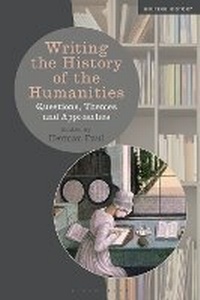
Writing the History of the Humanities
Questions, Themes, and Approaches
Published on 17. November 2022
Book
Hardback
392 pages
978-1-350-19906-4 (ISBN)
Description
Choice Outstanding Academic Title 2023
What are the humanities? As the cluster of disciplines historically grouped together as "humanities" has grown and diversified to include media studies and digital studies alongside philosophy, art history and musicology to name a few, the need to clearly define the field is pertinent.
Herman Paul leads a stellar line-up of esteemed and early-career scholars to provide an overview of the themes, questions and methods that are central to current research on the history of the nineteenth- and twentieth-century humanities. This exciting addition to the successful Writing History series will draw from a wide range of case-studies from diverse fields, as classical philology, art history, and Biblical studies, to provide a state-of-the-art overview of the field.
In doing so, this ground-breaking book challenges the rigid distinctions between disciplines and show the variety of prisms through which historians of the humanities study the past.
What are the humanities? As the cluster of disciplines historically grouped together as "humanities" has grown and diversified to include media studies and digital studies alongside philosophy, art history and musicology to name a few, the need to clearly define the field is pertinent.
Herman Paul leads a stellar line-up of esteemed and early-career scholars to provide an overview of the themes, questions and methods that are central to current research on the history of the nineteenth- and twentieth-century humanities. This exciting addition to the successful Writing History series will draw from a wide range of case-studies from diverse fields, as classical philology, art history, and Biblical studies, to provide a state-of-the-art overview of the field.
In doing so, this ground-breaking book challenges the rigid distinctions between disciplines and show the variety of prisms through which historians of the humanities study the past.
Reviews / Votes
Globally, the Humanities are in trouble and only a thorough grasp of their history can give us the knowledge we need to deal with the situation. That's why this timely book is, beyond all hype, so exciting and rewarding. Herman Paul's exhilarating introduction establishes the terms for a comprehensive historical understanding of the humanities and the essays that he has chosen illuminate not just the past but the present too. Essential reading. * Simon During, Professor of English, University of Melbourne, Australia * The history of the humanities is a new field but a remarkably dynamic one. Herman Paul has assembled an outstanding international team to produce a book that both provides an accessible introduction to the field and showcases some of the most innovative work it is producing. * Stuart Jones, Professor of Intellectual History, University of Manchester, UK * This collection serves as a prescriptive ... guide to the current status of the history of humanities ... [T]his is a timely addition to modern research on a topic immense significance for many areas of study. * CHOICE *More details
Series
Language
English
Place of publication
London
United Kingdom
Publishing group
Bloomsbury Publishing PLC
Target group
College/higher education
Illustrations
20 bw illus
Dimensions
Height: 240 mm
Width: 164 mm
Thickness: 30 mm
Weight
744 gr
ISBN-13
978-1-350-19906-4 (9781350199064)
Copyright in bibliographic data and cover images is held by Nielsen Book Services Limited or by the publishers or by their respective licensors: all rights reserved.
Schweitzer Classification
Other editions
Additional editions
E-Book
11/2022
1st Edition
Bloomsbury Academic
€30.99
Available for download
Person
Herman Paul is Professor of the History of the Humanities at Leiden University, The Netherlands.
Content
Preface
List of Illustrations
List of Tables
List of Contributors
Introduction: What Is the History of the Humanities?, Herman Paul (Leiden University, The Netherlands)
Part I: Definitions and Backgrounds
1. What Are the Humanities? A Short History of Concepts and Classifications, Fabian Kraemer (University of Munich, Germany)
2. From Philology to the Humanities: Fragmentation and Discipline Formation in the United Kingdom and United States, James Turner (University of Notre Dame, USA)
3. The Humanities in Crisis: Comparative Perspectives on a Recurring Motif, Hampus OEsth Gustafsson (Uppsala University, Sweden)
Part II: Research Practices
4. Modernizing the Comparative Method: Marx and Darwin, Devin Griffiths (University of Southern California, USA)
5. Language and the Mapping of the World: Nineteenth-Century Linguistics in Relation to Ethnology and Geography, Floris Solleveld (KU Leuven, Belgium)
6. "Big"-ness in Action: Notes from a Lexicon, Christian Bradley Flow (Mississippi State University, USA)
7. Oral History and the (Digital) Humanities, Julianne Nyhan and Andrew Flinn (both University College London, UK)
Part III: Values and Virtues
8. Practical Learning: The Transnational Career of an Epistemic Value in Japan, Michael Facius (University of Tokyo, Japan)
9. An Ethos of Criticism: Virtues and Vices in Nineteenth-Century Strasbourg, Herman Paul (Leiden University, The Netherlands)
10. Producing the Masculine Scholar: Europe in the Nineteenth and Twentieth Centuries, Falko Schnicke (Johannes Kepler University, Linz, Austria)
11. Scholarly Activism in Africa: The General History of Africa (1964-98), Larissa Schulte Nordholt (Leiden University, The Netherlands)
Part IV: Teaching Practices
12. The Humanities in the Vocational University: On the Unity of Teaching and Research, Kasper Risbjerg Eskildsen (Roskilde University, Denmark)
13. On the Purpose of Humanities Education: A Historical Perspective from the Mid-Twentieth-Century United States, Claire Rydell Arcenas (University of Montana, USA)
Part V: Visions of the Future
14. A Postcritical Turn? Unravelling the Meaning of "Post" and "Turn", Herman Paul (Leiden University, The Netherlands)
15. Environmental Humanities: Entangled Interdisciplinarity, Kristine Steenbergh (Vrije University Amsterdam, The Netherlands)
16. Humanities across Time and Space: Four Challenges for a New Discipline, Rens Bod (University of Amsterdam, The Netherlands)
Glossary
Index
List of Illustrations
List of Tables
List of Contributors
Introduction: What Is the History of the Humanities?, Herman Paul (Leiden University, The Netherlands)
Part I: Definitions and Backgrounds
1. What Are the Humanities? A Short History of Concepts and Classifications, Fabian Kraemer (University of Munich, Germany)
2. From Philology to the Humanities: Fragmentation and Discipline Formation in the United Kingdom and United States, James Turner (University of Notre Dame, USA)
3. The Humanities in Crisis: Comparative Perspectives on a Recurring Motif, Hampus OEsth Gustafsson (Uppsala University, Sweden)
Part II: Research Practices
4. Modernizing the Comparative Method: Marx and Darwin, Devin Griffiths (University of Southern California, USA)
5. Language and the Mapping of the World: Nineteenth-Century Linguistics in Relation to Ethnology and Geography, Floris Solleveld (KU Leuven, Belgium)
6. "Big"-ness in Action: Notes from a Lexicon, Christian Bradley Flow (Mississippi State University, USA)
7. Oral History and the (Digital) Humanities, Julianne Nyhan and Andrew Flinn (both University College London, UK)
Part III: Values and Virtues
8. Practical Learning: The Transnational Career of an Epistemic Value in Japan, Michael Facius (University of Tokyo, Japan)
9. An Ethos of Criticism: Virtues and Vices in Nineteenth-Century Strasbourg, Herman Paul (Leiden University, The Netherlands)
10. Producing the Masculine Scholar: Europe in the Nineteenth and Twentieth Centuries, Falko Schnicke (Johannes Kepler University, Linz, Austria)
11. Scholarly Activism in Africa: The General History of Africa (1964-98), Larissa Schulte Nordholt (Leiden University, The Netherlands)
Part IV: Teaching Practices
12. The Humanities in the Vocational University: On the Unity of Teaching and Research, Kasper Risbjerg Eskildsen (Roskilde University, Denmark)
13. On the Purpose of Humanities Education: A Historical Perspective from the Mid-Twentieth-Century United States, Claire Rydell Arcenas (University of Montana, USA)
Part V: Visions of the Future
14. A Postcritical Turn? Unravelling the Meaning of "Post" and "Turn", Herman Paul (Leiden University, The Netherlands)
15. Environmental Humanities: Entangled Interdisciplinarity, Kristine Steenbergh (Vrije University Amsterdam, The Netherlands)
16. Humanities across Time and Space: Four Challenges for a New Discipline, Rens Bod (University of Amsterdam, The Netherlands)
Glossary
Index