

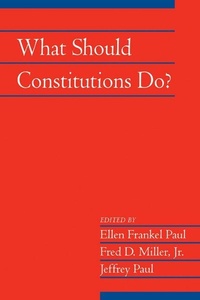
What Should Constitutions Do?
Published on 31. January 2011
Book
Paperback/Softback
354 pages
978-0-521-17553-1 (ISBN)
Description
The essays in this volume - written by prominent philosophers, political scientists and legal scholars - address the basic purposes of constitutions and their status as fundamental law. Some deal with specific constitutional provisions: they ask, for example, which branches of government should have the authority to conduct foreign policy, or how the judiciary should be organized, or what role a preamble should play in a nation's founding document. Other essays explore questions of constitutional design: they consider the advantages of a federal system of government, or the challenges of designing a constitution for a pluralistic society - or they ask what form of constitution best promotes personal liberty and economic prosperity.
More details
Series
Language
English
Place of publication
Cambridge
United Kingdom
Target group
Professional and scholarly
Product notice
Paperback (trade)
Illustrations
Worked examples or Exercises
Dimensions
Height: 229 mm
Width: 152 mm
Thickness: 19 mm
Weight
513 gr
ISBN-13
978-0-521-17553-1 (9780521175531)
Copyright in bibliographic data and cover images is held by Nielsen Book Services Limited or by the publishers or by their respective licensors: all rights reserved.
Schweitzer Classification
Other editions
Additional editions
Ellen Frankel Paul | Fred D. Miller, Jr | Jeffrey Paul
What Should Constitutions Do?
E-Book
03/2012
1st Edition
Cambridge University Press
€38.49
Available for download
Ellen Frankel Paul
What Should Constitutions Do?
E-Book
01/2011
Cambridge University Press
€31.99
Available for download
Persons
Content
1. What are constitutions, and what should (and can) they do? Larry Alexander; 2. Constitution and fundamental law: the lesson of Classical Athens John David Lewis; 3. Contract, covenant, constitution Loren E. Lomasky; 4. Constitutionalism in the age of terror Michael Zuckert and Peter Valenzuela; 5. The liberal constitution and foreign affairs Fernando R. Teson; 6. Do constitutions have a point? Reflections on 'parchment barriers' and preambles Sanford Levinson; 7. The origins of an independent judiciary in New York, 1621-1777 Scott D. Gerber; 8. Foot voting, political ignorance, and constitutional design Ilya Somin; 9. Pluralist constitutionalism William A. Galston; 10. Deliberative democracy and constitutions James S. Fishkin; 11. The constitution of nondomination Guido Pincione; 12. Can we design an optimal constitution? Of structural ambiguity and rights clarity Richard A. Epstein.