

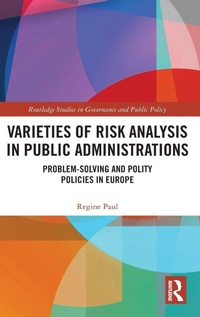
Varieties of Risk Analysis in Public Administrations
Problem-Solving and Polity Policies in Europe
1st Edition
Published on 12. May 2021
Book
Hardback
222 pages
978-0-367-14147-9 (ISBN)
Description
This book sets out a novel conceptual and analytical framework to explain why risk analysis, cost-benefit analysis, and similar analytical tools have gained sizeable currency in public administrations, in comparative perspective.
Situated in critical interpretive policy analysis methodology, the book systematizes and innovates respective debates in three ways. First, it develops a novel typology of actors' appreciations of analytical tools as instrumental problem-solving, legitimacy-seeking, and power-seeking. It conceptualizes the latter two as "polity policies" with actors seeking to confirm or rework decision-making structures. Second, the book theorizes how executive fragmentation and the multiplication of coordination requirements - often treated as hindrances to substantial analytical turns in an administration - nourish actors' ideal typical appreciations of analytical tools in distinct ways. Lastly, it scrutinizes varieties of risk analysis across three risk-heavy policy domains in Germany (including the EU) and discusses the potential of risk analysis to stabilize or transform decision-making in multi-level settings.
This book will be of key interest to policy analysts and risk analysts, and scholars of European politics, comparative politics, policy studies, public administration, multi-level governance, EU studies, risk analysis, policy evaluation, and the political sociology of quantification.
Situated in critical interpretive policy analysis methodology, the book systematizes and innovates respective debates in three ways. First, it develops a novel typology of actors' appreciations of analytical tools as instrumental problem-solving, legitimacy-seeking, and power-seeking. It conceptualizes the latter two as "polity policies" with actors seeking to confirm or rework decision-making structures. Second, the book theorizes how executive fragmentation and the multiplication of coordination requirements - often treated as hindrances to substantial analytical turns in an administration - nourish actors' ideal typical appreciations of analytical tools in distinct ways. Lastly, it scrutinizes varieties of risk analysis across three risk-heavy policy domains in Germany (including the EU) and discusses the potential of risk analysis to stabilize or transform decision-making in multi-level settings.
This book will be of key interest to policy analysts and risk analysts, and scholars of European politics, comparative politics, policy studies, public administration, multi-level governance, EU studies, risk analysis, policy evaluation, and the political sociology of quantification.
More details
Series
Language
English
Place of publication
London
United Kingdom
Publishing group
Taylor & Francis Ltd
Target group
College/higher education
Illustrations
7 s/w Abbildungen, 7 s/w Zeichnungen, 7 s/w Tabellen
7 Tables, black and white; 7 Line drawings, black and white; 7 Illustrations, black and white
Dimensions
Height: 240 mm
Width: 161 mm
Thickness: 17 mm
Weight
523 gr
ISBN-13
978-0-367-14147-9 (9780367141479)
Copyright in bibliographic data and cover images is held by Nielsen Book Services Limited or by the publishers or by their respective licensors: all rights reserved.
Schweitzer Classification
Other editions
Additional editions
Regine Paul
Varieties of Risk Analysis in Public Administrations
Problem-Solving and Polity Policies in Europe
Book
05/2021
1st Edition
Routledge
€61.60
Shipment within 15-20 days
Regine Paul
Varieties of Risk Analysis in Public Administrations
Problem-Solving and Polity Policies in Europe
E-Book
05/2021
1st Edition
Routledge
€53.99
Available for download
Regine Paul
Varieties of Risk Analysis in Public Administrations
Problem-Solving and Polity Policies in Europe
E-Book
05/2021
1st Edition
Routledge
€53.99
Available for download
Person
Regine Paul is Professor in Political Science at the Department of Government at the University of Bergen, Norway.
Content
1. Introduction: Exploring the Rise of Analysis in Public Administrations PART 1: Concepts and Theory: Contextualizing the Appeal of Analytical Tools 2. From Problem-Solving to Polity Policies: Three Interpretive Frames for Analytical Tools 3. Risk Analysis as a Semiotic Magic Bullet: Societal Risk Management, Institutional Risk Management, and Governance by Risk 4. Analytical Tools in Context: Why Risk Analysis Appeals in Multi-Level Administrations PART 2: Comparative Analysis: Risk Analysis across Three Policy Domains in Germany 5. Forging "One Voice" on the Common Market: Risk Analysis and the Unitarization of Food Safety Controls 6. Addressing Transregional Risks: Risk Analysis, Policy Coordination, and the Re-allocation of Flood Prevention Duties 7. Breaking Free of the "Legitimacy Trap": Risk Analysis as Collective Defence Strategy in Work Safety Inspections 8. Mapping and Understanding the Varied Appeals of Risk Analysis in a Multi-level Administration. Conclusion: Analyze and Rule: Findings and Future Research Venues