

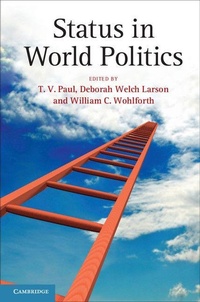
Status in World Politics
Published on 7. April 2014
Book
Paperback/Softback
324 pages
978-1-107-62929-5 (ISBN)
Description
Rising powers such as Brazil, China, India, Russia, and Turkey are increasingly claiming heightened profiles in international politics. Although differing in other respects, rising states have a strong desire for recognition and respect. This pioneering volume on status features contributions that develop propositions on status concerns and illustrate them with case studies and aggregate data analysis. Four cases are examined in depth: the United States (how it accommodates rising powers through hierarchy), Russia (the influence of status concerns on its foreign policy), China (how Beijing signals its status aspirations), and India (which has long sought major power status). The authors analyze status from a variety of theoretical perspectives and tackle questions such as: How do states signal their status claims? How are such signals perceived by the leading states? Will these status concerns lead to conflict, or is peaceful adjustment possible?
Reviews / Votes
'In World War I status disagreements contributed to the war. Once again in the twenty-first century status is becoming an important issue. Definitively and thoroughly examining status from a number of angles, this book is an indispensable source on the subject.' Charles Doran, Andrew W. Mellon Professor of International Relations, School of Advanced International Studies, Johns Hopkins University 'Status in World Politics is a major contribution to a heretofore neglected topic. The debate over 'status' ... its meaning, causes and consequences ... offered by the authors in this volume is an essential introduction to forces that have shaped world politics and will be part of the currency of competition defining the new world order.' Michael W. Doyle, Columbia University 'Quality essays explore and evaluate the influence of status in the foreign policy behaviour of the great powers. The analyses are rich in theoretical insights and policy implications, and are highly relevant in our era of power transitions.' K. J. Holsti, Professor Emeritus, University of British Columbia 'This is a path-breaking volume. It fills an important intellectual gap by exploring with nuance and sophistication the role that status plays in shaping interstate relations and the prospects for stability in a changing world.' Charles A. Kupchan, Georgetown University, Council on Foreign Relations, and author of No One's World 'T. V. Paul, Deborah Welch Larson, and William Wohlforth have given IR scholars the right book at the right time. The study of great power relations traditionally focuses on power. Status in World Politics calls our attention to the fact that great powers - especially rising ones - seek acknowledgment of their newfound position in the international system. This book fills a gap in the study of great power behaviour and draws our attention to the fact that prestige and status are important drivers of great power strategies. This is a path breaking book that is sure to inspire new research on this important topic.' Christopher Layne, University Distinguished Professor and Robert M. Gates Chair in National Security, George H. W. Bush School of Government and Public Service, Texas A and M University 'States seek status as an end in itself as it enhances the self-esteem of leaders and peoples alike. Contributors to this volume offer useful insights into how status is achieved and signalled and how conflicts can arise when leaders of different countries make asymmetric assessments of their relative standing.' Richard Ned Lebow, Professor of International Political Theory, King's College London '... [a] valuable book ...' Pierre Hassner, SurvivalMore details
Language
English
Place of publication
Cambridge
United Kingdom
Target group
Professional and scholarly
Product notice
Paperback (trade)
Illustrations
11 Tables, black and white; 5 Line drawings, unspecified
Dimensions
Height: 229 mm
Width: 152 mm
Thickness: 18 mm
Weight
471 gr
ISBN-13
978-1-107-62929-5 (9781107629295)
Copyright in bibliographic data and cover images is held by Nielsen Book Services Limited or by the publishers or by their respective licensors: all rights reserved.
Schweitzer Classification
Other editions
Additional editions
T. V. Paul | Deborah Welch Larson | William C. Wohlforth
Status in World Politics
Book
04/2014
Cambridge University Press
€98.60
Shipment within 15-20 days
T. V. Paul | Deborah Welch Larson | William C. Wohlforth
Status in World Politics
E-Book
03/2014
1st Edition
Cambridge University Press
€26.49
Available for download
Persons
T. V. Paul is James McGill Professor of International Relations in the Department of Political Science at McGill University. Deborah Welch Larson is Professor of Political Science in the Department of Political Science at the University of California, Los Angeles. William C. Wohlforth is the Daniel Webster Professor of Government in the Department of Government at Dartmouth College.
Content
Part I. Introduction: 1. Status and world order Deborah Welch Larson, T. V. Paul and William C. Wohlforth; Part II. Admission into the Great-Power Club: 2. Managing rising powers: the role of status concerns Deborah Welch Larson and Alexei Shevchenko; 3. Status considerations in international politics and the rise of regional powers Thomas J. Volgy, Renato Corbetta, J. Patrick Rhamey, Jr, Ryan G. Baird and Keith A. Grant; 4. Status is cultural: Durkheimian Poles and Weberian Russians seek great-power status Iver B. Neumann; Part III. Status Signaling: 5. Status dilemmas and interstate conflict William C. Wohlforth; 6. Status signaling, multiple audiences, and China's blue-water naval ambition Xiaoyu Pu and Randall L. Schweller; Part IV. International Institutions and Status: 7. Status accommodation through institutional means: India's rise and the global order T. V. Paul and Mahesh Shankar; 8. Setting status in stone: the negotiation of international institutional privileges Vincent Pouliot; Part V. Status, Authority, and Structure: 9. Status conflict, hierarchies, and interpretation dilemmas William R. Thompson; 10. Status, authority, and the end of the American century David A. Lake; Part VI. Conclusions: 11. Why status matters in world politics Anne L. Clunan.