

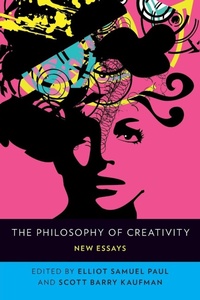
The Philosophy of Creativity
New Essays
Published on 15. June 2017
Book
Paperback/Softback
338 pages
978-0-19-068375-7 (ISBN)
Description
Creativity pervades human life. It is the mark of individuality, the vehicle of self-expression, and the engine of progress in every human endeavor. It also raises a wealth of neglected and yet evocative philosophical questions: What is the role of consciousness in the creative process? How does the audience for a work for art influence its creation? How can creativity emerge through childhood pretending? Do great works of literature give us insight into human nature? Can a computer program really be creative? How do we define creativity in the first place? Is it a virtue? What is the difference between creativity in science and art? Can creativity be taught?
The new essays that comprise The Philosophy of Creativity take up these and other key questions and, in doing so, illustrate the value of interdisciplinary exchange. Written by leading philosophers and psychologists involved in studying creativity, the essays integrate philosophical insights with empirical research.
The new essays that comprise The Philosophy of Creativity take up these and other key questions and, in doing so, illustrate the value of interdisciplinary exchange. Written by leading philosophers and psychologists involved in studying creativity, the essays integrate philosophical insights with empirical research.
Reviews / Votes
The essays in this anthology explore many of [creativity's] aspects, presenting familiar philosophical issues in less familiar contexts, which is an encouragement to take a fresh look at those issues and perhaps rethink our opinions. Creativity is looked at in relation to literature, music, audience response, character, imagination, the unconscious, and artificial intelligence ... the compilers of the anthology are to be congratulated on its range and variety. * Les Reid, Philosophy Now * The editors have done a very good job. It is a good place to start. The anthology is a useful resource to get both familiar with creativity, e.g. for students and researcher, but also to be inspired to raise new questions about this multifaceted concept. Many authors thank the editors, so do I." * Metapsychology Online Reviews*
More details
Language
English
Place of publication
New York
United States
Target group
College/higher education
Dimensions
Height: 234 mm
Width: 156 mm
Thickness: 21 mm
Weight
577 gr
ISBN-13
978-0-19-068375-7 (9780190683757)
Copyright in bibliographic data and cover images is held by Nielsen Book Services Limited or by the publishers or by their respective licensors: all rights reserved.
Schweitzer Classification
Other editions
Additional editions
Book
05/2014
Oxford University Press Inc
€110.10
Shipment within 15-20 days
E-Book
04/2014
1st Edition
OUP eBook
€48.99
Available for download
Persons
Elliot Samuel Paul is Assistant Professor of Philosophy at Barnard College, Columbia University, and is co-founder of The Creativity Post (creativitypost.com), a non-profit web platform that features quality content on creativity, innovation and imagination.
Scott Barry Kaufman, Ph.D., is scientific director of the Imagination Institute and investigates the measurement and development of imagination, creativity and well-being in the Positive Psychology Center at the University of Pennsylvania. He has written or edited seven books, including Wired to Create: Unravelling the Mysteries of the Creative Mind (with Carolyn Gregoire) and Ungifted: Intelligence Redefined. He is also co-founder of The Creativity Post, host of The Psychology Podcast, and he writes the blog Beautiful Minds for Scientific American. Kaufman lives in Philadelphia.
Scott Barry Kaufman, Ph.D., is scientific director of the Imagination Institute and investigates the measurement and development of imagination, creativity and well-being in the Positive Psychology Center at the University of Pennsylvania. He has written or edited seven books, including Wired to Create: Unravelling the Mysteries of the Creative Mind (with Carolyn Gregoire) and Ungifted: Intelligence Redefined. He is also co-founder of The Creativity Post, host of The Psychology Podcast, and he writes the blog Beautiful Minds for Scientific American. Kaufman lives in Philadelphia.
Content
I. Introduction
Introducing The Philosophy of Creativity Elliot Samuel Paul and Scott Barry Kaufman
II. The Concept of Creativity
1. An Experiential Account of Creativity Bence Nanay
III. Aesthetics & Philosophy of Art
2. Creativity and Insight Gregory Currie
3. The Creative Audience: Some Ways in which Readers, Viewers and/or Listeners Use their Imaginations to Engage Fictional Artworks Noel Carroll
4. The Products of Musical Creativity Christopher Peacocke
IV. Ethics & Value Theory
5. Performing Oneself Owen Flanagan
6. Creativity as a Virtue of Character Matthew Kieran
V. Philosophy of Mind & Cognitive Science
7. Creativity and Not So Dumb Luck Simon Blackburn
8. The Role of Imagination in Creativity Dustin Stokes
9. Creativity, Consciousness, and Free Will: Evidence from Psychology Experiments Roy F. Baumeister, Brandon J. Schmeichel, and C. Nathan DeWall
10. The Origins of Creativity Elizabeth Picciuto and Peter Carruthers
11. Creativity and Artificial Intelligence: a Contradiction in Terms? Margaret Boden
VI. Philosophy of Science
12. Hierarchies of Creative Domains: Disciplinary Constraints on Blind-Variation and Selective-Retention Dean Keith Simonton
VII. Philosophy of Education (& Education of Philosophy)
13. Educating for Creativity Berys Gaut
14. Philosophical Heuristics Alan Hajek
Introducing The Philosophy of Creativity Elliot Samuel Paul and Scott Barry Kaufman
II. The Concept of Creativity
1. An Experiential Account of Creativity Bence Nanay
III. Aesthetics & Philosophy of Art
2. Creativity and Insight Gregory Currie
3. The Creative Audience: Some Ways in which Readers, Viewers and/or Listeners Use their Imaginations to Engage Fictional Artworks Noel Carroll
4. The Products of Musical Creativity Christopher Peacocke
IV. Ethics & Value Theory
5. Performing Oneself Owen Flanagan
6. Creativity as a Virtue of Character Matthew Kieran
V. Philosophy of Mind & Cognitive Science
7. Creativity and Not So Dumb Luck Simon Blackburn
8. The Role of Imagination in Creativity Dustin Stokes
9. Creativity, Consciousness, and Free Will: Evidence from Psychology Experiments Roy F. Baumeister, Brandon J. Schmeichel, and C. Nathan DeWall
10. The Origins of Creativity Elizabeth Picciuto and Peter Carruthers
11. Creativity and Artificial Intelligence: a Contradiction in Terms? Margaret Boden
VI. Philosophy of Science
12. Hierarchies of Creative Domains: Disciplinary Constraints on Blind-Variation and Selective-Retention Dean Keith Simonton
VII. Philosophy of Education (& Education of Philosophy)
13. Educating for Creativity Berys Gaut
14. Philosophical Heuristics Alan Hajek