

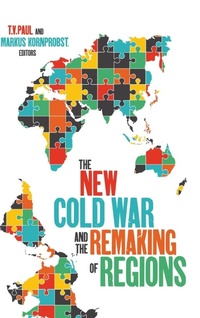
The New Cold War and the Remaking of Regions
Published on 1. July 2025
Book
Hardback
278 pages
978-1-64712-586-8 (ISBN)
Description
A compelling examination of how secondary states are preserving their strategic autonomy and are resisting spheres of influence
Russia's invasion of Ukraine and the deteriorating United States-China relationship signify the onset of the New Cold War. Unlike the original Cold War, this competition is multipolar and "multiplex," with secondary powers, small states, and even nonstate actors pragmatically selecting which of their interests intersect with those of the great powers.
The New Cold War and the Remaking of Regions contends that multiplexity and multipolarity have important repercussions for the world's regional orders. Contributors to the book address the New Cold War and regional ordering processes from realist, liberal, and constructivist perspectives. They demonstrate how variable regional dynamics will lead either to peaceful change or conflict.
This volume is part of a new wave of scholarship that expands the focus of international relations beyond great powers and recognizes the increasing agency that other states have gained in the twenty-first-century world order.
Russia's invasion of Ukraine and the deteriorating United States-China relationship signify the onset of the New Cold War. Unlike the original Cold War, this competition is multipolar and "multiplex," with secondary powers, small states, and even nonstate actors pragmatically selecting which of their interests intersect with those of the great powers.
The New Cold War and the Remaking of Regions contends that multiplexity and multipolarity have important repercussions for the world's regional orders. Contributors to the book address the New Cold War and regional ordering processes from realist, liberal, and constructivist perspectives. They demonstrate how variable regional dynamics will lead either to peaceful change or conflict.
This volume is part of a new wave of scholarship that expands the focus of international relations beyond great powers and recognizes the increasing agency that other states have gained in the twenty-first-century world order.
Reviews / Votes
[T]he contents offer multiple nuanced perspectives....A good choice for university libraries and international affairs collections. * CHOICE connect * It's a timely and thought-provoking analysis of the new geopolitical realities facing regions from Europe to Asia. * United States Army War College Press *More details
Language
English
Place of publication
Washington, DC
United States
Target group
Professional and scholarly
US School Grade: College Graduate Student and over
Product notice
Laminated cover
Illustrations
Not illustrated
Dimensions
Height: 229 mm
Width: 152 mm
Thickness: 19 mm
Weight
546 gr
ISBN-13
978-1-64712-586-8 (9781647125868)
Copyright in bibliographic data and cover images is held by Nielsen Book Services Limited or by the publishers or by their respective licensors: all rights reserved.
Schweitzer Classification
Other editions
Additional editions
T. V. Paul | Markus Kornprobst
The New Cold War and the Remaking of Regions
E-Book
07/2025
Georgetown University Press
€44.49
Available for download
Persons
T. V. Paul is the Distinguished James McGill Professor at McGill University and a past-president of the International Studies Association. Markus Kornprobst is professor of international relations at the Vienna School of International Studies, Diplomatische Akademie Wien.
Content
List of Illustrations
Preface and Acknowledgments
1. Introduction: The New Cold War, Regional Orders, and Peaceful Change, T.V. Paul and Markus Kornprobst
2. Regional Orders and Great Power Rivalry in a Multiplex World, Manjeet S. Pardesi and Amitav Acharya
3. Norms in Great Power Competition: Peaceful Change in a Spheres of Influence World, Anders Wivel
4. The Ideological Sources of Great Power Competition in the Regions, Thierry Balzacq and Vera Grantseva
5. Great Power Competition and Regional Orders: A Neoclassical Realist Interpretation, Mark Brawley and Jonathan Paquin
6. Status Competition in the Regions: Past, Present, and Future, Xiaoyu Pu
7. New Institutional Economic Statecraft Beyond the Border: Technology Competition in the Asia-Pacific, Vinod K. Aggarwal and Andrew W. Reddie
8. The US and Changing Regional Orders in Europe and Asia, Deborah Welch Larson
9. China and the Changing Regional Order in East Asia, Selina Ho
10. Russia and the Shaping of the Regional Order in Eurasia, Seckin Koestem
11. Conclusion: Rethinking Great Powers, Regions, and Peaceful Change in the New Cold War Era, Andrej Krickovic and Jaeyoung Kim
Index
List of Contributors
Preface and Acknowledgments
1. Introduction: The New Cold War, Regional Orders, and Peaceful Change, T.V. Paul and Markus Kornprobst
2. Regional Orders and Great Power Rivalry in a Multiplex World, Manjeet S. Pardesi and Amitav Acharya
3. Norms in Great Power Competition: Peaceful Change in a Spheres of Influence World, Anders Wivel
4. The Ideological Sources of Great Power Competition in the Regions, Thierry Balzacq and Vera Grantseva
5. Great Power Competition and Regional Orders: A Neoclassical Realist Interpretation, Mark Brawley and Jonathan Paquin
6. Status Competition in the Regions: Past, Present, and Future, Xiaoyu Pu
7. New Institutional Economic Statecraft Beyond the Border: Technology Competition in the Asia-Pacific, Vinod K. Aggarwal and Andrew W. Reddie
8. The US and Changing Regional Orders in Europe and Asia, Deborah Welch Larson
9. China and the Changing Regional Order in East Asia, Selina Ho
10. Russia and the Shaping of the Regional Order in Eurasia, Seckin Koestem
11. Conclusion: Rethinking Great Powers, Regions, and Peaceful Change in the New Cold War Era, Andrej Krickovic and Jaeyoung Kim
Index
List of Contributors