

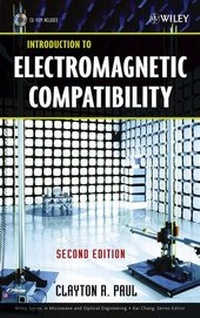
Introduction to Electromagnetic Compatibility
2nd Edition
Published on 10. February 2006
Book
Hardback
1016 pages
978-0-471-75500-5 (ISBN)
Description
A Landmark text thoroughly updated, including a new CD
As digital devices continue to be produced at increasingly lower costs and with higher speeds, the need for effective electromagnetic compatibility (EMC) design practices has become more critical than ever to avoid unnecessary costs in bringing products into compliance with governmental regulations. The Second Edition of this landmark text has been thoroughly updated and revised to reflect these major developments that affect both academia and the electronics industry. Readers familiar with the First Edition will find much new material, including:
* Latest U.S. and international regulatory requirements
* PSpice used throughout the textbook to simulate EMC analysis solutions
* Methods of designing for Signal Integrity
* Fortran programs for the simulation of Crosstalk supplied on a CD
* OrCAD(r) PSpice(r) Release 10.0 and Version 8 Demo Edition software supplied on a CD
* The final chapter on System Design for EMC completely rewritten
* The chapter on Crosstalk rewritten to simplify the mathematics
Detailed, worked-out examples are now included throughout the text. In addition, review exercises are now included following the discussion of each important topic to help readers assess their grasp of the material. Several appendices are new to this edition including Phasor Analysis of Electric Circuits, The Electromagnetic Field Equations and Waves, Computer Codes for Calculating the Per-Unit-Length Parameters and Crosstalk of Multiconductor Transmission Lines, and a SPICE (PSPICE) tutorial.
Now thoroughly updated, the Second Edition of Introduction to Electromagnetic Compatibility remains the textbook of choice for university/college EMC courses as well as a reference for EMC design engineers.
As digital devices continue to be produced at increasingly lower costs and with higher speeds, the need for effective electromagnetic compatibility (EMC) design practices has become more critical than ever to avoid unnecessary costs in bringing products into compliance with governmental regulations. The Second Edition of this landmark text has been thoroughly updated and revised to reflect these major developments that affect both academia and the electronics industry. Readers familiar with the First Edition will find much new material, including:
* Latest U.S. and international regulatory requirements
* PSpice used throughout the textbook to simulate EMC analysis solutions
* Methods of designing for Signal Integrity
* Fortran programs for the simulation of Crosstalk supplied on a CD
* OrCAD(r) PSpice(r) Release 10.0 and Version 8 Demo Edition software supplied on a CD
* The final chapter on System Design for EMC completely rewritten
* The chapter on Crosstalk rewritten to simplify the mathematics
Detailed, worked-out examples are now included throughout the text. In addition, review exercises are now included following the discussion of each important topic to help readers assess their grasp of the material. Several appendices are new to this edition including Phasor Analysis of Electric Circuits, The Electromagnetic Field Equations and Waves, Computer Codes for Calculating the Per-Unit-Length Parameters and Crosstalk of Multiconductor Transmission Lines, and a SPICE (PSPICE) tutorial.
Now thoroughly updated, the Second Edition of Introduction to Electromagnetic Compatibility remains the textbook of choice for university/college EMC courses as well as a reference for EMC design engineers.
Reviews / Votes
"...well written and flows smoothly...provides electrical engineering students with a new perspective in applied electromagnetics and circuit design...highly recommended." (CHOICE, September 2006)More details
Product info
Book with CD-ROM
Series
Edition
2. Auflage
Language
English
Place of publication
United States
Publishing group
John Wiley & Sons Inc
Target group
Professional and scholarly
Dimensions
Height: 24.4 cm
Width: 16.3 cm
Thickness: 5.3 cm
Weight
1513 gr
ISBN-13
978-0-471-75500-5 (9780471755005)
Schweitzer Classification
Other editions
New editions
Book
11/2022
Wiley-Blackwell
€136.50
Shipment within 15-20 days
Additional editions
Clayton R. Paul
Introduction to Electromagnetic Compatibility
E-Book
01/2006
2nd Edition
Wiley
€168.99
Available for download
Previous edition
Clayton R. Paul
Introduction to Electromagnetic Compatibility
Book
03/1992
1st Edition
Wiley
€135.00
Article exhausted; check for reprint
Person
CLAYTON R. PAUL, PHD, is Professor and Sam Nunn Chair of Aerospace Systems Engineering, Department of Electrical and Computer Engineering, Mercer University. He is also Emeritus Professor of Electrical Engineering at the University of Kentucky, where he served on the faculty for twenty-seven years. Dr. Paul is the author of twelve textbooks in electrical engineering, has contributed numerous chapters to engineering handbooks and reference texts, and has published numerous technical papers in scientific journals and symposia. He is a Fellow of the IEEE and a Honorary Life Member of the IEEE EMC Society.
Content
Preface.
1. Introduction to Electromagnetic Compatibility (EMC).
2. EMC Requirements for Electronic Systems.
3. Signal Spectra-The Relationship Between theTime Domain and the Frequency Domain.
4. Transmission Lines and Signal Integrity.
5. Nonideal Behavior of Components.
6. Conducted Emissions and Susceptibility.
7. Antennas.
8. Radiated Emissions and Susceptibility.
9. Crosstalk.
10. Shielding.
11. System Design for EMC.
Appendix A: The Phasor Solution Method.
Appendix B: The Electromagnetic Field Equations and Waves.
Appendix C: Computer Codes for Calculating the Per-Unit-Length Parameters and Crosstalk of Multiconductor Transmission Lines.
Appendix D: Spice (PSPICE) Tutorial.
Index.
1. Introduction to Electromagnetic Compatibility (EMC).
2. EMC Requirements for Electronic Systems.
3. Signal Spectra-The Relationship Between theTime Domain and the Frequency Domain.
4. Transmission Lines and Signal Integrity.
5. Nonideal Behavior of Components.
6. Conducted Emissions and Susceptibility.
7. Antennas.
8. Radiated Emissions and Susceptibility.
9. Crosstalk.
10. Shielding.
11. System Design for EMC.
Appendix A: The Phasor Solution Method.
Appendix B: The Electromagnetic Field Equations and Waves.
Appendix C: Computer Codes for Calculating the Per-Unit-Length Parameters and Crosstalk of Multiconductor Transmission Lines.
Appendix D: Spice (PSPICE) Tutorial.
Index.