

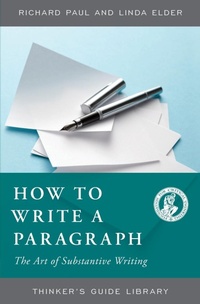
How to Write a Paragraph
The Art of Substantive Writing
Published on 1. January 2013
Book
Paperback/Softback
58 pages
978-0-944583-22-7 (ISBN)
Description
Though close reading and substantive writing are essential skills for the educated person, they are frequently ignored in education. How to Write a Paragraph applies critical thinking tools to the process of writing to guide students towards developing clear, effective, and meaningful written communication.
As a companion to How to Read a Paragraph, this volume in the Thinker’s Guide Library includes activities to sharpen writing skills and overall reasoning abilities. Readers who work through this guide learn to be clearer, more purposeful, more aware of the assumptions guiding their thoughts, and more substantive in their approach to writing.
As part of the Thinker’s Guide Library, this book advances the mission of the Foundation for Critical Thinking to promote fairminded critical societies through cultivating essential intellectual abilities and virtues across every field of study across world.
More details
Series
Language
English
Place of publication
United States
Dimensions
Height: 203 mm
Width: 133 mm
Thickness: 4 mm
Weight
78 gr
ISBN-13
978-0-944583-22-7 (9780944583227)
Copyright in bibliographic data and cover images is held by Nielsen Book Services Limited or by the publishers or by their respective licensors: all rights reserved.
Schweitzer Classification
Other editions
Additional editions
E-Book
06/2019
1st Edition
Foundation for Critical Thinking
€24.49
Available for download
E-Book
06/2019
1st Edition
The Foundation for Critical Thinking
€24.49
Available for download
Persons
Dr. Richard Paul was a leading proponent of critical thinking and through his work and legacy remains an international authority in the field. He founded the Center for Critical Thinking at Sonoma State University in 1980, followed by the Foundation for Critical Thinking. He developed concepts, principles, and theory essentials to a robust and fairminded conception of critical thinking and authored more than 200 articles and seven books on the topic. He presented workshops to hundreds of thousands of educators over his 35-year career as a leader in the critical thinking movement.