

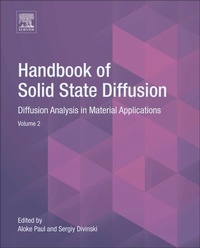
Handbook of Solid State Diffusion: Volume 2
Diffusion Analysis in Material Applications
Published on 10. April 2017
Book
Hardback
476 pages
978-0-12-804548-0 (ISBN)
Description
Handbook of Solid State Diffusion, Volume 2: Diffusion Analysis in Material Applications covers the basic fundamentals, techniques, applications, and latest developments in the area of solid-state diffusion, offering a pedagogical understanding for students, academicians, and development engineers. Both experimental techniques and computational methods find equal importance in the second of this two volume set.
Volume 2 covers practical issues on diffusion phenomena in bulk, thin film, and in nanomaterials. Diffusion related problems and analysis of methods in industrial applications, such as electronic industry, high temperature materials, nuclear materials, and superconductor materials are discussed.
Volume 2 covers practical issues on diffusion phenomena in bulk, thin film, and in nanomaterials. Diffusion related problems and analysis of methods in industrial applications, such as electronic industry, high temperature materials, nuclear materials, and superconductor materials are discussed.
More details
Language
English
Place of publication
United States
Target group
Professional and scholarly
Dimensions
Height: 235 mm
Width: 191 mm
Weight
1110 gr
ISBN-13
978-0-12-804548-0 (9780128045480)
Copyright in bibliographic data and cover images is held by Nielsen Book Services Limited or by the publishers or by their respective licensors: all rights reserved.
Schweitzer Classification
Persons
Professor Aloke Paul heads a research group working on various aspects of diffusion in solids in the Department of Materials Engineering, Indian Institute of Science, Bengaluru, India. Major research areas include developing new phenomenological models, materials in electronic packaging, bond coat in jet engine applications, the growth of A15 intermetallic superconductors etc. He teaches a postgraduate level course on Diffusion in solids. He has guided several Ph.D. and M.E. students and co-authored around 100 articles in various international journals. During his Ph.D. at the Eindhoven University of Technology, he was part of one of the most important discoveries of recent times on previously unknown phenomena related to the Kirkendall effect. After joining the Indian Institute of Science, his group developed new methods for estimation of the diffusion coefficients such as a physicochemical approach that relates microstructural evolution with the rate of diffusing components and a pseudo-binary method in multicomponent diffusion. These are included in course curriculum in many universities and also included in the books written on this topic. He has co-authored a textbook titled Thermodynamics, Diffusion and the Kirkendall effect in Solids. Professor Dr. Sergiy Divinski leads the radiotracer laboratory at the Institute of Materials Physics, University of Muenster, Germany. The research activities are concentrated on kinetic and thermodynamic properties of interfaces in solids, including intergranular and interphase boundaries. Other major interests include diffusion phenomena in intermetallic compounds, effects of ordering on diffusion kinetic and diffusion mechanisms, interfaces in severely deformed materials. He teaches graduate and postgraduate courses on Diffusion in Solids, Numerical methods in Material Science and different aspects of Materials Science. He has co-authored more than 150 articles in various international journals, several book chapters in the field of Diffusion in Solids and a textbook titled Thermodynamics, Diffusion and the Kirkendall effect in Solids.
Content
1. Diffusion Measurements in Nanostructures
2. Diffusion-Controlled Phase Transformations in Open Systems
3. Thermodynamic-Kinetic Method on Microstructural Evolutions in Electronics
4. Microstructural Evolution by Reaction-Diffusion: Bulk, Thin Film, and Nanomaterials
5. Electromigration in Metallic Materials and Its Role in Whiskering
6. Diffusion Couple Technique: A Research Tool in Materials Science
7. Diffusion-Controlled Internal Precipitation Reactions
8. Diffusion in Nuclear Materials
9. The Growth of Silicides and Germanides
2. Diffusion-Controlled Phase Transformations in Open Systems
3. Thermodynamic-Kinetic Method on Microstructural Evolutions in Electronics
4. Microstructural Evolution by Reaction-Diffusion: Bulk, Thin Film, and Nanomaterials
5. Electromigration in Metallic Materials and Its Role in Whiskering
6. Diffusion Couple Technique: A Research Tool in Materials Science
7. Diffusion-Controlled Internal Precipitation Reactions
8. Diffusion in Nuclear Materials
9. The Growth of Silicides and Germanides