

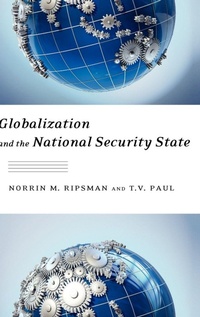
Globalization and the National Security State
Published on 4. March 2010
Book
Hardback
296 pages
978-0-19-539390-3 (ISBN)
Description
In the past two decades, many have posited a correlation between the spread of globalization and the decline of the nation-state. In the realm of national security, advocates of the globalization thesis have argued that states' power has diminished relative to transnational governmental institutions, NGOs, and transnational capitalism. Initially, they pointed to declines in both global military spending (which has risen dramatically in recent years) and interstate war. But are these trends really indicative of the decline of nation-state's role as a guarantor of national security? In Globalization and the National Security State, T.V. Paul and Norrin Ripsman test the proposition against the available evidence and find that the globalization school has largely gotten it wrong. The decline in interstate warfare can largely be attributed to the end of the Cold War, not globalization. Moreover, great powers (the US, China, and Russia) continue to pursue traditional nation-state strategies. Regional security arrangements like the EU and ASEAN have not achieved much, and weak states - the ones most impacted by the turmoil generated by globalization - are far more traditional in their approaches to national security, preferring to rely on their own resources rather than those of regional and transnational institutions. This is a bold argument, and Paul and Ripsman amass a considerable amount of evidence for their claims. It cuts against a major movement in international relations scholarship, and is sure to generate controversy.
Reviews / Votes
Ripsman and Paul debunk loose generalizations about globalization's effects on the state and security policy. States today neither spend less on defense nor fight fewer wars than in less globalized eras. Globalization's effects, to the extent they exist, are not universal. The authors argue persuasively that states are the masters rather than victims of the process of globalization. * David A. Lake, Distinguished Professor of Political Science, University of California, San Diego *More details
Language
English
Place of publication
New York
United States
Target group
College/higher education
Dimensions
Height: 240 mm
Width: 161 mm
Thickness: 20 mm
Weight
608 gr
ISBN-13
978-0-19-539390-3 (9780195393903)
Copyright in bibliographic data and cover images is held by Nielsen Book Services Limited or by the publishers or by their respective licensors: all rights reserved.
Schweitzer Classification
Other editions
Additional editions
Norrin M. Ripsman | T. V. Paul
Globalization and the National Security State
E-Book
03/2010
1st Edition
OUP eBook
€17.99
Available for download
Norrin M. Ripsman | T. V. Paul
Globalization and the National Security State
E-Book
03/2010
1st Edition
OUP eBook
€16.49
Available for download
Persons
Norrin Ripsman is Associate Professor of Political Science at Concordia University in Montreal.
T.V. Paul is James McGill Professor of International Relations at McGill University.
T.V. Paul is James McGill Professor of International Relations at McGill University.
Content
LIST OF TABLES; ACKNOWLEDGMENTS; INTRODUCTION: NATIONAL SECURITY STATE IN THE ERA OF GLOBALIZATION; CONCLUSION: STATE ADAPTATION TO A CHANGED GLOBAL ENVIRONMENT; SELECT BIBLIOGRAPHY