

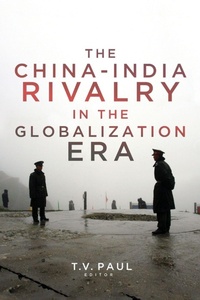
The China-India Rivalry in the Globalization Era
Published on 3. September 2018
Book
Paperback/Softback
304 pages
978-1-62616-600-4 (ISBN)
Description
As the aspirations of the two rising Asian powers collide, the China-India rivalry is likely to shape twenty-first-century international politics in the region and far beyond.
This volume by T.V. Paul and an international group of leading scholars examines whether the rivalry between the two countries that began in the 1950s will intensify or dissipate in the twenty-first century. The China-India relationship is important to analyze because past experience has shown that when two rising great powers share a border, the relationship is volatile and potentially dangerous. India and China's relationship faces a number of challenges, including multiple border disputes that periodically flare up, division over the status of Tibet and the Dalai Lama, the strategic challenge to India posed by China's close relationship with Pakistan, the Chinese navy's greater presence in the Indian Ocean, and the two states' competition for natural resources. Despite these irritants, however, both countries agree on issues such as global financial reforms and climate change and have much to gain from increasing trade and investment, so there are reasons for optimism as well as pessimism.
The contributors to this volume answer the following questions: What explains the peculiar contours of this rivalry? What influence does accelerated globalization, especially increased trade and investment, have on this rivalry? What impact do US-China competition and China's expanding navy have on this rivalry? Under what conditions will it escalate or end? The China-India Rivalry in the Globalization Era will be of great interest to students, scholars, and policymakers concerned with Indian and Chinese foreign policy and Asian security.
This volume by T.V. Paul and an international group of leading scholars examines whether the rivalry between the two countries that began in the 1950s will intensify or dissipate in the twenty-first century. The China-India relationship is important to analyze because past experience has shown that when two rising great powers share a border, the relationship is volatile and potentially dangerous. India and China's relationship faces a number of challenges, including multiple border disputes that periodically flare up, division over the status of Tibet and the Dalai Lama, the strategic challenge to India posed by China's close relationship with Pakistan, the Chinese navy's greater presence in the Indian Ocean, and the two states' competition for natural resources. Despite these irritants, however, both countries agree on issues such as global financial reforms and climate change and have much to gain from increasing trade and investment, so there are reasons for optimism as well as pessimism.
The contributors to this volume answer the following questions: What explains the peculiar contours of this rivalry? What influence does accelerated globalization, especially increased trade and investment, have on this rivalry? What impact do US-China competition and China's expanding navy have on this rivalry? Under what conditions will it escalate or end? The China-India Rivalry in the Globalization Era will be of great interest to students, scholars, and policymakers concerned with Indian and Chinese foreign policy and Asian security.
Reviews / Votes
An important addition to the literature . . . students of the India-China dynamic should use it as a platform to further comparative studies of what is without doubt one of the most important bilateral relationships in the world. * H-Diplo * As China-India relations impact global politics and attract global attention, this collection of articles put together by T. V. Paul, Professor of International Relations at McGill University,is extremely timely. The book comprehensively examines the historical and evolving SinoIndia security dynamics, which include traditional as well as non-traditional security issues * The International Spectator * This is a useful book whose major strength is the diversity of well-researched perspectives it brings to the study of India-China rivalry. * China Report * In sum, this is a stimulating volume that provides key insights into a vital relationship in contemporary international politics. * International Affairs * Overall this book makes a valuable contribution to the growing literature on China-India rivalry and it should be on the reading list of every scholar and policymaker. * Journal of Chinese Political Science * Paul's edited volume is indeed an incisive and solid overview of the emerging India-China relationship. * South Asia: Journal of South Asian Studies * "[T]his is a useful book whose major strength is the diversity of well-researched perspectives it brings to the study of India-China rivalry. * China Report *More details
Series
Language
English
Place of publication
Washington, DC
United States
Target group
Professional and scholarly
US School Grade: College Graduate Student and over
Product notice
Paperback (trade)
Illustrations
Not illustrated
Dimensions
Height: 229 mm
Width: 152 mm
Weight
431 gr
ISBN-13
978-1-62616-600-4 (9781626166004)
Copyright in bibliographic data and cover images is held by Nielsen Book Services Limited or by the publishers or by their respective licensors: all rights reserved.
Schweitzer Classification
Other editions
Additional editions
E-Book
09/2018
Georgetown University Press
€38.99
Available for download
Persons
T.V. Paul is James McGill Professor of International Relations at McGill University, past president of the International Studies Association, and author or editor of eighteen books, including The Warrior State: Pakistan in the Contemporary World and The Accommodation of Rising Powers: Past, Present, and Future.
Content
List of Illustrations
Acknowledgments
Part I: Introduction
1. Explaining Conflict and Cooperation in the China-India Rivalry
T.V. Paul
Part II: Sources
2. Territory and the China-India Competition
Mahesh Shankar
3. Asymmetrical Competitors: Status Concerns and the China-India Rivalry
Xiaoyu Pu
4. China, India, and Their Differing Conceptions of International Order
Manjari Chatterjee Miller
5. Balancing Strategies and the China-India Rivalry
Zhen Han and Jean-Francois Belanger
6. China and India's Quest for Resources and Its Impact on the Rivalry
Calvin Chen
7. Power Asymmetry and the China-India Water Dispute
Selina Ho
Part III: Strategies
8. Himalayan Standoff: Strategic Culture and the China-India Rivalry
Andrew Scobell
9. Nuclear Deterrence in the China-India Dyad
Vipin Narang
Part IV: Mitigators
10. Globalization's Impact: Trade and Investment in China-India Relations
Matthew A. Castle
11. China-India Engagement in Institutions: Convergence and Divergence on Global Governance Reforms
Feng Liu
Part V: Conclusions
12. Whither Rivalry or Withered Rivalry?
Paul F. Diehl
List of Contributors
Index
Acknowledgments
Part I: Introduction
1. Explaining Conflict and Cooperation in the China-India Rivalry
T.V. Paul
Part II: Sources
2. Territory and the China-India Competition
Mahesh Shankar
3. Asymmetrical Competitors: Status Concerns and the China-India Rivalry
Xiaoyu Pu
4. China, India, and Their Differing Conceptions of International Order
Manjari Chatterjee Miller
5. Balancing Strategies and the China-India Rivalry
Zhen Han and Jean-Francois Belanger
6. China and India's Quest for Resources and Its Impact on the Rivalry
Calvin Chen
7. Power Asymmetry and the China-India Water Dispute
Selina Ho
Part III: Strategies
8. Himalayan Standoff: Strategic Culture and the China-India Rivalry
Andrew Scobell
9. Nuclear Deterrence in the China-India Dyad
Vipin Narang
Part IV: Mitigators
10. Globalization's Impact: Trade and Investment in China-India Relations
Matthew A. Castle
11. China-India Engagement in Institutions: Convergence and Divergence on Global Governance Reforms
Feng Liu
Part V: Conclusions
12. Whither Rivalry or Withered Rivalry?
Paul F. Diehl
List of Contributors
Index