

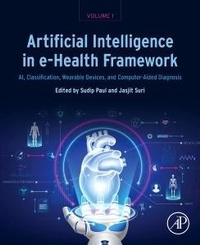
Artificial Intelligence in e-Health Framework, Volume 1
AI, Classification, Wearable Devices, and Computer-Aided Diagnosis
Published on 27. January 2025
Book
Paperback/Softback
344 pages
978-0-443-13816-4 (ISBN)
Description
Artificial Intelligence in e-health Framework, Volume One: AI, Classification, Wearable Devices, and Computer-Aided Diagnosis presents a variety of AI techniques and applications for solving issues in the healthcare industry. As Artificial Intelligence is increasingly incorporated into medical systems and methods, it is critical to understand the formulations and basics of machine and deep learning as well as how to implement these advances into practice. This book specifically explores Artificial Intelligence developments in disease diagnosis, health monitoring, medical image recognition, and diagnostics, as well as e-health records management.
This is a valuable resource for health professionals, scientists, researchers, students, and all who wish to broaden their knowledge in this advancing technology.
This is a valuable resource for health professionals, scientists, researchers, students, and all who wish to broaden their knowledge in this advancing technology.
More details
Language
English
Place of publication
San Diego
United States
Publishing group
Elsevier Science Publishing Co Inc
Target group
Professional and scholarly
Product notice
Paperback (trade)
Unsewn / adhesive bound
Dimensions
Height: 228 mm
Width: 150 mm
Thickness: 18 mm
Weight
517 gr
ISBN-13
978-0-443-13816-4 (9780443138164)
Copyright in bibliographic data and cover images is held by Nielsen Book Services Limited or by the publishers or by their respective licensors: all rights reserved.
Schweitzer Classification
Other editions
Additional editions
Ph. D. (BME) Paul PDF (CSSE) | Mba Suri
Artificial Intelligence in e-Health Framework, Volume 1
AI, Classification, Wearable Devices, and Computer-Aided Diagnosis
E-Book
01/2025
Elsevier
€172.99
Available for download
Persons
Dr. Sudip Paul presently holds the position of Associate Professor in the Department of Biomedical Engineering at the National Institute of Technology, Raipur, India. He conducted his post-doctoral research at the School of Computer Science and Software Engineering, The University of Western Australia, Perth, under the Biotechnology Overseas Associateship scheme for scientists from the North-Eastern States of India (2017-18), supported by the Department of Biotechnology, Government of India. He obtained his Ph.D. from the Indian Institute of Technology (Banaras Hindu University), Varanasi, specializing in Electrophysiology and brain signal analysis. He organized numerous workshops and conferences, notably the 40th Indian Academy of Neuroscience Annual Meeting in 2022, the IEEE Conference on Computational Performance Evaluation in 2020 and 2021, the IRBO/APRC Associate School in 2017, the IBRO Global Engagement in 2021, the IBRO Meeting in 2021, and the 29th Annual Meeting of the Society for Neurochemistry, India in 2015. Dr. Sudip has published about 60 publications in international and national journals, as well as over 50 conference papers across several international and national platforms. He possesses 7 granted patents and 6 granted copyrights. He has finalized 20 book projects as an editor or author with Springer Nature, Elsevier, IGI Global, and others. Dr. Sudip is a Senior Member of IEEE and belongs to various societies and professional organizations, including IAN, IEEE-EMBS, APSN, ISN, and IBRO. He was honored with numerous accolades, notably the World Federation of Neurology (WFN) traveling fellowship, the Young Investigator Award, the IBRO Travel Award, and the ISN Travel Award. Dr. Sudip also imparted his expertise to other international publications as a member of the editorial board and as a reviewer. He has showcased his research achievements in several nations, including the USA, Greece, France, South Africa, and Australia.
Dr. Jasjit Suri, PhD, MBA, is a renowned innovator and scientist. He received the Director General's Gold Medal in 1980 and is a Fellow of several prestigious organizations, including the American Institute of Medical and Biological Engineering and the Institute of Electrical and Electronics Engineers. Dr. Suri has been honored with lifetime achievement awards from Marcus, NJ, USA, and Graphics Era University, India. He has published nearly 300 peer-reviewed AI articles, 100 books, and holds 100 innovations/trademarks, achieving an H-index of nearly 100 with about 43,000 citations. Dr. Suri has served as chairman of AtheroPoint, IEEE Denver section, and as an advisory board member to various healthcare industries and universities globally.
Dr. Jasjit Suri, PhD, MBA, is a renowned innovator and scientist. He received the Director General's Gold Medal in 1980 and is a Fellow of several prestigious organizations, including the American Institute of Medical and Biological Engineering and the Institute of Electrical and Electronics Engineers. Dr. Suri has been honored with lifetime achievement awards from Marcus, NJ, USA, and Graphics Era University, India. He has published nearly 300 peer-reviewed AI articles, 100 books, and holds 100 innovations/trademarks, achieving an H-index of nearly 100 with about 43,000 citations. Dr. Suri has served as chairman of AtheroPoint, IEEE Denver section, and as an advisory board member to various healthcare industries and universities globally.
Content
Section 1: Introduction to Artificial Intelligence
1. Data Processing
2. Regression, Classification, and Clustering Algorithms
3. Deep Learning
Section 2: Application of Artificial Intelligence in Disease Diagnosis
4. Application of Artificial Intelligence in Pioneering Heart Disease Detection
5. From Data to Diagnosis: Leveraging Machine Learning for Heart Disease Classification with the Cleveland Heart Disease Dataset
6. AI-based Treatment Solutions
7. Application of AI in Big Data Management
Section 3: AI in Health Monitoring and Wearables Devices
8. Remote Health Monitoring Using Artificial Intelligence
9. Predicting Women's Fertility with AI
10. A Comparative Study on "Face Mask Detection" Using Machine Learning and Deep Learning Algorithms
11. Enhancing Communication: A Review on AI Wearables for the Deaf and Mute
12. AI based cuffless digital sphygmomanometric measuring system for chronic illness patients
Section 4: Application of AI Medical Image Recognition
13. Identifying Cardiovascular Abnormalities
14. Non-linear Activation Functions of CNN for Classification of MRI Brain tumor Images
15. Artificial Intelligence-Based Management Prospects of Neurological Disorders with Special Reference to Epilepsy
16. Screening for Common Cancers
1. Data Processing
2. Regression, Classification, and Clustering Algorithms
3. Deep Learning
Section 2: Application of Artificial Intelligence in Disease Diagnosis
4. Application of Artificial Intelligence in Pioneering Heart Disease Detection
5. From Data to Diagnosis: Leveraging Machine Learning for Heart Disease Classification with the Cleveland Heart Disease Dataset
6. AI-based Treatment Solutions
7. Application of AI in Big Data Management
Section 3: AI in Health Monitoring and Wearables Devices
8. Remote Health Monitoring Using Artificial Intelligence
9. Predicting Women's Fertility with AI
10. A Comparative Study on "Face Mask Detection" Using Machine Learning and Deep Learning Algorithms
11. Enhancing Communication: A Review on AI Wearables for the Deaf and Mute
12. AI based cuffless digital sphygmomanometric measuring system for chronic illness patients
Section 4: Application of AI Medical Image Recognition
13. Identifying Cardiovascular Abnormalities
14. Non-linear Activation Functions of CNN for Classification of MRI Brain tumor Images
15. Artificial Intelligence-Based Management Prospects of Neurological Disorders with Special Reference to Epilepsy
16. Screening for Common Cancers