

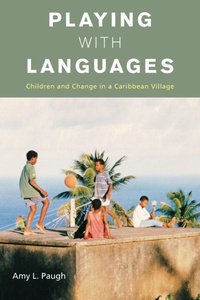
Playing with Languages
Children and Change in a Caribbean Village
1st Edition
Published on 1. May 2014
Book
Paperback/Softback
264 pages
978-1-78238-516-5 (ISBN)
Description
Over several generations villagers of Dominica have been shifting from Patwa, an Afro-French creole, to English, the official language. Despite government efforts at Patwa revitalization and cultural heritage tourism, rural caregivers and teachers prohibit children from speaking Patwa in their presence. Drawing on detailed ethnographic fieldwork and analysis of video-recorded social interaction in naturalistic home, school, village and urban settings, the study explores this paradox and examines the role of children and their social worlds. It offers much-needed insights into the study of language socialization, language shift and Caribbean children's agency and social lives, contributing to the burgeoning interdisciplinary study of children's cultures. Further, it demonstrates the critical role played by children in the transmission and transformation of linguistic practices, which ultimately may determine the fate of a language.
Reviews / Votes
"One may hope that other anthropologists, especially those interested in the language use of migrant children, will feel inspired by this application of linguistic anthropology that (unfortunately) appears to be so much better established in the USA than in Europe. In this respect the book can also serve as a very useful introduction to many recent developments in this field because it explains and illustrates quite nicely such theoretical concepts as linguistic ideology, indexicality and register variation, to mention only a few important ones." ? Social Anthropology/Anthropologie sociale"[The author] provides her readers with a nuanced longitudinal ethnographic and discourse analytic investigation that features the roles that children, as caretakers and agents of language socialization, play in language shift and maintenance." ? Journal of Linguistic Anthropology
"This is an extremely well written and accessible text. It integrates data and theory in a way that few writers have achieved... [and] breaks new ground in its innovative, comprehensive and theoretically engaging approach to peer
language socialization and language ideology." ? Marjorie Harness Goodwin, University of California, Los Angeles
"[This book] presents important issues in clear, precise language and the use of the transcripts is wonderful. The detail and insight captured by this ethnographic account of children (1)s interactions and language change is reminiscent of the best in the field." ? Barbra Meek, University of Michigan
"The study is highly original and exceptionally valuable." ? Elinor Ochs, University of California, Los Angeles
More details
Language
English
Place of publication
Oxford
United Kingdom
Target group
College/higher education
Product notice
Paperback (trade)
Illustrations
20 Tables, unspecified; 20 Maps; 20 Illustrations
Dimensions
Height: 229 mm
Width: 152 mm
Thickness: 15 mm
Weight
390 gr
ISBN-13
978-1-78238-516-5 (9781782385165)
DOI
10.3167/9780857457608
Copyright in bibliographic data and cover images is held by Nielsen Book Services Limited or by the publishers or by their respective licensors: all rights reserved.
Schweitzer Classification
Other editions
Additional editions
E-Book
09/2012
1st Edition
Berghahn Books
from
€41.79
Available for download
Person
Amy L. Paugh is Associate Professor of Anthropology at James Madison University. Her research investigates language socialization, children's cultures and language ideologies in the Caribbean and United States.
Content
List of Maps, Figures, and Tables
Acknowledgments
Note on Transcription Conventions
Introduction
Chapter 1. Discourses of Differentiation, Unity, and Identity
Chapter 2. Childhood in a Village "Behind God's Back"
Chapter 3. Learning English: Language Ideologies and Practices in the Classroom and Home
Chapter 4. Becoming "Good for Oneself": Patwa and Autonomy in Language Socialization
Chapter 5. Negotiating Play: Children's Code-switching as Symbolic Resource
Chapter 6. Acting Adult: Children's Language Use in Imaginary Play
Conclusion
Bibliography
Index
Acknowledgments
Note on Transcription Conventions
Introduction
Chapter 1. Discourses of Differentiation, Unity, and Identity
Chapter 2. Childhood in a Village "Behind God's Back"
Chapter 3. Learning English: Language Ideologies and Practices in the Classroom and Home
Chapter 4. Becoming "Good for Oneself": Patwa and Autonomy in Language Socialization
Chapter 5. Negotiating Play: Children's Code-switching as Symbolic Resource
Chapter 6. Acting Adult: Children's Language Use in Imaginary Play
Conclusion
Bibliography
Index