

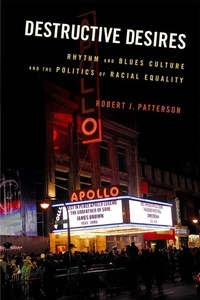
Destructive Desires
Rhythm and Blues Culture and the Politics of Racial Equality
Published on 5. April 2019
Book
Hardback
264 pages
978-1-9788-0359-6 (ISBN)
Description
Despite rhythm and blues culture's undeniable role in molding, reflecting, and reshaping black cultural production, consciousness, and politics, it has yet to receive the serious scholarly examination it deserves. Destructive Desires corrects this omission by analyzing how post-Civil Rights era rhythm and blues culture articulates competing and conflicting political, social, familial, and economic desires within and for African American communities. As an important form of black cultural production, rhythm and blues music helps us to understand black political and cultural desires and longings in light of neo-liberalism's increased codification in America's racial politics and policies since the 1970s. Robert J. Patterson provides a thorough analysis of four artists-Kenneth "Babyface" Edmonds, Adina Howard, Whitney Houston, and Toni Braxton-to examine black cultural longings by demonstrating how our reading of specific moments in their lives, careers, and performances serve as metacommentaries for broader issues in black culture and politics.
Reviews / Votes
"This incisive, engaging analysis of post-Civil Rights era rhythm and blues culture models the best kind of cultural studies scholarship: resisting the tendencies to view popular culture as a passive reflection of conservative ideologies or to inflate its oppositional effects, Patterson's both/and approach reveals the rich and often contradictory ways in which RB culture navigates the pressures of neoliberal gender and sexual politics." - Madhu Dubey (author of Signs and Cities: Black Literary Postmodernism) "Contextualizing the music and careers of four seminal late twentieth-century RB artists, Babyface, Toni Braxton, Adina Howard, and Whitney Houston, Robert J. Patterson's exhilarating book grapples with the 'destructive desires' that compelled these artists' negotiations of restrictive norms of black American gendered, class, and sexual performance. A work of tremendous intellectual 'whip appeal,' a 'front and center,' 'special brew' of engaged and illuminating interdisciplinary scholarship, Destructive Desires: Rhythm and Blues Culture and the Politics of Racial Equality arrives 'just in time,' and will doubtlessly be savored." - Michael Awkward (Gayl Jones Professor of Afro-American Literature and Culture, University of Michigan) "New Book Examines Relationship Between RB Culture, Black Aspirations"https://www.georgetown.edu/news/robert-patterson-book-on-tie-between-randb-culture-and-black-aspirations
(Georgetown.edu) "Highly recommended." (Choice) "Patterson studies lyrics from various African American rhythm and blues musicians. Through the lyrics, the author examines the big picture behind the words, analyzing hidden meanings and possible political stances throughout the verses and rhythm. Patterson provides an in-depth analysis of four musicians-Kenneth "Babyface" Edmonds, Adina Howard, Whitney Houston, and Toni Braxton-to analyze Black culture and the political climate through the lyrics and melodies of each of the songs discussed throughout the text." (Communication Booknotes Quarterly)
More details
Language
English
Place of publication
New Brunswick NJ
United States
Target group
College/higher education
Professional and scholarly
Product notice
Laminated cover
Illustrations
25
Dimensions
Height: 229 mm
Width: 152 mm
Thickness: 23 mm
Weight
513 gr
ISBN-13
978-1-9788-0359-6 (9781978803596)
Copyright in bibliographic data and cover images is held by Nielsen Book Services Limited or by the publishers or by their respective licensors: all rights reserved.
Schweitzer Classification
Other editions
Additional editions
E-Book
04/2019
1st Edition
Rutgers University Press
€96.99
Available for download
Person
ROBERT J. PATTERSON is a professor of African American Studies and served as the inaugural chair of the Department of African American Studies at Georgetown University in Washington, D.C. He is the editor of Black Cultural Production After Civil Rights, a coeditor of The Psychic Hold of Slavery: Legacies in American Expressive Culture (Rutgers University Press), and author of Exodus Politics: Civil Rights and Leadership in African American Literature and Culture.
Content
Preface
Introduction
1. Reading Race, Gender, and Sex: Black Intimate Relations, Black Inequality,
and the Rhythm and the Blues Imagination
2. "Whip Appeal:" Reading Kenneth "Babyface" Edmonds
3. "Freak Like Me:" Reading Adina Howard
4."Didn't We Almost Have It All:" Reading Whitney Houston
Epilogue
Appendix A
Appendix B
Appendix C
Acknowledgements
Bibliography
Introduction
1. Reading Race, Gender, and Sex: Black Intimate Relations, Black Inequality,
and the Rhythm and the Blues Imagination
2. "Whip Appeal:" Reading Kenneth "Babyface" Edmonds
3. "Freak Like Me:" Reading Adina Howard
4."Didn't We Almost Have It All:" Reading Whitney Houston
Epilogue
Appendix A
Appendix B
Appendix C
Acknowledgements
Bibliography