

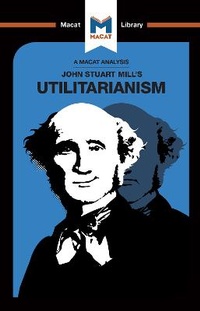
An Analysis of John Stuart Mills's Utilitarianism
1st Edition
Published on 25. July 2017
Book
Hardback
96 pages
978-1-912303-39-7 (ISBN)
Description
John Stuart Mill's 1861 Utilitarianism remains one of the most widely known and influential works of moral philosophy ever written. It is also a model of critical thinking - one in which Mill's reasoning and interpretation skills are used to create a well-structured, watertight, persuasive argument for his position on core questions in ethics.
The central question, for Mill, was to decide upon a valid definition of right and wrong, and reason out his moral theory from there. Laying down valid, defensible definitions is a crucial aspect of good interpretative thinking, and Mill gets his in as early as possible. Actions are good, he suggests, if they increase happiness, and bad if they reduce happiness.
But, vitally, it is not our own happiness that matters, but the total happiness of all those affected by a given action. From this interpretation of moral good, Mill is able to systematically reason out a coherent framework for calculating and judging overall happiness, while considering different kinds and qualities of happiness.
Like any good example of reasoning, Mill's argument consistently takes account of possible objections, building them into the structure of the book in order to acknowledge and counter them as he goes.
The central question, for Mill, was to decide upon a valid definition of right and wrong, and reason out his moral theory from there. Laying down valid, defensible definitions is a crucial aspect of good interpretative thinking, and Mill gets his in as early as possible. Actions are good, he suggests, if they increase happiness, and bad if they reduce happiness.
But, vitally, it is not our own happiness that matters, but the total happiness of all those affected by a given action. From this interpretation of moral good, Mill is able to systematically reason out a coherent framework for calculating and judging overall happiness, while considering different kinds and qualities of happiness.
Like any good example of reasoning, Mill's argument consistently takes account of possible objections, building them into the structure of the book in order to acknowledge and counter them as he goes.
More details
Series
Language
English
Place of publication
London
United Kingdom
Dimensions
Height: 198 mm
Width: 129 mm
Weight
330 gr
ISBN-13
978-1-912303-39-7 (9781912303397)
Copyright in bibliographic data and cover images is held by Nielsen Book Services Limited or by the publishers or by their respective licensors: all rights reserved.
Schweitzer Classification
Other editions
Additional editions
Tom Patrick | Sander Werkhoven
An Analysis of John Stuart Mills's Utilitarianism
Book
07/2017
1st Edition
Macat International Limited
€12.40
Shipment within 3-4 weeks
Tom Patrick | Sander Werkhoven
An Analysis of John Stuart Mills's Utilitarianism
E-Book
07/2017
Routledge
€8.99
Available for download
Tom Patrick | Sander Werkhoven
An Analysis of John Stuart Mills's Utilitarianism
E-Book
07/2017
Routledge
€8.99
Available for download
Persons
Dr Patrick Tom holds masters degrees from Notre Dame, Leeds and the University of Zimbabwe, and a PhD in politics and international relations from the University of St Andrews. He currently works for the Zimbabwe Policy Dialogue Institute.
Dr Sander Werkhoven holds a PhD in philosophy from the University of Warwick. He is currently a member of the Department of Philosophy and Religious Studies at the University of Utrecht, where he specialises in ethics and the philosophy of medicine.
Dr Sander Werkhoven holds a PhD in philosophy from the University of Warwick. He is currently a member of the Department of Philosophy and Religious Studies at the University of Utrecht, where he specialises in ethics and the philosophy of medicine.
Content
Ways in to the Text Who was John Stuart Mills? What does Utilitarianism Say? Why does Utilitarianism Matter? Section 1: Influences Module 1: The Author and the Historical Context Module 2: Academic Context Module 3: The Problem Module 4: The Author's Contribution Section 2: Ideas Module 5: Main Ideas Module 6: Secondary Ideas Module 7: Achievement Module 8: Place in the Author's Work Section 3: Impact Module 9: The First Responses Module 10: The Evolving Debate Module 11: Impact and Influence Today Module 12: Where Next? Glossary of Terms People Mentioned in the Text Works Cited