

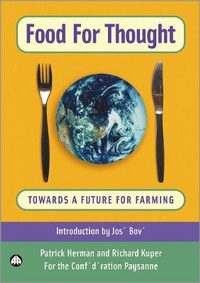
Food for Thought
Towards a Future For Farming
Will be published approx. on 20. December 2003
Book
Paperback/Softback
176 pages
978-0-7453-2077-9 (ISBN)
Description
The French radical farmers union Confederation Paysanne, with its charismatic leader Jose Bove, has led the world in demonstrating the possibility of a socially progressive future for farming. Rejecting the increasing intensification and industrialisation of agriculture, the Confederation has argued for the need for local food production by small, independent farmers - both for the sake of the quality of the food we consume and to support the kind of societies we want to live in.
Food for Thought demonstrates how the European Union's Common Agricultural Policy and now the WTO's Agreement on Agriculture are both designed to encourage an increasingly free-market, profit-maximising, destructive agriculture. The majority of farmers have lost out and continue to lose. Agribusiness thrives at their expense. The consequences are dire in terms of social and environmental costs in the industrialised world, and devastating for developing countries, whose ability to feed themselves is being destroyed along with a massive proportion of their small farmers.
There are alternatives: to outlaw dumping of food on world markets effectively, to control the amounts of food produced, to share its production fairly among regions and countries, to encourage rather than to outlaw the use of import controls. There are farmers and other radical organisations struggling in support of these aims world wide. They are at the forefront of the struggle against free market globalisation. They hold out the possibility of a radical, human-centred way of producing our food and organising our society.
Food for Thought demonstrates how the European Union's Common Agricultural Policy and now the WTO's Agreement on Agriculture are both designed to encourage an increasingly free-market, profit-maximising, destructive agriculture. The majority of farmers have lost out and continue to lose. Agribusiness thrives at their expense. The consequences are dire in terms of social and environmental costs in the industrialised world, and devastating for developing countries, whose ability to feed themselves is being destroyed along with a massive proportion of their small farmers.
There are alternatives: to outlaw dumping of food on world markets effectively, to control the amounts of food produced, to share its production fairly among regions and countries, to encourage rather than to outlaw the use of import controls. There are farmers and other radical organisations struggling in support of these aims world wide. They are at the forefront of the struggle against free market globalisation. They hold out the possibility of a radical, human-centred way of producing our food and organising our society.
Reviews / Votes
'Provides an exciting alternative to both globalisation and localisation, together with an informative survey of the niceties of Cap, the WTO and farming politics' -- Red PepperMore details
Language
English
Place of publication
London
United Kingdom
Target group
College/higher education
Professional and scholarly
Product notice
Paperback (UK-trade)
Dimensions
Height: 177 mm
Width: 125 mm
ISBN-13
978-0-7453-2077-9 (9780745320779)
Copyright in bibliographic data and cover images is held by Nielsen Book Services Limited or by the publishers or by their respective licensors: all rights reserved.
Schweitzer Classification
Persons
Patrick Herman is a long-time member of the Confederation Paysanne and a full-time farmer. He is a trade-union activist in the department of the Aveyron and co-author of Food for Thought (Pluto, 2003).
Richard Kuper has been a publisher, university lecturer and trade-union and political activist. He was a founder member of Jews for Justice for Palestinians and its chair for many years. He is the co-author of Food for Thought (Pluto, 2003).
The Confederation Paysanne is a French agricultural union. It It is a member of the European Farmers' Coordination and Via Campesina.
Richard Kuper has been a publisher, university lecturer and trade-union and political activist. He was a founder member of Jews for Justice for Palestinians and its chair for many years. He is the co-author of Food for Thought (Pluto, 2003).
The Confederation Paysanne is a French agricultural union. It It is a member of the European Farmers' Coordination and Via Campesina.
Content
List of boxes
List of abbreviations
Translator's note
Foreword by Jose Bove
Introduction
1. The industrialisation of farming
1962: the birth of productivism
Exporting and free trade
From stockpiling to commercial war
The logic of free trade
Europe's export vocation
2. Reforming the CAP
1992: the topsy-turvy CAP
The Marrakech shambles
1999: From Berlin to Seattle
Headlong to disaster!
3. French agricultural trade unionism: the long march of the Confederation Paysanne
The FNSEA (the National Federation of Farmers' Unions)
The rumblings of opposition
The birth of the Confederation
4. Major principles for changing international policies
An overview of the 'givens'
Reaffirm food sovereignty
Make dumping illegal
5. Fateful choice for the CAP
A false opposition
Towards a reform of the CAP in 2003
A real revolution
6. Towards a solidaristic citizens' and farmers' CAP
End the supposed export vocation of the EU
Supply management
A policy founded on equitable prices
A de-intensified agriculture
A genuine policy of rural development
Giving answers to farmers while awaiting
CAP reform
7. Conclusion
Appendix 1: l'Agriculture paysanne: a charter for small farming
Appendix 2: Campaign for an immediate change in the direction of the Common Agricultural Policy (CAP)
Appendix 3: Resources
Appendix 4: The 2003 reform of the CAP
Notes
Index
List of abbreviations
Translator's note
Foreword by Jose Bove
Introduction
1. The industrialisation of farming
1962: the birth of productivism
Exporting and free trade
From stockpiling to commercial war
The logic of free trade
Europe's export vocation
2. Reforming the CAP
1992: the topsy-turvy CAP
The Marrakech shambles
1999: From Berlin to Seattle
Headlong to disaster!
3. French agricultural trade unionism: the long march of the Confederation Paysanne
The FNSEA (the National Federation of Farmers' Unions)
The rumblings of opposition
The birth of the Confederation
4. Major principles for changing international policies
An overview of the 'givens'
Reaffirm food sovereignty
Make dumping illegal
5. Fateful choice for the CAP
A false opposition
Towards a reform of the CAP in 2003
A real revolution
6. Towards a solidaristic citizens' and farmers' CAP
End the supposed export vocation of the EU
Supply management
A policy founded on equitable prices
A de-intensified agriculture
A genuine policy of rural development
Giving answers to farmers while awaiting
CAP reform
7. Conclusion
Appendix 1: l'Agriculture paysanne: a charter for small farming
Appendix 2: Campaign for an immediate change in the direction of the Common Agricultural Policy (CAP)
Appendix 3: Resources
Appendix 4: The 2003 reform of the CAP
Notes
Index