

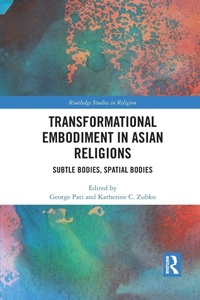
Transformational Embodiment in Asian Religions
Subtle Bodies, Spatial Bodies
1st Edition
Published on 30. June 2021
Book
Paperback/Softback
268 pages
978-1-032-08707-8 (ISBN)
Description
This volume examines several theoretical concerns of embodiment in the context of Asian religious practice. Looking at both subtle and spatial bodies, it explores how both types of embodiment are engaged as sites for transformation, transaction and transgression.
Collectively bridging ancient and modern conceptualizations of embodiment in religious practice, the book offers a complex mapping of how body is defined. It revisits more traditional, mystical religious systems, including Hindu Tantra and Yoga, Tibetan Buddhism, Bon, Chinese Daoism and Persian Sufism and distinctively juxtaposes these inquiries alongside analyses of racial, gendered, and colonized bodies. Such a multifaceted subject requires a diverse approach, and so perspectives from phenomenology and neuroscience as well as critical race theory and feminist theology are utilised to create more precise analytical tools for the scholarly engagement of embodied religious epistemologies.
This a nuanced and interdisciplinary exploration of the myriad issues around bodies within religion. As such it will be a key resource for any scholar of Religious Studies, Asian Studies, Anthropology, Sociology, Philosophy, and Gender Studies.
Collectively bridging ancient and modern conceptualizations of embodiment in religious practice, the book offers a complex mapping of how body is defined. It revisits more traditional, mystical religious systems, including Hindu Tantra and Yoga, Tibetan Buddhism, Bon, Chinese Daoism and Persian Sufism and distinctively juxtaposes these inquiries alongside analyses of racial, gendered, and colonized bodies. Such a multifaceted subject requires a diverse approach, and so perspectives from phenomenology and neuroscience as well as critical race theory and feminist theology are utilised to create more precise analytical tools for the scholarly engagement of embodied religious epistemologies.
This a nuanced and interdisciplinary exploration of the myriad issues around bodies within religion. As such it will be a key resource for any scholar of Religious Studies, Asian Studies, Anthropology, Sociology, Philosophy, and Gender Studies.
More details
Series
Language
English
Place of publication
London
United Kingdom
Publishing group
Taylor & Francis Ltd
Target group
College/higher education
Professional and scholarly
Postgraduate, Professional, and Undergraduate
Product notice
Paperback (trade)
Unsewn / adhesive bound
Dimensions
Height: 234 mm
Width: 156 mm
Thickness: 14 mm
Weight
381 gr
ISBN-13
978-1-032-08707-8 (9781032087078)
Copyright in bibliographic data and cover images is held by Nielsen Book Services Limited or by the publishers or by their respective licensors: all rights reserved.
Schweitzer Classification
Other editions
Additional editions
George Pati | Katherine C. Zubko
Transformational Embodiment in Asian Religions
Subtle Bodies, Spatial Bodies
Book
10/2019
1st Edition
Routledge
€217.50
Shipment within 15-20 days
George Pati | Katherine C. Zubko
Transformational Embodiment in Asian Religions
Subtle Bodies, Spatial Bodies
E-Book
10/2019
1st Edition
Routledge
€60.49
Available for download
George Pati | Katherine C. Zubko
Transformational Embodiment in Asian Religions
Subtle Bodies, Spatial Bodies
E-Book
10/2019
1st Edition
Routledge
€60.49
Available for download
Persons
George Pati is Associate Professor of Theology and International Studies and the Surjit S. Patheja Chair in World Religions and Ethics at Valparaiso University, USA. His research interests include religious literature in the Malayalam language, South Asian devotional traditions, the mediation of Hindu devotion through texts, rituals, and performances of Kerala, South India, and the body and religion. He is the author of Religious Devotion and the Poetics of Reform: Love and Liberation in Malayalam Poetry (2019).
Katherine C. Zubko is Associate Professor of Religious Studies and NEH Distinguished Professor of the Humanities at University of North Carolina, Asheville, USA. Her research interests include aesthetics, ritual, performance, dance anthropology, and embodied religion in South Asia. She is the author of Dancing Bodies of Devotion: Fluid Gestures in Bharata Natyam (2014).
Katherine C. Zubko is Associate Professor of Religious Studies and NEH Distinguished Professor of the Humanities at University of North Carolina, Asheville, USA. Her research interests include aesthetics, ritual, performance, dance anthropology, and embodied religion in South Asia. She is the author of Dancing Bodies of Devotion: Fluid Gestures in Bharata Natyam (2014).
Content
List of Figures; Notes on Transliteration; Notes on Contributors; Acknowledgements; Introduction-Katherine C. Zubko and George Pati; 1 The Subtle Body of Vital Presence in Contemplative Practices of Abhinavagupta's Trika Saivism and Longchenpa's Great Perfection-Kerry Martin Skora; 2 Daoist Body-Maps and Meditative Praxis -Louis Komjathy; 3 Yuasa Yasuo's Contextualization of the Subtle Body: Phenomenology and Practice- Edward Geoffrey; 4 Dismembering Demons: Spatial and Bodily Representations in the Fifteenth-Century Ekali?gamahatmya- Adam Newman; 5 Subtle Body: Rethinking the Body's Subjectivity through Abhinavagupta Body-Loriliai Biernacki; 6 Reprogramming Embodied Experiences in the Maharthamanjari of Mahesvarananda- Sthaneshwar Timalsina; 7 Sensing the Ascent: Embodied Elements of Muhammad's Heavenly Journey in Nizami Ganjavi's Treasury of Mysteries-Matthew Hotham; 8 Bodies in Translation: Esoteric Conceptions of the Muslim Body in Early-modern South Asia -Patrick J. D'Silva; 9 The Prostituted Body of War: U.S. Military Prostitution in South Korea as a Site of Spiritual Activism- Keun-Joo Christine Pae; 10 Frisky Methods: Subtle Bodies, Epistemological Pluralism and Creative Scholarship- Jay Johnston; 11 Autophagous Bliss: The Obliteration of Spatiality in the Bodily Philosophies of Georges Bataille and the Taittiriya Upanishad.-Matthew Robertson