

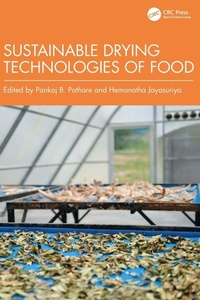
Sustainable drying technologies? of food
1st Edition
Will be published approx. on 19. December 2025
Book
Hardback
356 pages
978-1-032-37834-3 (ISBN)
Description
This book is an updated reference about the fundamentals, applications, and modeling of sustainable energy-based drying systems in the food industry. It includes the economic assessment, quality control and safety parameters of the drying techniques. Drying is one of the most important food preservation techniques. Sustainable drying uses little or no fossil fuel input and low-cost technologies. This book reviews the alternative sources of energy for drying fresh produce. It includes relevant case studies from some developing countries. The book is meant for researchers and industry experts in food processing, food engineering and agriculture.
Key feature
Covers the drying technology on a vast array of food types like fruits, vegetables, fish, and meat produce.
Highlights the alternative energy sources for drying fresh produce.
Discusses modelling and simulation approaches.
Reviews energy and exergy assessment of sustainable drying.
Key feature
Covers the drying technology on a vast array of food types like fruits, vegetables, fish, and meat produce.
Highlights the alternative energy sources for drying fresh produce.
Discusses modelling and simulation approaches.
Reviews energy and exergy assessment of sustainable drying.
More details
Language
English
Place of publication
London
United Kingdom
Publishing group
Taylor & Francis Ltd
Target group
College/higher education
Professional and scholarly
Academic, Postgraduate, and Professional
Illustrations
23 s/w Zeichnungen, 58 farbige Zeichnungen, 21 s/w Tabellen, 1 Farbfoto bzw. farbiges Rasterbild, 23 s/w Abbildungen, 59 farbige Abbildungen
21 Tables, black and white; 58 Line drawings, color; 23 Line drawings, black and white; 1 Halftones, color; 59 Illustrations, color; 23 Illustrations, black and white
Dimensions
Height: 260 mm
Width: 183 mm
Thickness: 19 mm
Weight
687 gr
ISBN-13
978-1-032-37834-3 (9781032378343)
Copyright in bibliographic data and cover images is held by Nielsen Book Services Limited or by the publishers or by their respective licensors: all rights reserved.
Schweitzer Classification
Other editions
Additional editions
Pankaj B. Pathare | Hemantha Jayasuriya
Sustainable drying technologies? of food
E-Book
12/2025
1st Edition
CRC Press
€73.99
Available for download
Pankaj B. Pathare | Hemantha Jayasuriya
Sustainable drying technologies? of food
E-Book
12/2025
1st Edition
CRC Press
€73.99
Available for download
Persons
Pankaj Pathare is an Associate Professor of Postharvest Technology at Sultan Qaboos University. He has graduated with a B. Tech. degree (Agricultural Engineering) from India and PhD (Process & Chemical Engineering) from the University College Cork (Ireland). Before joining SQU, he worked as a researcher at Newcastle University, UK, and Stellenbosch University, South Africa. His work focuses on postharvest loss quantification, computer vision applications, and renewable energy in food processing. Dr. Pathare addresses critical food industry challenges, including minimizing mechanical damage, enhancing product quality, and improving energy efficiency. An internationally recognized expert, he has published over 100 peer-reviewed articles and numerous keynote conference presentations. He has also edited three books. He received the Distinguished Researcher Award from SQU in 2025, and his team earned the National Research Award (Oman) in 2024. Dr. Pathare serves on the editorial boards of several leading SCI journals, demonstrating his commitment to advancing knowledge in food engineering and postharvest technology. His expertise has been acknowledged by Stanford University, which recognized him as a World Top 2% Scientist from 2022 to 2024.
Hemantha Jayasuriya is a Faculty Member at the Department of Soils, Water and Agricultural Engineering, College of Agricultural and Marine Sciences, Sultan Qaboos University, Oman. He obtained B.Sc. Eng. (Hons) in Mechanical Engineering from the University of Peradeniya, Sri Lanka in 1983. His M.Eng. and Ph.D. in Agricultural Engineering were from the Asian Institute of Technology (AIT) Thailand. He is a chartered mechanical engineer by profession with over 7 years of industrial experience and over 30 years of academic experience in teaching, research, and administrative activities during his career. He has supervised and completed nearly 40 postgraduate students including several Ph.D. students and published over 100 scientific publications in peer-reviewed journals, and international conference proceedings. He has also published edited books, technical reports, and book chapters and possesses patents. He has membership credentials with international professional bodies such as ASABE, ISPA, ISTVS, and AAAE and is currently the Vice president of AAAE for Energy, Environment, and Emerging Technologies.
Hemantha Jayasuriya is a Faculty Member at the Department of Soils, Water and Agricultural Engineering, College of Agricultural and Marine Sciences, Sultan Qaboos University, Oman. He obtained B.Sc. Eng. (Hons) in Mechanical Engineering from the University of Peradeniya, Sri Lanka in 1983. His M.Eng. and Ph.D. in Agricultural Engineering were from the Asian Institute of Technology (AIT) Thailand. He is a chartered mechanical engineer by profession with over 7 years of industrial experience and over 30 years of academic experience in teaching, research, and administrative activities during his career. He has supervised and completed nearly 40 postgraduate students including several Ph.D. students and published over 100 scientific publications in peer-reviewed journals, and international conference proceedings. He has also published edited books, technical reports, and book chapters and possesses patents. He has membership credentials with international professional bodies such as ASABE, ISPA, ISTVS, and AAAE and is currently the Vice president of AAAE for Energy, Environment, and Emerging Technologies.
Content
1. Recent Advances in Sustainable Food Drying Technologies. 2. Sustainable drying technology for fresh foods. 3. Biomass energy applications for drying fresh produce. 4. Waste heat based drying systems. 5. Geothermal energy for drying fresh produce. 6. Energy storage based hybrid solar drying systems. 7. Refractive window drying for food materials. 8. Sustainable Drying Technology of Marine Products. 9. Solar drying technology for meat products - A case study. 10. Energy and exergy analyses of various solar energy applications. 11. Numerical simulations of sustinable drying systems. 12. Computational modelling and validations for Sustainable drying processes.