

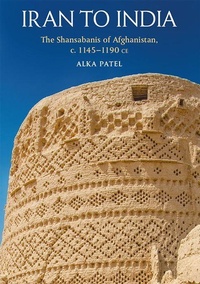
Iran to India
The Shansabanis of Afghanistan, c. 1145-1190 CE
Published on 1. November 2021
Book
Hardback
424 pages
978-1-4744-8222-6 (ISBN)
Description
Alka Patel brings together all the architectural patronage attributed to the Shansabanis in Afghanistan and Pakistan (Swat and lower Indus region). In doing so, she creates an architectural biography of this pivotal polity and its trans-regional empire. By treating built remains as independent, primary sources, and juxtaposing them with the principal texts, Patel creates a complex understanding of the historical processes the Shansabanis initiated throughout the landscapes they re-conjoined. Overall, this book provides the first analysis of this important epigraphic corpus. It will serve as the starting point for future research on the medieval epigraphy of Afghanistan and Pakistan.
Reviews / Votes
Professor Patel provides an exciting, thought-provoking critical analysis of the origins of the first Muslim dynasty to successfully establish itself as a political power in late-12th century north India. -- Catherine B. Asher, Professor of Islamic Art, University of MinnesotaMore details
Language
English
Place of publication
Edinburgh
United Kingdom
Target group
Professional and scholarly
Illustrations
184 colour illustrations
Dimensions
Height: 177 mm
Width: 254 mm
Thickness: 30 mm
Weight
1198 gr
ISBN-13
978-1-4744-8222-6 (9781474482226)
Copyright in bibliographic data and cover images is held by Nielsen Book Services Limited or by the publishers or by their respective licensors: all rights reserved.
Schweitzer Classification
Other editions
Additional editions
E-Book
11/2021
1st Edition
Edinburgh University Press
€125.99
Available for download
E-Book
11/2021
1st Edition
Edinburgh University Press
€125.99
Available for download
Person
Alka Patel is Professor in the Department of Art History and in the PhD Program for Visual Studies at the University of California, Irvine. Patel's research has focused on South Asia and its connections with Iran and Central Asia, including overland and Indian Ocean maritime networks. Her works include Building Communities in Gujarat: Architecture and Society during the Twelfth-Fourteenth Centuries (Brill 2004), and special issues of Ars Orientalis XXXIV (2004) and Archives of Asian Art LIX (2007). Patel's interests have expanded to include mercantile networks and architectural patronage in 18th-19th-century South Asia, as evidenced in Indo-Muslim Cultures in Transition (co-ed. K. Leonard, Brill 2012). Her recent volume India and Iran in the Longue Duree (Jordan Center for Persian Studies, 2017), co-edited with ancient Iranist Touraj Daryaee, analyzes Indo-Iranian connections over two millennia.
Content
Acknowledgements
Notes on Transliteration
Introduction: The Elephant and Its Parts
Kingly Trajectories
Beginnings
The Early Shansabanis: Firuzkuh, Bamiyan, and Tiginabad/Old Qandahar (c.1140s-1170s)
One and Several: Gharjistan, Chisht, and Imperial Firuzkuh
The "Ports of India": Ghazna and Bust-Lashkari Bazar
Encountering the Many "Indias"
Epilogue: Iran to India
Appendix: Shansabani Religious and Historical Inscriptions in Afghanistan and Pakistan
Works Cited and Bibliography
Index
Notes on Transliteration
Introduction: The Elephant and Its Parts
Kingly Trajectories
Beginnings
The Early Shansabanis: Firuzkuh, Bamiyan, and Tiginabad/Old Qandahar (c.1140s-1170s)
One and Several: Gharjistan, Chisht, and Imperial Firuzkuh
The "Ports of India": Ghazna and Bust-Lashkari Bazar
Encountering the Many "Indias"
Epilogue: Iran to India
Appendix: Shansabani Religious and Historical Inscriptions in Afghanistan and Pakistan
Works Cited and Bibliography
Index