

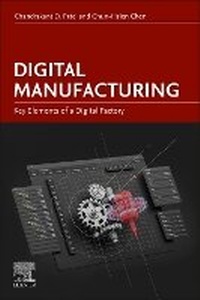
Digital Manufacturing
Key Elements of a Digital Factory
Published on 1. December 2023
Book
Paperback/Softback
506 pages
978-0-443-13812-6 (ISBN)
Description
Digital Manufacturing: Key Elements of a Digital Factory explains the different devices and agents at the factory floor level that are driving the digital manufacturing revolution, including autonomous robots, process automation, artificial intelligence and cyber-physical systems. Individual chapters explore the fundamentals and benefits of major digital manufacturing tools including robotics, the industrial internet of things, digital twins, edge security, knowledge discovery, service-centric production, and related supply-chain strategies. Real-world case studies from industry are provided throughout to show how these work in practice.
In addition to learning about individual technologies, readers will discover how they are integrating to drive the digital transformation of manufacturing ecosystem. Final sections present new business models working towards sustainable net zero operations and economy.
In addition to learning about individual technologies, readers will discover how they are integrating to drive the digital transformation of manufacturing ecosystem. Final sections present new business models working towards sustainable net zero operations and economy.
More details
Language
English
Place of publication
Philadelphia
United States
Target group
Professional and scholarly
Dimensions
Height: 229 mm
Width: 152 mm
Weight
930 gr
ISBN-13
978-0-443-13812-6 (9780443138126)
Copyright in bibliographic data and cover images is held by Nielsen Book Services Limited or by the publishers or by their respective licensors: all rights reserved.
Schweitzer Classification
Other editions
Additional editions
E-Book
12/2023
Elsevier
€265.00
Available for download
Persons
Chandrakant D. Patel is a Chief Engineer and Senior Fellow at HP Inc., United States. He is a pioneer in thermal and energy management in data centers and in applications of the information technology to drive available energy management at city scales. He currently leads the HP Global Technical Community, and he also leads the strategic selection of technologies in light of the social, economic, and ecological megatrends that are shaping our future. His current technical interests are focused on leveraging his multidisciplinary past work to develop the 21st century cyber physical systems such as HP's 3D Print Engines. Chun-Hsien Chen is a Full Professor at the School of Mechanical and Aerospace Engineering of Nanyang Technological University, Singapore, where he is also Director of the Design Stream and Professor-in-Charge of the Design & Human Factors Laboratory. He has several years of product design and development experience in industry. His teaching and research interests are in collaborative/human-centric, consumer-oriented product design and development, knowledge engineering, design sciences, engineering informatics, and artificial intelligence in product/engineering design. He has more than 280 publications in these areas.
Content
1. Building a 3D Digital Factory
2. Robotics in Intelligent Manufacturing
3. Robot Surface Interaction for Industrial Tooling Tasks
4. Artificial Intelligence of Things for Industrial Vision Applications
5. Edge Intelligence: From Deep Learning's Perspective
6. Digital Twin-based Decision Support System for Planning and Scheduling
7. Resource Allocation for Distributed Production Networks
8. Engineering Knowledge Management and Industrial Knowledge Graph
9. Service-oriented digital manufacturing
10. Business models and supply chain strategy for digital manufacturing
11. Security for Digital Manufacturing
12. Accelerating Digital Transformation in Manufacturing Ecosystem
2. Robotics in Intelligent Manufacturing
3. Robot Surface Interaction for Industrial Tooling Tasks
4. Artificial Intelligence of Things for Industrial Vision Applications
5. Edge Intelligence: From Deep Learning's Perspective
6. Digital Twin-based Decision Support System for Planning and Scheduling
7. Resource Allocation for Distributed Production Networks
8. Engineering Knowledge Management and Industrial Knowledge Graph
9. Service-oriented digital manufacturing
10. Business models and supply chain strategy for digital manufacturing
11. Security for Digital Manufacturing
12. Accelerating Digital Transformation in Manufacturing Ecosystem