

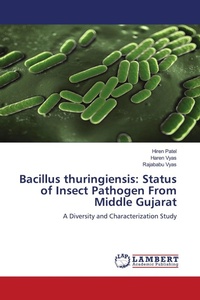
Bacillus thuringiensis
Status of Insect Pathogen From Middle Gujarat
Published on 11. October 2013
Book
Paperback/Softback
164 pages
978-3-659-43757-1 (ISBN)
Description
Bacillus thuringiensis comprise of gram-positive, big rod shaped, spore-forming bacterium. They have unusual property of producing a parasporal protein crystal known as ¿-endotoxin or Cry protein,which is found toxic for many serious insect pests. Efforts have been made in many countries to isolate new strains with increased potency against target pest insects having a wider host range. These toxins have not only shown activity against insect member of order Lepidoptera, Diptera, Hymenoptera, Isoptera, Orthoptera and Coleoptera but also against nematodes, mites, lice, aphids and ants. Till date, many ¿-endotoxin proteins were found effective against specific insects and surprisingly single strain of Bacillus thuringiensis found to produce one or more type of Cry proteins. An understanding of newly isolated Bacillus thuringiensis, their efficacy, mechanisms and presence of specific genes in them is essential for the future rational use of this Bacterial Insect Pathogen. The inimitable blend of benefits may help the farmers with the weapons they need to fight pests, maintaining crop yields and improving the health of the world¿s growing population.
More details
Language
English
Product notice
Paperback (trade)
Unsewn / adhesive bound
Dimensions
Height: 220 mm
Width: 150 mm
Thickness: 11 mm
Weight
262 gr
ISBN-13
978-3-659-43757-1 (9783659437571)
Copyright in bibliographic data and cover images is held by Nielsen Book Services Limited or by the publishers or by their respective licensors: all rights reserved.
Schweitzer Classification
Persons
I Dr Hiren Patel earned BSc (Microbiology) from M G Science Institute, Ahmedabad, MSc (Agricultural Microbiology, 2007) and PhD (Agricultural Microbiology, 2012) from Anand Agricultural University, Anand. My working area is Agriculturally Important Microorganisms with major emphasize on Microbial Pesticides and Plant Growth Promoting Rhizobacteria.