

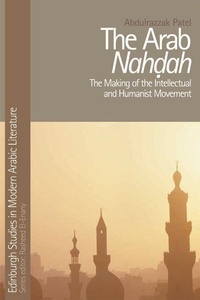
The Arab Nahdah
The Making of the Intellectual and Humanist Movement
Published on 18. June 2013
Book
Hardback
272 pages
978-0-7486-4069-0 (ISBN)
Description
To understand today's Arab thinking, you need to go back to the beginnings of modernity: the nahdah or Arab renaissance of the 19th and early 20th centuries. Abdulrazzak Patel enhances our understanding of the nahdah and its intellectuals, looking back to its origins in the 1700s and taking into account important internal factors alongside external forces. He explores the key factors that contributed to the rise and development of the nahdah, he introduces the humanist movement of the period that was the driving force behind much of the linguistic, literary and educational activity. Drawing on intellectual history, literary history and postcolonial studies, he argues that the nahdah was the product of native development and foreign assistance and that nahdah reformist thought was hybrid in nature. Overall, this study highlights the complexity of the movement and offers a more pluralist history of the period.
More details
Series
Language
English
Place of publication
Edinburgh
United Kingdom
Target group
College/higher education
Product notice
sewn/stitched
Cloth over boards
Dimensions
Height: 241 mm
Width: 159 mm
Thickness: 22 mm
Weight
547 gr
ISBN-13
978-0-7486-4069-0 (9780748640690)
Copyright in bibliographic data and cover images is held by Nielsen Book Services Limited or by the publishers or by their respective licensors: all rights reserved.
Schweitzer Classification
Other editions
Additional editions
E-Book
06/2013
Edinburgh University Press
€0.00
Available for download
E-Book
06/2013
Edinburgh University Press
€92.49
Available for download
Person
Dr Patel graduated from the University of Exeter with a PhD in Arabic and Islamic studies in 2007. He then worked as a Teaching Fellow at Exeter before moving to the University of Oxford in 2008 where he has been pursuing a program of research from his doctoral work and been working on a major new project on the rise and development of the Arab nah?ah. He has already published several articles on the subject in the top journals of his field.
Content
Preface
Introduction: Perspectives, Paradigms and Parameters
Contemporary Interpretations of the nah?ah: Tradition, Modernity and the Arab Intellectual
The Reintegration of Pre-modern Christians into the Mainstream of Arabic Literature and the Creation of an Inter-religious Cultural Space
Guardians of the Pre-modern Arab-Islamic Humanist Tradition: Legends without a Legacy, a tradition without heirs
Language Reform and Controversy: the al-Shartunis Respond in Defence of the Pre-modern Humanist Tradition
Arabism, Patriotism and Ottomanism as means to Reform
Arab intellectuals and the West: Borrowing for the Sake of Progress
Education, Reform and Enlightened Azharis
Enacting reform: Local Agents, Statesmen, Missionaries and the Evolution of a Cultural Infrastructure
Conclusion
Bibliography
Index
Introduction: Perspectives, Paradigms and Parameters
Contemporary Interpretations of the nah?ah: Tradition, Modernity and the Arab Intellectual
The Reintegration of Pre-modern Christians into the Mainstream of Arabic Literature and the Creation of an Inter-religious Cultural Space
Guardians of the Pre-modern Arab-Islamic Humanist Tradition: Legends without a Legacy, a tradition without heirs
Language Reform and Controversy: the al-Shartunis Respond in Defence of the Pre-modern Humanist Tradition
Arabism, Patriotism and Ottomanism as means to Reform
Arab intellectuals and the West: Borrowing for the Sake of Progress
Education, Reform and Enlightened Azharis
Enacting reform: Local Agents, Statesmen, Missionaries and the Evolution of a Cultural Infrastructure
Conclusion
Bibliography
Index