

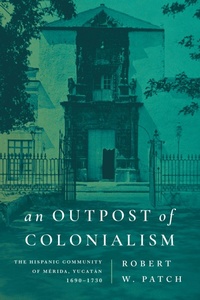
An Outpost of Colonialism
The Hispanic Community of Merida, Yucatan, 1690-1730
Published on 11. March 2025
Book
Hardback
282 pages
978-1-5036-4190-7 (ISBN)
Description
Using the categories of status, political power, and wealth, Robert W. Patch shows how Hispanic society in Merida, Yucatan was stratified into upper, middle, and lower classes. Lacking any exportable resource except cotton textiles extracted from Maya people and exported to northern Mexico, the Hispanic community earned enough through those exports to import the material goods necessary to maintain a "Spanish" identity. The only productive economic activity of the Hispanic people was cattle ranching, and ownership of cattle was widespread, though some owned a lot more than others. Political participation was shared by the upper and middle classes, but a power elite dominated politics. Socially, people usually married within their social class and remained separate from the Maya population. The upper class, however, was not an endogamous caste descended from the conquistadors, but instead accepted wealthy people, including European immigrants, into their group. Basques, Cantabrians, and Canary Islanders tried to maintain their separate ethnicities but ultimately created a new "Spanish" identity, and many entered the upper class. Social mobility upward and downward was thus common in colonial Merida. An Outpost of Colonialism illuminates this process of class formation and explains how the successful social reproduction of Hispanic society perpetuated the correlation between skin color (race) and social class.
Reviews / Votes
"Robert Patch has spent decades studying the Mayan people of Yucatan and their relations with the Spanish colonizers who entered their world. Now he has bravely tackled the daunting-even distressing-task of writing about the power-wielding Spanish minority and the ways in which they kept their colonial mindset alive. The results are deeply illuminating."-Camilla Townsend, Rutgers University "This important book is valuable for its historical reconstruction of the political, social, and economic elite of the colonial city of Merida, Yucatan. Through an array of meticulously treated primary sources, Robert Patch tracks the ebb and flow of the city's elite and the social reproduction of Spanishness."
-Eric Van Young, University of California, San Diego
More details
Edition
New edition
Language
English
Place of publication
Palo Alto
United States
Target group
College/higher education
Edition type
New edition
Product notice
Cloth
Illustrations
16 tables, 1 figure, 1 halftone
Dimensions
Height: 229 mm
Width: 152 mm
Thickness: 23 mm
Weight
576 gr
ISBN-13
978-1-5036-4190-7 (9781503641907)
Copyright in bibliographic data and cover images is held by Nielsen Book Services Limited or by the publishers or by their respective licensors: all rights reserved.
Schweitzer Classification
Other editions
Additional editions

E-Book
03/2025
Stanford University Press
€142.99
Available for download
Person
Robert W. Patch is Professor Emeritus of History at the University of California, Riverside.
Content
1. A New Year's Eve to Remember: A Prologue and Introduction
2. The City: The Founding and Establishment of Merida
3. Death: Dying, Love, and Catholic Culture
4. Life: Status, Relationships, and Children
5. Migration: People in Motion
6. Immigrants and Society: Social Lives and Behavior
7. Social Status: Class and Political Power
8. Class and Wealth: Ranchers and the Urban Market
9. Rival Factions: Political Conflict in Merida
Conclusion. America, Yucatan, Merida
2. The City: The Founding and Establishment of Merida
3. Death: Dying, Love, and Catholic Culture
4. Life: Status, Relationships, and Children
5. Migration: People in Motion
6. Immigrants and Society: Social Lives and Behavior
7. Social Status: Class and Political Power
8. Class and Wealth: Ranchers and the Urban Market
9. Rival Factions: Political Conflict in Merida
Conclusion. America, Yucatan, Merida