

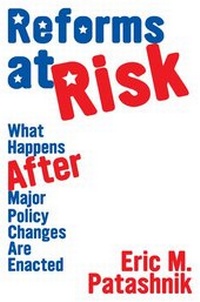
Reforms at Risk
What Happens After Major Policy Changes Are Enacted
Published on 14. September 2008
Book
Hardback
256 pages
978-0-691-11998-4 (ISBN)
Description
"Reforms at Risk" is the first book to closely examine what happens to sweeping and seemingly successful policy reforms after they are passed. Most books focus on the politics of reform adoption, yet as Eric Patashnik shows here, the political struggle does not end when major reforms become enacted. Why do certain highly praised policy reforms endure while others are quietly reversed or eroded away? Patashnik peers into some of the most critical arenas of domestic-policy reform - including taxes, agricultural subsidies, airline deregulation, emissions trading, welfare state reform, and reform of government procurement - to identify the factors that enable reform measures to survive. He argues that the reforms that stick destroy an existing policy subsystem and reconfigure the political dynamic. Patashnik demonstrates that sustainable reforms create positive policy feedbacks, transform institutions, and often unleash the "creative destructiveness" of market forces."
Reforms at Risk" debunks the argument that reforms inevitably fail because Congress is prey to special interests, and the book provides a more realistic portrait of the possibilities and limits of positive change in American government. It is essential reading for scholars and practitioners of U.S. politics and public policy, offering practical lessons for anyone who wants to ensure that hard-fought reform victories survive.
Reforms at Risk" debunks the argument that reforms inevitably fail because Congress is prey to special interests, and the book provides a more realistic portrait of the possibilities and limits of positive change in American government. It is essential reading for scholars and practitioners of U.S. politics and public policy, offering practical lessons for anyone who wants to ensure that hard-fought reform victories survive.
Reviews / Votes
Tremendous effort is invested by political scientists in an attempt to understanding the conditions that produce significant policy change. In this important book, Patashnik considers the fate of major policy changes. -- S.Q. Kelly, Choice Eric M. Patashnik's excellent book ... is an important book, for obvious reasons--as the Obama Administration settles in to a long, hard slog of reform across the broad swath of government activity, it will need to understand not only how to get reforms passed, but how to make sure they're carried out. -- Elaine Kamarck, Democracy [Patashnik] produces not only a helpful primer for policy entrepreneurs on how to design reforms with self-reinforcing features, but also a fine-grained scholarly analysis of the limits of previous work on policymaking. It is an instant classic that will be widely read by practitioners and scholars alike... Eric Patashnik has written a fascinating and enormously important book that tells us how policy designs help shape the long-term sustainability of general-interest reforms... It is a brilliant book that confirms Patashnik's place among the top scholars examining the interaction between political science and public policy. -- Andrea Louise Campbell, Journal of Policy History This is a very fine book--an example of American political science at its best, which is to say, very good indeed... Fine scholarship informs and leaves the reader arguing with it throughout; by these two measures this is fine scholarship. -- Michael Moran, Governance As the Obama administration and Congressional leaders address these and other challenges, they would do well to read Eric Patashnik's new book, Reforms at Risk. It is a book that adds to our base of knowledge and also provides insights that can be used to improve public policy. -- John Hoornbeek, Journal of Politics [I]n contrast to portions of the political science literature that try to portray post-reform politics as a matter of cycles, or coalitions, or institutional design, Patashnik provides a more complex and, to me, more realistic account of the political dynamics, including the importance of timing, historical circumstance, and learning from experience. -- J. Samuel Fitch, Policy SciencesMore details
Series
Language
English
Place of publication
New Jersey
United States
Target group
College/higher education
Professional and scholarly
Product notice
Trade binding
Illustrations
14 halftones. 13 tables.
Dimensions
Height: 229 mm
Width: 152 mm
Weight
482 gr
ISBN-13
978-0-691-11998-4 (9780691119984)
Copyright in bibliographic data and cover images is held by Nielsen Book Services Limited or by the publishers or by their respective licensors: all rights reserved.
Schweitzer Classification
Other editions
Additional editions
Book
09/2008
Princeton University Press
€32.60
Shipment within 10-20 days
Person
Eric M. Patashnik is associate professor of politics at the University of Virginia. His books include "Putting Trust in the US Budget: Federal Trust Funds and the Politics of Commitment".
Content
List of Figures and Tables ix Acknowledgments xi Chapter 1: Introduction: General-Interest Policymaking and the Politics of Reform Sustainability 1 Chapter 2: Policy Reform as a Political Project 16 Chapter 3: Expert Ideas Meet Politics: Reforming the Tax Code 35 Chapter 4: Reforming the Agricultural Welfare State: The Mixed Case of the Freedom to Farm Act 55 Chapter 5: Reforming the American Welfare State: ERISA and the Medicare Catastrophic Coverage Act 72 Chapter 6: Uncle Sam Goes Shopping: Reinventing Government Procurement 91 Chapter 7: Unshackling an Unstable Industry: Airline Deregulation 110 Chapter 8: Making Pollution Control Pay: Emissions Trading for Acid Rain 136 Chapter 9: Conclusions: The Patterns and Paradoxes of Policy Reform 155 Notes 181 Index 229