

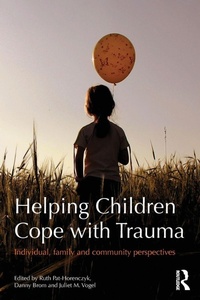
Helping Children Cope with Trauma
Individual, family and community perspectives
Published on 10. December 2013
Book
Paperback/Softback
280 pages
978-0-415-50456-0 (ISBN)
Description
Helping Children Cope with Trauma bridges theory and practice in examining emerging approaches to enhancing resilience and treating traumatised children. Adopting a child-centred perspective, it highlights the importance of the synergy between individual, family, community and social interventions for recovery from post-traumatic stress.
Consisting of chapters by an international range of contributors, the book is presented in three sections, reflecting the ecological circles of support that facilitate healthy development in the face of traumatic circumstances. Section 1, Individual, addresses the impact of exposure to trauma and loss on post-traumatic adaptation, focusing on biological aspects, attachment patterns, emotion regulation and aggressive behaviour in children. Section 2, Family, looks at the concept of family resilience, the impact of trauma on playfulness in toddlers and parents, innovative models for working with children traumatised by war, domestic violence and poverty and describes the challenges faced by refugee families in the light of intergenerational transmission of trauma. Section 3, Community, broadly explores the concept of community resilience and preparedness, the centrality of the school in the community during times of war and conflict, post-traumatic distress and resilience in diverse cultural contexts and the impact of trauma work on mental health professionals who live and work in shared traumatic realities. The book concludes with a theoretical discussion of the concept of Survival Mode as an organisng principle for understanding post-traumatic phenomena.
Helping Children Cope with Trauma will provide mental health professionals, child welfare workers, educators, child development experts and researchers with a thorough understanding of the needs of children after trauma and how those needs may best be met.
Consisting of chapters by an international range of contributors, the book is presented in three sections, reflecting the ecological circles of support that facilitate healthy development in the face of traumatic circumstances. Section 1, Individual, addresses the impact of exposure to trauma and loss on post-traumatic adaptation, focusing on biological aspects, attachment patterns, emotion regulation and aggressive behaviour in children. Section 2, Family, looks at the concept of family resilience, the impact of trauma on playfulness in toddlers and parents, innovative models for working with children traumatised by war, domestic violence and poverty and describes the challenges faced by refugee families in the light of intergenerational transmission of trauma. Section 3, Community, broadly explores the concept of community resilience and preparedness, the centrality of the school in the community during times of war and conflict, post-traumatic distress and resilience in diverse cultural contexts and the impact of trauma work on mental health professionals who live and work in shared traumatic realities. The book concludes with a theoretical discussion of the concept of Survival Mode as an organisng principle for understanding post-traumatic phenomena.
Helping Children Cope with Trauma will provide mental health professionals, child welfare workers, educators, child development experts and researchers with a thorough understanding of the needs of children after trauma and how those needs may best be met.
Reviews / Votes
'Helping Children Cope with Trauma reflects the breadth of knowledge, experience, and commitment of the editors and authors. It is an important and interesting volume with the emphasis on theory, research, and interventions from many cross-cultural perspectives. The emphasis on ways to build individual, family, and community resilience is particularly important in that for children coping with trauma, learning more about strengths that aid recovery is crucial. Given the range of perspectives and approaches covered in this excellent volume and its international scope, I recommend that this book be required reading for all who work with traumatized children and families.' - Joy D. Osofsky, Ph.D, LSU Health Sciences Center, USA.More details
Language
English
Place of publication
London
United Kingdom
Publishing group
Taylor & Francis Ltd
Target group
College/higher education
Professional and scholarly
Postgraduate, Professional, and Professional Practice & Development
Illustrations
3 s/w Abbildungen, 3 s/w Zeichnungen, 1 s/w Tabelle
1 Tables, black and white; 3 Line drawings, black and white; 3 Illustrations, black and white
Dimensions
Height: 234 mm
Width: 156 mm
Thickness: 15 mm
Weight
427 gr
ISBN-13
978-0-415-50456-0 (9780415504560)
Copyright in bibliographic data and cover images is held by Nielsen Book Services Limited or by the publishers or by their respective licensors: all rights reserved.
Schweitzer Classification
Other editions
Additional editions
Ruth Pat-Horenczyk | Danny Brom | Juliet M. Vogel
Helping Children Cope with Trauma
Individual, family and community perspectives
Book
06/2014
Routledge
€262.30
Shipment within 15-20 days
Ruth Pat-Horenczyk | Danny Brom | Juliet M. Vogel
Helping Children Cope with Trauma
Individual, family and community perspectives
E-Book
01/2014
1st Edition
Routledge
€81.99
Available for download
Ruth Pat-Horenczyk | Danny Brom | Juliet M. Vogel
Helping Children Cope with Trauma
Individual, family and community perspectives
E-Book
01/2014
1st Edition
Routledge
€81.99
Available for download
Persons
Ruth Pat-Horenczyk is a clinical psychologist and Director of Child and Adolescent Clinical Services at the Temmy and Albert Latner Israel Center for the Treatment of Psychotrauma at Herzog Hospital in Jerusalem. She is also Adjunct Associate Professor at the Paul Baerwald School of Social Work and Social Welfare at the Hebrew University of Jerusalem.
Danny Brom is a clinical psychologist, the Founding Director of the Israel Center for the Treatment of Psychotrauma at Herzog Hospital in Jerusalem, and an Adjunct Associate Professor at the Paul Baerwald School of Social Work and Social Welfare at the Hebrew University of Jerusalem. He is the former director of the Dutch Institute for Psychotrauma (IVP), the Netherlands.
Juliet M. Vogel is a clinical psychologist and has been associated with the North Shore-Long Island Jewish Health System in Manhasset, New York for more than 20 years. She was previously the Director of Training for the Division of Trauma Psychiatry, and is currently an associate professor at the Hofstra North Shore-LIJ School of Medicine at Hofstra University.
Danny Brom is a clinical psychologist, the Founding Director of the Israel Center for the Treatment of Psychotrauma at Herzog Hospital in Jerusalem, and an Adjunct Associate Professor at the Paul Baerwald School of Social Work and Social Welfare at the Hebrew University of Jerusalem. He is the former director of the Dutch Institute for Psychotrauma (IVP), the Netherlands.
Juliet M. Vogel is a clinical psychologist and has been associated with the North Shore-Long Island Jewish Health System in Manhasset, New York for more than 20 years. She was previously the Director of Training for the Division of Trauma Psychiatry, and is currently an associate professor at the Hofstra North Shore-LIJ School of Medicine at Hofstra University.
Content
Introduction. Part One: Individual. Part Two: Family. Part Three: Community. Concluding Comments. Brom, Thoughts about Survival Mode Theory of Post-traumatic Reactions. Index.