

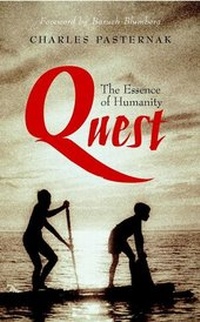
Quest
The Essence of Humanity
Published on 13. June 2003
Book
Hardback
432 pages
978-0-470-85144-9 (ISBN)
Description
An intriguing work of history, philosophy, and popular science that explores the human desire to quest.
Scientists continually look for the genetic factors that make humans so very different in appearance and behaviour from most animals -- the genes that are uniquely human. Respected biochemist and author Charles Pasternak argues that such genes do not exist. Instead, he suggests that it is our desire to quest - for food and shelter, for knowledge, for wealth, for adventure - coupled with our unique physical abilities to do so that have controlled our evolution and have led humans to develop away from closely related animals.
In this intriguing work of history, philosophy, and popular science, Pasternak uses his extensive biological knowledge to discuss man's nature and achievements, his genetic makeup, and his evolution.
Charles A.Pasternak, is an eminent international biochemist and Director and founder of the Oxford International Biomedical Centre. He comes from a family of highly talented individuals: nephew of Boris Pasternak (author of Dr Zhivago), father of Anna Pasternak (writer), grandson of Leonid Pasternak (Impressionalist painter) and son of Josephine Pasternak (philosopher). He is the author of a number of works and has recently turned his attention to communicating scientific subjects to a broader readership.
Reviews / Votes
".I can recommend Quest: The Essence of Humanity.one of the most thought-provoking books to come my way for some time." (The Sunday Telegraph., 20 July 2003) ".fluent, fast-moving.Quest is controversial.which all ambitious works like this one should be." (New Scientist, 23 August 2003) ".I really enjoyed this book.What impressed me throughout was Parsternak's use of science." (M2 Best Books, 7 December 2003)More details
Other editions
Additional editions
Book
06/2004
Wiley
€11.90
Article exhausted; check different version
Persons
Charles A. Pasternak is a biochemist and founding Director of the Oxford International Biomedical Centre. His previous academic experience has included research and teaching posts at the universities of Oxford, London (St George's Medical School), Yale and California (UCSD Medical School). While at St George's Medical School, he was founder and Chairman of the Department of Biochemistry, which he later expanded into the Department of Cellular and Molecular Sciences.
Charles Pasternak is acclaimed for his pioneering work in membrane research and is a tireless promoter of international collaboration, working with UNESCO, IUBMB and universities worldwide. He is the author of a number of books and is editor-in-chief of a scientific journal. He has recently turned his attention to communicating scientific subjects to a broader readership.
Charles comes from a highly talented family. He is nephew of Boris Pasternak, author of Doctor Zhivago, and grandson of Leonid Pasternak, the Russian Impressionist painter.
Content
Illustrations.
Foreword.
Acknowledgements.
1. Prologue.
Part I: Evolution: the genetic basis of quest.
2. Unity and diversity in living organisms.
3. Plants and microbes: the origin of vision.
4. Animals and man: development of human attributes.
Part II: Domination: the consequences of human quest.
5. Out of Africa: exploration and expansion.
6. The ladder: adversity and achievement.
7. Civilisation1: towns and temples.
8. Civilisation 2: communication and culture.
9. Technology: war and welfare
10. Religion: belief and dogma.
11. Science: explanation and experimentation.
Part III: Controversy: current quest.
12. Tinkering with genes1: GM foods.
13. Tinkering with genes 2: GM people.
14. Extinction or survival of Homo quaerens?
15. Epilogue.
Bibliography.
Glossary.
Index.