

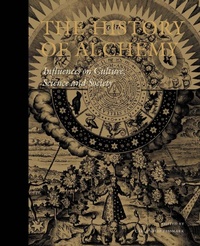
The History of Alchemy
Influences on Culture, Science and Society
Published on 20. May 2025
Book
Hardback
350 pages
978-91-89882-69-0 (ISBN)
Description
The etymological roots of alchemy are found in both the Arabic and Greek languages, and refer to the process of transmutation that leads to a complete reunion with the original divine form. However, the esoteric practice of alchemy stretches all the way to India and China and has been practiced since at least the fourth century.
During the Middle Ages, alchemy attracted many of the most prominent scholars of the time. Strongly influenced by the classical theory of the elements, the alchemists based their hypotheses on Aristotle's idea that everything can be created through different proportions of the four elements. From the 19th century onwards, alchemy has been wrongly reduced to a primitive pseudoscience with the sole aim of transmuting base metals into gold. However, this narrow interpretation ignores the true complexity of alchemy and ignores its deep philosophical and religious aspects, as well as its crucial contribution to the development of chemistry.
This richly illustrated anthology presents a diversity of perspectives on how reciprocity, metaphysical connections, and the relationship between macrocosm and microcosm form the core of the philosophy of alchemy. Some of the world's most prominent researchers and academics gather to analyze the alchemical worldview and explore how esoteric currents of thought have shaped culture, society and science.
During the Middle Ages, alchemy attracted many of the most prominent scholars of the time. Strongly influenced by the classical theory of the elements, the alchemists based their hypotheses on Aristotle's idea that everything can be created through different proportions of the four elements. From the 19th century onwards, alchemy has been wrongly reduced to a primitive pseudoscience with the sole aim of transmuting base metals into gold. However, this narrow interpretation ignores the true complexity of alchemy and ignores its deep philosophical and religious aspects, as well as its crucial contribution to the development of chemistry.
This richly illustrated anthology presents a diversity of perspectives on how reciprocity, metaphysical connections, and the relationship between macrocosm and microcosm form the core of the philosophy of alchemy. Some of the world's most prominent researchers and academics gather to analyze the alchemical worldview and explore how esoteric currents of thought have shaped culture, society and science.
More details
Language
English
Place of publication
Sweden
Product notice
sewn/stitched
Cloth over boards
Dimensions
Height: 284 mm
Width: 234 mm
Thickness: 37 mm
Weight
1588 gr
ISBN-13
978-91-89882-69-0 (9789189882690)
Copyright in bibliographic data and cover images is held by Nielsen Book Services Limited or by the publishers or by their respective licensors: all rights reserved.
Schweitzer Classification
Persons
Georgiana (Jo) Hedesan is an early modern historian of science at the University of Oxford, specialising in the study of alchemy and alchemical medicine. Her first book, An Alchemical Quest for Universal Knowledge: The 'Christian Philosophy' of Jan Baptist Van Helmont (1579-1644) was published in 2016 by Routledge. Mark S Morrisson is an associate dean and English professor at Penn State University, and author of several monographs, including Modern Alchemy: Occultism and the Emergence of Atomic Theory. He is completing a monograph for Oxford University Press tentatively titled Light on the Path: Genre Fiction and the Mainstreaming of Occultism, 1880-1940. Andreas Winkler is an assistant professor of Egyptology in the Department of Near and Middle Eastern Civilizations at the University of Toronto, specialising in history and philology. While his research spans the entirety of ancient Egyptian history, he focuses primarily on the Graeco- Roman period, particularly its socio-economic and intellectual history. His specific areas of work include ancient Egyptian astral sciences and the transfer of knowledge in the ancient Mediterranean world. Salam Rassi is lecturer in Islam and Christian-Muslim Relations at the School of Divinity, University of Edinburgh. His main area of research is Christian-Muslim interactions across theology, philosophy and literature. Following the completion of his doctorate at the University of Oxford, he became a Mellon Foundation postdoctoral fellow at the American University of Beirut. He has also worked as a cataloguer of Syriac and Arabic manuscripts at the Hill Museum & Manuscript Library, Minnesota and was a British Academy postdoctoral fellow at Oxford. His first book, entitled Christian Thought in the Medieval Islamicate World, was published by OUP in early 2022. DagmarWujastyk is an associate professor in the Department of History, Classics, and Religion at the University of Alberta. She is an Indologist specialising in the history and literature of classical South Asia, including Indian medicine (Ayurveda), iatrochemistry (rasasastra) and yoga.