

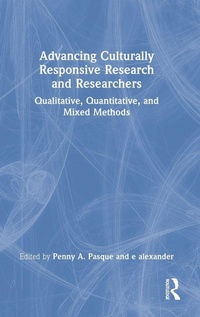
Advancing Culturally Responsive Research and Researchers
Qualitative, Quantitative, and Mixed Methods
1st Edition
Published on 19. August 2022
Book
Hardback
258 pages
978-0-367-64859-6 (ISBN)
Description
Advancing Culturally Responsive Research and Researchers: Qualitative, Quantitative, and Mixed Methods encourages readers to design and engage in methodologies and methods that place cultural relevancy at the center of inquiry. In doing so, it highlights the need to uplift voices and needs of people who have been historically marginalized in the environments that we both inhabit and engage in as part of knowledge construction.
The scholars whose work is featured in this volume take up research from different paradigmatic, ontological, epistemological, axiological, and methodological approaches - yet, with adherence to centering cultural responsiveness in all research decisions. Each chapter seeks to extend understandings of social inequities, methodologies, and/or methods - and to contribute to meaningful and evolving social change through innovative and cutting-edge research strategies. While doing this work, the authors illustrate and highlight the importance of researcher positions and reflexivity in supporting the expansion of culturally responsive approaches; they also do so while considering global sociopolitical conditions of this moment in time. The contributions to this volume were initially presented at the first biennial Advanced Methods Institute in 2021. The Institute was hosted by QualLab in The Ohio State University's College of Education and Human Ecology and shared this volume's thematic focus.
As a handbook, the volume can help faculty and advanced researchers with interest in doing culturally responsive projects to better understand frameworks, approaches, and considerations for doing so. It includes activities to support readers in developing said understandings.
The scholars whose work is featured in this volume take up research from different paradigmatic, ontological, epistemological, axiological, and methodological approaches - yet, with adherence to centering cultural responsiveness in all research decisions. Each chapter seeks to extend understandings of social inequities, methodologies, and/or methods - and to contribute to meaningful and evolving social change through innovative and cutting-edge research strategies. While doing this work, the authors illustrate and highlight the importance of researcher positions and reflexivity in supporting the expansion of culturally responsive approaches; they also do so while considering global sociopolitical conditions of this moment in time. The contributions to this volume were initially presented at the first biennial Advanced Methods Institute in 2021. The Institute was hosted by QualLab in The Ohio State University's College of Education and Human Ecology and shared this volume's thematic focus.
As a handbook, the volume can help faculty and advanced researchers with interest in doing culturally responsive projects to better understand frameworks, approaches, and considerations for doing so. It includes activities to support readers in developing said understandings.
More details
Language
English
Place of publication
London
United Kingdom
Publishing group
Taylor & Francis Ltd
Target group
College/higher education
Professional and scholarly
Postgraduate and Professional
Illustrations
21 s/w Abbildungen, 1 s/w Photographie bzw. Rasterbild, 20 s/w Zeichnungen, 6 s/w Tabellen
6 Tables, black and white; 20 Line drawings, black and white; 1 Halftones, black and white; 21 Illustrations, black and white
Dimensions
Height: 240 mm
Width: 161 mm
Thickness: 19 mm
Weight
581 gr
ISBN-13
978-0-367-64859-6 (9780367648596)
Copyright in bibliographic data and cover images is held by Nielsen Book Services Limited or by the publishers or by their respective licensors: all rights reserved.
Schweitzer Classification
Other editions
Additional editions
Penny A. Pasque | E. Alexander
Advancing Culturally Responsive Research and Researchers
Qualitative, Quantitative, and Mixed Methods
E-Book
08/2022
1st Edition
Routledge
€53.99
Available for download
Penny A. Pasque | E. Alexander
Advancing Culturally Responsive Research and Researchers
Qualitative, Quantitative, and Mixed Methods
Book
08/2022
1st Edition
Routledge
€61.50
Shipment within 15-20 days
Penny A. Pasque | E. Alexander
Advancing Culturally Responsive Research and Researchers
Qualitative, Quantitative, and Mixed Methods
E-Book
08/2022
1st Edition
Routledge
€53.99
Available for download
Persons
Penny A. Pasque is a Professor in Educational Studies, Director of Qualitative Methods and Director of the QualLab in the Office of Research, Innovation and Collaboration (ORIC) in College of Education and Human Ecology at The Ohio State University. She is editor of the Review of Higher Education (with Nelson Laird).
e alexander is an Assistant Professor at the University of Kansas, and qualitative-leaning mixed methodologist who enjoys learning with others about tailoring research to be grounded in community and place.
e alexander is an Assistant Professor at the University of Kansas, and qualitative-leaning mixed methodologist who enjoys learning with others about tailoring research to be grounded in community and place.
Content
1. Introduction: The Importance of Culturally Responsive Research and Culturally Responsive Researchers. Section I: Contexts and Considerations for Quantitative, Qualitative, and Mixed Methods Research. 2. The Transformative Paradigm: An Evolving Journey in Methods and Social Justice Aims. 3. Culturally Responsive Post-Qualitative Research. 4. Must an Education in Research Ethics Engage Issues of Culture, Context, and Community?. Section II: Qualitative Innovations. 5. Teaching and Engaging Autoethnogaphy as Qualitative Engagement. 6. Critical, De/colonial, and Contemplative Approaches to Qualitative Inquiry. 7. Intersectionality as a Lens in Qualitative Research: Possibilities, Problems, and Practices. 8. good kid, m.A.A.d research: Culturally Sustaining Research and Calling Out the White Gaze in Our Epistemologies. Section III: Quantitative and Mixed Methods Innovations. 9. Using Counterfactual Modeling and Machine Learning Generated Propensity Scores to Examine Black Social Control and Mathematics. 10. Examining Discipline from an Intersectional Lens. 11. Detecting Differential Effects Using Regression Mixture Models: Applications Using Mplus. 12. The Utility of Critical Race Mixed Methodology: An Explanatory Sequential Example. 13. Advancing Critical Race Spatial Analysis: Implications for the use of GIS in Educational Research. Section IV: The Future of Culturally Responsive Research. 14. The Future: Advancing Innovations of Culturally Sustaining Research and Researchers.