

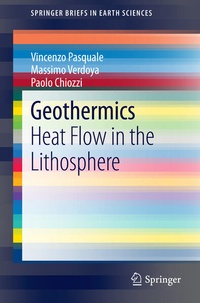
Geothermics
Heat Flow in the Lithosphere
Published on 13. November 2013
Book
Paperback/Softback
VIII, 119 pages
978-3-319-02510-0 (ISBN)
Description
After a brief review of global tectonics and the structure of the crust and upper mantle, the basic relations of conductive heat transport and the rock thermal properties are introduced as well as the various methods for measuring thermal conductivity and heat generation due to the decay of radioactive elements. The authors analyze geothermal flow and the thermal state of the lithosphere and deep interior and discuss the fundamental problems related to the formation, upwelling mechanisms, solidification and cooling of magmas. The text presents analytical methods that allow us to gain information on heat and groundwater flow from the analyses of temperature-depth data. It also provides ample data and examples to facilitate understanding of the different topics. This book is useful to researchers and graduate students interested in pure and applied geothermics.
More details
Series
Edition
2014 ed.
Language
English
Place of publication
Cham
Switzerland
Publishing group
Springer International Publishing
Target group
Professional and scholarly
Research
Illustrations
55 s/w Abbildungen
VIII, 119 p. 55 illus.
Dimensions
Height: 235 mm
Width: 155 mm
Thickness: 8 mm
Weight
213 gr
ISBN-13
978-3-319-02510-0 (9783319025100)
DOI
10.1007/978-3-319-02511-7
Schweitzer Classification
Other editions
Additional editions
E-Book
10/2013
1st Edition
Springer
€53.49
Available for download
Persons
Vincenzo Pasquale worked as a Researcher for the National Research Council (CNR) from 1972 to 1979 and as Assistant Professor of Physics of the Earth for the Geodetic and Geophysical Institute of the University of Genoa, Italy. Since 1980, he is a Professor of Solid Earth Geophysics at the University of Genoa. He has authored more than 250 scientific papers, 100 of which were published in leading international journals. The first ten years of his research were devoted mainly to seismology. In 1980s, he began his studies on the Earth's rheology and thermal field. He has been responsible of a numerous research projects. He is a member of national and international scientific associations and referee of international journals.
Massimo Verdoya received his MSc in Geological Sciences in 1985, and in 1992 his Ph.D. degree in Geophysics at the University of Genoa, Italy. From 1993 to 2014 he worked as a Researcher in Solid Earth Geophysics and thereafter as Associate Professor at the University of Genoa. His fields of interest are: thermal modeling of lithospheric geodynamical processes, applied geothermics, analytical and numerical simulations of heat and groundwater transfer (with special reference to hydrothermal reservoirs), determinations of thermo-physical properties of rocks and soils (thermal conductivity and diffusivity), past climate change inferred from underground temperatures. He is vice-chairman of the International Heat Flow Commission of the IASPEI (International Association of Seismology and Physics of the Earth Interior) and member of the board of directors of the International Geothermal Association.
Paolo Chiozzi received his MSc in Earth Sciences in 1989 and his Ph.D. in Geophysics at the University of Genoa (Italy) in 1995. Since 1996, he works as a Research Fellow at the University of Genoa on several projects encompassing a wide range of geodynamic and geothermic problems. Hisresearch is focused on the relationships between the thermal structure and the deformation processes within the lithosphere. He has developed techniques of spectral analysis of magnetic data to obtain information on the deep magnetic boundary and their relation with the temperature distribution and the Curie point. Moreover, his activity is addressed to the determination of thermo-physical properties and natural radioactivity of rocks and soils and underground temperatures. He has published more than 50 papers in international journals.
Content
Lithosphere Structure and Dynamics.- Heat Conduction and Thermal Parameters.- Thermal State.- Temperature and Magmatic Processes.- Heat in the Groundwater Flow.