

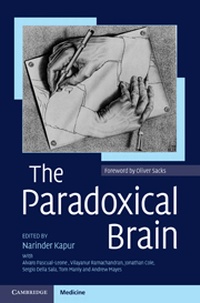
The Paradoxical Brain
Published on 21. July 2011
Book
Hardback
488 pages
978-0-521-11557-5 (ISBN)
Description
The Paradoxical Brain focuses on a range of phenomena in clinical and cognitive neuroscience that are counterintuitive and go against the grain of established thinking. The book covers a wide range of topics by leading researchers, including: * Superior performance after brain lesions or sensory loss * Return to normal function after a second brain lesion in neurological conditions * Paradoxical phenomena associated with human development * Examples where having one disease appears to prevent the occurrence of another disease * Situations where drugs with adverse effects on brain functioning may have beneficial effects in certain situations A better understanding of these interactions will lead to a better understanding of brain function and to the introduction of new therapeutic strategies. The book will be of interest to those working at the interface of brain and behaviour, including neuropsychologists, neurologists, psychiatrists and neuroscientists.
Reviews / Votes
'Narinder Kapur has expanded the concept of paradoxical functional facilitation to cover many areas in neurology, neuroscience and neurorehabilitation, assembling a diverse and comprehensive group of world-class experts to explore the concept of paradox in many different disciplines. Their experience and ideas are of fundamental importance and deserve close attention from all who deal with disorders of brain function, so that we may focus on the uniqueness of the individual and their positive potentials, rather than thinking solely in terms of disorder.' Oliver Sacks, Columbia University Medical Center '... a refreshingly thoughtful, informative and provocative view of neuroscience that challenges the reader to consider and appreciate the brain in novel ways. It is a truly fascinating read.' Eleanor A. Maguire, University College London '... a fascinating tour of the unexpected - the disorders, anomalies and paradoxes that are part of the human condition and that yield insights about the abnormal brain and normal brain function. The extraordinary range of examples and case studies assures that every reader will find material that is novel, informative and absorbing.' Larry R. Squire, University of California, San DiegoMore details
Language
English
Place of publication
Cambridge
United Kingdom
Target group
Professional and scholarly
Illustrations
30 Tables, black and white; 10 Halftones, unspecified; 29 Halftones, color; 20 Line drawings, unspecified; 39 Line drawings, color
Dimensions
Height: 240 mm
Width: 160 mm
Thickness: 25 mm
Weight
930 gr
ISBN-13
978-0-521-11557-5 (9780521115575)
Copyright in bibliographic data and cover images is held by Nielsen Book Services Limited or by the publishers or by their respective licensors: all rights reserved.
Schweitzer Classification
Other editions
Additional editions
Alvaro Pascual-Leone | Vilayanur Ramachandran | Jonathan Cole
The Paradoxical Brain
E-Book
12/2011
1st Edition
Cambridge University Press
€104.99
Available for download
Persons
Narinder Kapur is Visiting Professor of Neuropsychology at University College London and Honorary Professor of Neuropsychology, University of Southampton. He was formerly Head of the Neuropsychology Department, Addenbrooke's Hospital, Cambridge, UK. Alvaro Pascual-Leone is Professor of Neurology at Harvard Medical School and Director of the Berenson-Allen Center for Non-Invasive Brain Stimulation at the Beth Israel Deaconess Medical Center, USA. Vilayanur Ramachandran is Director of the Center for Brain and Cognition at the University of San Diego, California and Adjunct Professor of Biology at the Salk Institute, San Diego, USA. Jonathan Cole is Honorary Senior Lecturer in Clinical Neurosciences, University of Southampton and Professor, University of Bournemouth, UK. Sergio Della Sala is Professor of Human Cognitive Neuroscience, University of Edinburgh, Scotland, UK. Tom Manly is a researcher for the MRC Cognition and Brain Sciences Unit, Cambridge, UK. Andrew Mayes is Professor, Cognition and Cognitive Neuroscience, School of Psychological Sciences, University of Manchester, UK. Oliver Sacks is Professor of Neurology and Psychiatry, Columbia University Medical Center, USA.
Content
Acknowledgements; Preface; Foreword Oliver Sacks; Author affiliations; Abbreviations; 1. The paradoxical nature of nature Narinder Kapur, Alvaro Pascual-Leone, Tom Manly and Jonathan Cole; 2. Paradoxical effects of sensory loss Alvaro Pascual-Leone, Souzana Obretenova and Lotfi B. Merabet; 3. Paradoxical functional facilitation and recovery in neurological and psychiatric conditions Narinder Kapur; 4. Paradoxes in neurorehabilitation Tom Manly, Ian H. Robertson and Narinder Kapur; 5. The paradoxical self Vilayanur Ramachandran and William Hirstein; 6. Paradoxical psychological functioning in early child development David J. Lewkowicz and Asif A. Ghazanfar; 7. Cognitive ageing: a positive perspective Shira Zimerman, Lynn Hasher and David Goldstein; 8. Paradoxes of learning and memory Henry L. Roediger, III and Andrew C. Butler; 9. The paradox of human expertise: why experts get it wrong Itiel E. Dror; 10. Paradoxes in Parkinson's disease and other movement disorders Ashwani Jha and Peter Brown; 11. Paradoxical phenomena in epilepsy Steven C. Schachter; 12. Paradoxical creativity and adjustment in neurological conditions Indre V. Viskontas and Bruce L. Miller; 13. Paradoxical functional facilitation with noninvasive brain stimulation Umer Najib and Alvaro Pascual-Leone; 14. Unexpected benefits of allergies and cigarette smoking: two examples of paradox in neuroepidemiology Judith Schwartzbaum, Linda Karavodin, Narinder Kapur and James L. Fisher; 15. The paradox of autism: why does disability sometimes give rise to talent? Simon Baron-Cohen, Emma Ashwin, Chris Ashwin, Teresa Tavassoli and Bhismadev Chakrabarti; 16. Paradoxes in creativity and psychiatric conditions Jonathan Hurlow and James H. MacCabe; 17. The paradox of psychosurgery to treat mental disorders Perminder S. Sachdev; 18. The paradox of electroconvulsive therapy Angela Merkl and Malek Bajbouj; 19. Paradoxes of comparative cognition Howard C. Hughes; 20. Paradoxical phenomena in brain plasticity Bryan Kolb and G. Campbell Teskey; 21. Immature neurons in the adult brain. Breaking all the rules J. Martin Wojtowicz; 22. The paradoxical hippocampus: when forgetting helps learning Howard Eichenbaum; 23. Paradoxical effects of drugs on cognitive function: the neuropsychopharmacology of the dopamine and other neurotransmitter systems Roshan Cools, Esther Aarts and Mitul A. Mehta; 24. The paradoxical brain - so what? Narinder Kapur, Tom Manly, Jonathan Cole and Alvaro Pascual-Leone; Index.