

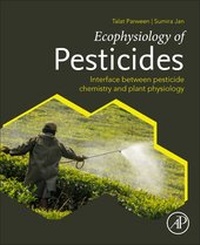
Ecophysiology of Pesticides
Interface between Pesticide Chemistry and Plant Physiology
Published on 1. August 2019
Book
Paperback/Softback
332 pages
978-0-12-817614-6 (ISBN)
Description
Ecophysiology of Pesticides: Interface between Pesticide Chemistry and Plant Physiology is the first comprehensive overview of the physical impact of this increasingly complex environmental challenge. Designed to offer state-of-the-art knowledge, the book covers pesticide usage and its consequences on the ecophysiology of plants. It includes the challenge of policymaking in pesticide consumption and a risk analysis of conventional and modern approaches on standard usage. In addition, it summarizes research reports pertaining to the physio-ecological effects of pesticides, discusses the environmental risks associated with the over-utilization of pesticides, and covers pesticide usage on the micro-flora and rhizosphere.
This book is a valuable reference for plant ecologists, plant biochemists and chemists who want to study pesticide consumption and its biochemical and physiological evaluation effects on plants. It will also be of immense help to university and college teachers and students of environmental biotechnology, environmental botany and plant ecophysiology.
This book is a valuable reference for plant ecologists, plant biochemists and chemists who want to study pesticide consumption and its biochemical and physiological evaluation effects on plants. It will also be of immense help to university and college teachers and students of environmental biotechnology, environmental botany and plant ecophysiology.
More details
Language
English
Place of publication
San Diego
United States
Publishing group
Elsevier Science Publishing Co Inc
Target group
College/higher education
Professional and scholarly
Plant ecologists, plant biochemists and chemists keen to study the pesticide consumption and its biochemical and physiological evaluation effects on plants. It will be of immense help to university and college teachers and students of environmental biotechnology, environmental botany and plant ecophysiology
Dimensions
Height: 229 mm
Width: 152 mm
Weight
520 gr
ISBN-13
978-0-12-817614-6 (9780128176146)
Copyright in bibliographic data and cover images is held by Nielsen Book Services Limited or by the publishers or by their respective licensors: all rights reserved.
Schweitzer Classification
Other editions
Additional editions
Talat Parween | Sumira Jan
Ecophysiology of Pesticides
Interface between Pesticide Chemistry and Plant Physiology
E-Book
07/2019
Academic Press
€155.00
Available for download
Persons
PhD with 4 Years of post-doctoral research experience. Selected for UGC Junior and Senior Research fellowships. Currently working on Pest management by integrated approach and indigenous technologies. Dr. Sumira Jan has worked out numerous medicinal plants, focusing on their phyto-geographical distribution, ontogenetic changes, chemical profiling, chemo diversity, and pharmaceutical potential. She received BioCaRe Early Career Scientist Award (2014), prestigious Fast Track Young Scientist Award (2015) and CSIR pool scientist award (2018). She has published over 40 research papers, 16 book chapters and four books (Three with Elsevier and One with Springer). All these books are authored versions focused on the abiotic stress, eco-physiology and metabolomics of various crops.
Author
Research Associate, Department of Petro Chemical & Chemicals, Institute of Pesticide Formulation Technology, Ministry of Chemicals and Fertilizers, India
Department of Basic Science and Humanities, Sher-e-Kashmir University of Agricultural Sciences and Technology of Kashmir, Shalimar, Srinagar, Jammu and Kashmir, India
Content
1. Pesticides and Environmental ecology2. Pesticide consumption and threats to Biodiversity3. Nutrient depletion and Pesticide Use4. Physiological Impacts of Pesticides5. Pesticide Consumption: Risks and Policy6. Perceptive exploitation of pesticides: Connecting link between Pesticide Consumption and Agricultural sustainability7. Ecological effect of pesticide on microbial communities8. Strategies for preventing and controlling Pesticide toxicity