

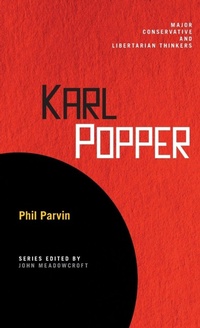
Karl Popper
Published on 3. June 2010
Book
Hardback
184 pages
978-0-8264-3222-3 (ISBN)
Description
Volume 14 in the "Major Conservative and Libertarian Thinkers" series focuses on Karl Popper, an important and controversial thinker of the 20th century. Karl Popper is best known for his contributions to the philosophy of science and the history of ideas. Elements of Popper's thought were clearly libertarian or conservative in character. His politics, however, were recognisably social democratic. His ideal of an open society was not a free market utopia, but a political community in which diverse people engaged with one another in constructive dialogue to seek political solutions to common problems. If Popper made important and enduring contributions to the libertarian and conservative traditions, it would be a mistake to uncritically label him a conservative or libertarian. Rather, Popper was a scholar who contributed to a range of different fields without being shackled to one particular perspective or approach. It is in this context that we should understand Popper's contribution to libertarian and conservative thought.
"Major Conservative and Libertarian Thinkers" provides comprehensive accounts of the works of seminal conservative thinkers from a variety of periods, disciplines, and traditions - the first series of its kind. Even the selection of thinkers adds another aspect to conservative thinking, including not only theorists but also writers and practitioners. The series comprises twenty volumes, each including an intellectual biography, historical context, critical exposition of the thinker's work, reception and influence, contemporary relevance, bibliography including references to electronic resources, and an index.
"Major Conservative and Libertarian Thinkers" provides comprehensive accounts of the works of seminal conservative thinkers from a variety of periods, disciplines, and traditions - the first series of its kind. Even the selection of thinkers adds another aspect to conservative thinking, including not only theorists but also writers and practitioners. The series comprises twenty volumes, each including an intellectual biography, historical context, critical exposition of the thinker's work, reception and influence, contemporary relevance, bibliography including references to electronic resources, and an index.
Reviews / Votes
"The volumes in this timely series comprise the most comprehensive body of material on conservative and libertarian thought yet published in a single project devoted to the subject. The series will prove an indispensable tool not only for those concerned with the history of political thought but also for those who confront the challenging task of constructing a viable contemporary conservative identity. Professor Meadowcroft had a difficult editorial task, to which he has responded with a judicious choice of thinkers and topics." Noel O'Sullivan, Professor of Political Philosophy, the University of Hull, UK."More details
Series
Language
English
Place of publication
New York
United States
Target group
College/higher education
Product notice
Laminated cover
Dimensions
Height: 216 mm
Width: 140 mm
Thickness: 11 mm
Weight
360 gr
ISBN-13
978-0-8264-3222-3 (9780826432223)
Copyright in bibliographic data and cover images is held by Nielsen Book Services Limited or by the publishers or by their respective licensors: all rights reserved.
Schweitzer Classification
Person
Dr Parvin is a Fellow of Trinity Hall, Cambridge. He is a specialist in contemporary political philosophy, in particular issues concerning liberal justice, democracy, and multiculturalism. He has taught politics at a number of universities, including the London School of Economics, where he completed his Doctorate. Dr Meadowcroft is Lecturer in Public Policy at King's College London and the author of The Ethics of the Market (Palgrave, 2005) and co-author of Rescuing Social Capital from Social Democracy (Institute of Economic Affairs, 2007).
Content
1. Intellectual Biography; Early beginnings; The Pedagogic Institute; Wittgenstein and the Vienna Circle; 'A fighting book'; The later years; 2. Popper's Ideas; Popper's epistemology; From science to social science; From social science to politics; The Open Society; 3. Reception and Influence of Popper's Philosophy; Popper, Burke, and the fallibility of reason; Radical politics, radical philosophy; Popper and the rise of the New Right; A final word on ideologies; 4. The Contemporary Relevance of Popper's Philosophy; Bibliography; Index.