

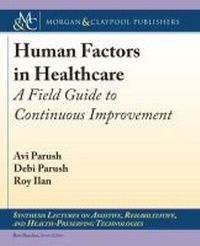
Human Factors in Healthcare
A Field Guide to Continuous Improvement
Published on 28. February 2017
Book
Paperback/Softback
202 pages
978-1-62705-944-2 (ISBN)
Description
Have you ever experienced the burden of an adverse event or a near-miss in healthcare and wished there was a way to mitigate it? This book walks you through a classic adverse event as a case study and shows you how.
It is a practical guide to continuously improving your healthcare environment, processes, tools, and ultimate outcomes, through the discipline of human factors. Using this book, you as a healthcare professional can improve patient safety and quality of care.
Adverse events are a major concern in healthcare today. As the complexity of healthcare increases-with technological advances and information overload-the field of human factors offers practical approaches to understand the situation, mitigate risk, and improve outcomes.
The first part of this book presents a human factors conceptual framework, and the second part offers a systematic, pragmatic approach. Both the framework and the approach are employed to analyze and understand healthcare situations, both proactively-for constant improvement-and reactively-learning from adverse events.
This book guides healthcare professionals through the process of mapping the environmental and human factors; assessing them in relation to the tasks each person performs; recognizing how gaps in the fit between human capabilities and the demands of the task in the environment have a ripple effect that increases risk; and drawing conclusions about what types of changes facilitate improvement and mitigate risk, thereby contributing to improved healthcare outcomes.
It is a practical guide to continuously improving your healthcare environment, processes, tools, and ultimate outcomes, through the discipline of human factors. Using this book, you as a healthcare professional can improve patient safety and quality of care.
Adverse events are a major concern in healthcare today. As the complexity of healthcare increases-with technological advances and information overload-the field of human factors offers practical approaches to understand the situation, mitigate risk, and improve outcomes.
The first part of this book presents a human factors conceptual framework, and the second part offers a systematic, pragmatic approach. Both the framework and the approach are employed to analyze and understand healthcare situations, both proactively-for constant improvement-and reactively-learning from adverse events.
This book guides healthcare professionals through the process of mapping the environmental and human factors; assessing them in relation to the tasks each person performs; recognizing how gaps in the fit between human capabilities and the demands of the task in the environment have a ripple effect that increases risk; and drawing conclusions about what types of changes facilitate improvement and mitigate risk, thereby contributing to improved healthcare outcomes.
More details
Series
Language
English
Place of publication
San Rafael, CA
United States
Publishing group
Morgan & Claypool Publishers
Dimensions
Height: 235 mm
Width: 190 mm
Weight
525 gr
ISBN-13
978-1-62705-944-2 (9781627059442)
Copyright in bibliographic data and cover images is held by Nielsen Book Services Limited or by the publishers or by their respective licensors: all rights reserved.
Schweitzer Classification
Persons
Content
- Background to Human Factors in Healthcare
- Part I: A Conceptual Framework
- About Human Factors Frameworks
- HF-MARC: Using the Human Factors Conceptual Framework to Map-Assess-Recognize-Conclude
- Part II: The Human Factors Field Guide
- Overview: A Human Factors Approach to Continuous Improvement
- Start the Process
- Map the Context
- Assess Fit
- Interim Findings: Problems of Fit
- Recognize Emergent Factors
- Conclude: Performance and Outcomes
- Interventions and Mitigations
- This is Not the End
- Appendix A: The Detailed Checklist
- Appendix B: Fully Analyzed Sepsis Management Scenario
- References and Resources
- Author Biographies
- Part I: A Conceptual Framework
- About Human Factors Frameworks
- HF-MARC: Using the Human Factors Conceptual Framework to Map-Assess-Recognize-Conclude
- Part II: The Human Factors Field Guide
- Overview: A Human Factors Approach to Continuous Improvement
- Start the Process
- Map the Context
- Assess Fit
- Interim Findings: Problems of Fit
- Recognize Emergent Factors
- Conclude: Performance and Outcomes
- Interventions and Mitigations
- This is Not the End
- Appendix A: The Detailed Checklist
- Appendix B: Fully Analyzed Sepsis Management Scenario
- References and Resources
- Author Biographies