

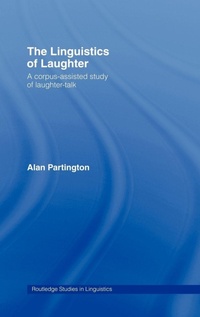
The Linguistics of Laughter
A Corpus-Assisted Study of Laughter-Talk
1st Edition
Published on 14. July 2006
Book
Hardback
240 pages
978-0-415-38166-6 (ISBN)
Description
The Linguistics of Laughter examines what speakers try to achieve by producing 'laughter-talk' (the talk preceding and eliciting an episode of laughter) and, by using abundant examples from language corpora, what hearers are signalling when they produce laughter.
In particular, Alan Partington focuses on the tactical use of laughter-talk to achieve specific rhetorical, and strategic, ends: for example, to construct an identity, to make an argumentative point, to threaten someone else's face or save one's own. Although laughter and humour are by no means always related, the book also considers the implications these corpus-based observations may have about humour theory in general.
As one of the first works to have recourse to such a sizeable databank of examples of laughter in spontaneous running talk, this impressive volume is an essential point of reference and an inspiration for scholars with an interest in corpus linguistics, discourse, humour, wordplay, irony and laughter-talk as a social phenomenon.
In particular, Alan Partington focuses on the tactical use of laughter-talk to achieve specific rhetorical, and strategic, ends: for example, to construct an identity, to make an argumentative point, to threaten someone else's face or save one's own. Although laughter and humour are by no means always related, the book also considers the implications these corpus-based observations may have about humour theory in general.
As one of the first works to have recourse to such a sizeable databank of examples of laughter in spontaneous running talk, this impressive volume is an essential point of reference and an inspiration for scholars with an interest in corpus linguistics, discourse, humour, wordplay, irony and laughter-talk as a social phenomenon.
Reviews / Votes
'The strengths of the book are many, the most important of which are the use of real spoken conversation to analyze a topic of much interest in current linguistics analysis and the use of corpus techniques in a relevant and accessible manner. Partington offers valuable insights, a clear and comprehensive review of foregoing research, and a consistent and easy-to-follow format... By the end of the book, the reader feels as though she has come to know the participants of these briefings, and an inevitable fondness for them develops. Thus Partington acheives a delicate and difficult balance.' - Christy Bird, University of California Santa Barbara, USAMore details
Series
Language
English
Place of publication
London
United Kingdom
Publishing group
Taylor & Francis Ltd
Target group
College/higher education
Professional and scholarly
Postgraduate
Illustrations
2 s/w Zeichnungen, 1 s/w Tabelle
1 Tables, black and white; 2 Line drawings, black and white
Dimensions
Height: 240 mm
Width: 161 mm
Thickness: 19 mm
Weight
575 gr
ISBN-13
978-0-415-38166-6 (9780415381666)
Copyright in bibliographic data and cover images is held by Nielsen Book Services Limited or by the publishers or by their respective licensors: all rights reserved.
Schweitzer Classification
Other editions
Additional editions
Book
10/2009
1st Edition
Routledge
€71.60
Shipment within 15-20 days
E-Book
10/2006
1st Edition
Routledge
€64.49
Available for download
E-Book
10/2006
1st Edition
Routledge
€64.49
Available for download
Person
Content
Introduction. Laughter-talk: research questions and methods 1. Joke Humour Theory and Language Principles 2. Laughter in Running Discourse: Shifts of Mode, Narrative, Role and Register 3. Face-work and the In-Group 4. Wordplay, Phraseplay and Relexicalization 5. Teasing and Verbal Duelling 6. Irony and Sarcasm 7. General Conclusions Appendices Notes Bibliography