

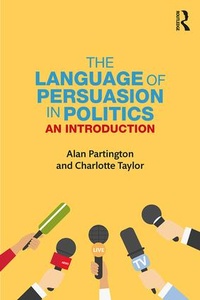
The Language of Persuasion in Politics
An Introduction
1st Edition
Published on 2. October 2017
Book
Paperback/Softback
246 pages
978-1-138-03848-6 (ISBN)
Description
This accessible introductory textbook looks at the modern relationship between politicians, the press and the public through the language they employ, with extensive coverage of key topics including:
'spin', 'spin control' and 'image' politics
models of persuasion: authority, contrast, association
pseudo-logical and 'post-truth' arguments
political interviewing: difficult questions, difficult answers
metaphors and metonymy
rhetorical figures
humour, irony and satire
Extracts from speeches, soundbites, newspapers and blogs, interviews, press conferences, election slogans, social media and satires are used to provide the reader with the tools to discover the beliefs, character and hidden strategies of the would-be persuader, as well as the counter-strategies of their targets. This book demonstrates how the study of language use can help us appreciate, exploit and protect ourselves from the art of persuasion.
With a wide variety of practical examples on both recent issues and historically significant ones, every topic is complemented with guiding tasks, queries and exercises with keys and commentaries at the end of each unit. This is the ideal textbook for all introductory courses on language and politics, media language, rhetoric and persuasion, discourse studies and related areas.
'spin', 'spin control' and 'image' politics
models of persuasion: authority, contrast, association
pseudo-logical and 'post-truth' arguments
political interviewing: difficult questions, difficult answers
metaphors and metonymy
rhetorical figures
humour, irony and satire
Extracts from speeches, soundbites, newspapers and blogs, interviews, press conferences, election slogans, social media and satires are used to provide the reader with the tools to discover the beliefs, character and hidden strategies of the would-be persuader, as well as the counter-strategies of their targets. This book demonstrates how the study of language use can help us appreciate, exploit and protect ourselves from the art of persuasion.
With a wide variety of practical examples on both recent issues and historically significant ones, every topic is complemented with guiding tasks, queries and exercises with keys and commentaries at the end of each unit. This is the ideal textbook for all introductory courses on language and politics, media language, rhetoric and persuasion, discourse studies and related areas.
More details
Language
English
Place of publication
London
United Kingdom
Publishing group
Taylor & Francis Ltd
Target group
College/higher education
Illustrations
22 s/w Tabellen
22 Tables, black and white
Dimensions
Height: 234 mm
Width: 156 mm
Weight
416 gr
ISBN-13
978-1-138-03848-6 (9781138038486)
Copyright in bibliographic data and cover images is held by Nielsen Book Services Limited or by the publishers or by their respective licensors: all rights reserved.
Schweitzer Classification
Other editions
New editions
Book
07/2025
2nd Edition
Routledge
€50.00
Shipment within 10-20 days
Additional editions
Book
10/2017
1st Edition
Routledge
€215.41
Article exhausted; check for reprint
Person
Alan Partington is Professor of Political Linguistics at Bologna University, Italy. He is the author of Patterns and Meanings in Discourse (with Alison Duguid and Charlotte Taylor, 2013), The Linguistics of Laughter: A Corpus-Assisted Study of Laughter-talk at the White House (Routledge, 2007), Persuasion in Politics (with Charlotte Taylor, 2006) and The Linguistics of Political Argument (Routledge, 2003).
Charlotte Taylor lectures in English Language and Linguistics at the University of Sussex (UK) and is editor of CADAAD Journal. Her publications include Mock Politeness in English and Italian (2016), Patterns and Meanings in Discourse (with Alison Duguid and Alan Partington, 2013) and Persuasion in Politics (with Alan Partington, 2010).
Charlotte Taylor lectures in English Language and Linguistics at the University of Sussex (UK) and is editor of CADAAD Journal. Her publications include Mock Politeness in English and Italian (2016), Patterns and Meanings in Discourse (with Alison Duguid and Alan Partington, 2013) and Persuasion in Politics (with Alan Partington, 2010).
Content
Chapter 1: Politics and the language of persuasion. Chapter 2: Evaluation: what's good and what's bad. Chapter 3: Ways of persuading Chapter 4: Cave Emptor! Arguments good and bad, true and false, logical and non-logical Chapter 5: The rhetoric of liberty, freedom, and emancipation. Chapter 6: The importance of importance marking in persuasion. Chapter 7: Metaphors and company: the subtle persuaders. Chapter 8: Questions and responses. Chapter 9: Humour, irony and satire in politics. Chapter 10: The language of election and referendum campaigns.