

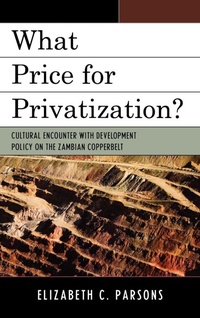
What Price for Privatization?
Cultural Encounter with Development Policy on the Zambian Copperbelt
Published on 10. June 2010
Book
Hardback
266 pages
978-0-7391-4062-8 (ISBN)
Description
What Price for Privatization?: Cultural Encounter with Development Policy on the Zambian Copperbelt considers how one African community experienced the sale to foreign investors of its main industry, a group of state-owned copper mines. Everyday Zambians saw a series of uncertain, shifting interactions among individuals, corporations, immaterial forces, and material interests as running counter to hard facts about the state of the mines and the country's overall economy. Supernatural or spiritual forces played a powerful, negative role in what Zambians understood to be happening as a result of privatization. But there was no place within dominant development policy talk to account for this sort of knowledge.
Indeed, many of the disappointments and failures that have long characterized development activities can be traced to profound discrepancies existing when local knowledge infused with a particular worldview is overlooked by policymakers. The types of policies that have undergirded development interventions for almost sixty years have elevated economic, political, and operational interests over all others. But such ways of thinking about the world leave huge gaps in comprehension. This is particularly true in regard to the cultural and religious experiences of both the people who devise policies and those who live with the policy consequences. What Price for Privatization? documents such an instance and suggests some intellectual and practical means by which things might change on behalf of the global common welfare.
Indeed, many of the disappointments and failures that have long characterized development activities can be traced to profound discrepancies existing when local knowledge infused with a particular worldview is overlooked by policymakers. The types of policies that have undergirded development interventions for almost sixty years have elevated economic, political, and operational interests over all others. But such ways of thinking about the world leave huge gaps in comprehension. This is particularly true in regard to the cultural and religious experiences of both the people who devise policies and those who live with the policy consequences. What Price for Privatization? documents such an instance and suggests some intellectual and practical means by which things might change on behalf of the global common welfare.
Reviews / Votes
It takes a patient listener to write these stories on how local people experience development beyond its material properties. Beautifully written, Parsons' book will surely help development planners to reflect on the cultural dimensions of their work. -- Dorothea Hilhorst, Wageningen University This book tells a compelling story of an encounter, or rather a missed encounter, between two cosmologies: that of Western views of development and progress and of the Zambians and their understanding and sense of the world in which they live. The author's detailed fieldwork provides overwhelming evidence that 'development' can only start with acknowledging one's own worldviews and that of others. Development is not making the other in one's own image. I hope that the development establishment will listen. -- Severine Deneulin, author of Religion in Development: Rewriting the Secular ScriptMore details
Language
English
Place of publication
United States
Publishing group
Bloomsbury Publishing Plc
Target group
Professional and scholarly
Dimensions
Height: 235 mm
Width: 157 mm
Thickness: 19 mm
Weight
562 gr
ISBN-13
978-0-7391-4062-8 (9780739140628)
Copyright in bibliographic data and cover images is held by Nielsen Book Services Limited or by the publishers or by their respective licensors: all rights reserved.
Schweitzer Classification
Persons
Elizabeth C. Parsons is lecturer and co-director of contextual education at Boston University School of Theology.
Content
Chapter 1 Prologue: The Miner's World of Work
Chapter 2 Chapter One: Stories We Tell Ourselves
Chapter 3 Chapter Two: Research Methods
Chapter 4 Chapter Three: Public Stories of Zambia's Mining History
Chapter 5 Chapter Four: Private Stories of Zambia's Mining History
Chapter 6 Chapter Five: "The Spirits are Not Happy:" How Zambians Knew Things Were Not Well
Chapter 7 Chapter Six: "Jealousy is There:" Accounting for Disparity, Ensuring Success
Chapter 8 Chapter Seven: "We are not Slaves:" The Pain and Power of Zambian Identity
Chapter 9 Chapter Eight: "They are Always Suspecting Us:" Expatriate Experiences of the Copperbelt
Chapter 10 Chapter Nine: Conclusion
Chapter 2 Chapter One: Stories We Tell Ourselves
Chapter 3 Chapter Two: Research Methods
Chapter 4 Chapter Three: Public Stories of Zambia's Mining History
Chapter 5 Chapter Four: Private Stories of Zambia's Mining History
Chapter 6 Chapter Five: "The Spirits are Not Happy:" How Zambians Knew Things Were Not Well
Chapter 7 Chapter Six: "Jealousy is There:" Accounting for Disparity, Ensuring Success
Chapter 8 Chapter Seven: "We are not Slaves:" The Pain and Power of Zambian Identity
Chapter 9 Chapter Eight: "They are Always Suspecting Us:" Expatriate Experiences of the Copperbelt
Chapter 10 Chapter Nine: Conclusion